

As Washington warms to Pakistan, New Delhi is signalling that strategic trust cannot be separated from India’s security concerns
By Lalit Shastri
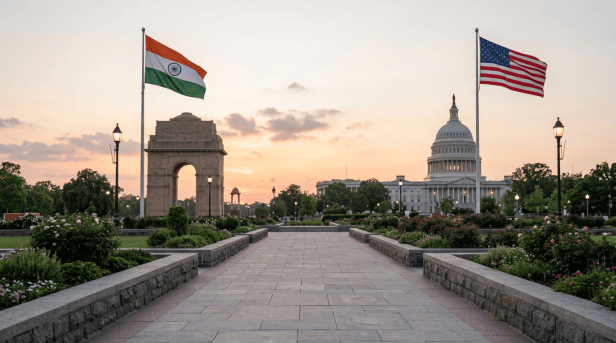
There is a warning embedded in External Affairs Minister S. Jaishankar’s latest remarks on India-US relations that deserves greater attention than the immediate dispute over tariffs and the delayed trade agreement.
India, Jaishankar suggested, expects Washington to understand that cross-border terrorism is not an abstract security concern for New Delhi but a deeply consequential issue that has shaped India’s relationship with Pakistan for decades.
The timing of the remarks is significant. They came amid visible signs of renewed warmth between Washington and Islamabad, including US President Donald Trump’s public praise for Pakistan’s role in bringing an end to the conflict following India’s Operation Sindoor and his warm references to Pakistan Prime Minister Shehbaz Sharif.
For India, this is not merely about diplomatic optics.
Jaishankar’s formulation was unusually pointed. He said that there are very few countries that have experienced the kind of terrorism India has faced from a neighbour as part of what he described as a deliberate and conscious policy over many decades. If an issue that matters so deeply to India is not sufficiently understood or appreciated by its partner, he warned, it creates a problem.
That is the real issue confronting the India-US relationship.
The question is not whether Washington should have a relationship with Pakistan. The problem arises when Washington’s engagement with Pakistan appears to disregard the security concerns that India considers fundamental to its own national interest. This is where the relationship has entered a more complicated phase.
For years, India and the United States invested considerable political capital in transforming a relationship once burdened by Cold War into what both sides now describe as a comprehensive or strategic partnership. Defence cooperation expanded, military exercises multiplied, technology partnerships deepened and economic ties grew substantially.
But strategic partnerships ultimately depend on trust. And trust is tested not when two countries agree, but when their interests diverge.
The present disagreement over Pakistan comes at an especially sensitive moment because India itself has been seeking greater recognition in Washington of its security concerns. New Delhi’s position after Operation Sindoor was that terrorism emanating from Pakistani territory could not be treated separately from the wider India-Pakistan relationship.
Trump’s public embrace of Pakistan’s leadership, therefore, has inevitably attracted attention in New Delhi.
There is an additional complication. India’s relationship with the United States is currently being negotiated on two parallel tracks. One is economic, centred on tariffs and the proposed bilateral trade agreement. The other is strategic, involving defence, technology, China, the Indo-Pacific and regional security.
Jaishankar’s comments suggest that India does not want these tracks to be treated as completely separate. That is an important message. A trade agreement can be negotiated through tariffs, market access, concessions and compromises. Strategic trust is different. It cannot simply be calculated in percentage points.
The minister’s comments on the trade negotiations themselves were relatively reassuring. He indicated that the process was continuing and that there was now a broad understanding on the agreement, while acknowledging that the delay had created some bumps in the relationship.
But the reference to India’s concerns over terrorism carries a different weight. India is effectively telling Washington that economic partnership cannot become a substitute for strategic sensitivity.
This does not mean that India is threatening to walk away from the United States. Quite the contrary. India has too much at stake in the relationship. The United States remains one of India’s most important economic partners and a critical source of technology, investment and advanced defence cooperation. The two countries also share an increasingly important interest in maintaining a stable balance of power in the Indo-Pacific at a time when China’s economic and military influence continues to expand.
That makes the Pakistan question more delicate, not less. Washington may view Pakistan through several different lenses – Afghanistan, regional stability, military cooperation and its own geopolitical calculations. India views Pakistan primarily through the lens of its own national security and the history of cross-border terrorism. Washington’s position becomes harder for New Delhi to reconcile when the United States simultaneously deepens its security engagement with Pakistan and speaks of shared interests in counterterrorism, while India’s longstanding concerns over cross-border terrorism from Pakistan remain insufficiently acknowledged. For India, the contradiction is not that Washington engages Pakistan. It is that the security calculus behind that engagement can appear to give inadequate weight to the security experience of India’s own neighbourhood.
Jaishankar’s assessment that India-China relations are “better” today than they were a few years ago, and even better compared with 2024 is significant in the context of the India-US relationship. India’s foreign policy is not constructed around choosing one permanent camp. It is built around maintaining strategic space.
New Delhi can simultaneously improve relations with Beijing, negotiate with Washington, engage Moscow, strengthen ties with Europe and deepen relationships across the Gulf and Indo-Pacific.This is strategic autonomy in practice.
The United States would naturally prefer India to align more closely with American strategic priorities, particularly regarding China and Russia. India, meanwhile, is unlikely to surrender the freedom to determine its own relationships simply because it has a strategic partnership with America.
This is where both sides need to understand the difference between alignment and convergence. India and the United States have substantial strategic convergence. They do not have complete strategic alignment. The distinction matters.
But if Washington expects India to remain a central strategic partner, it must also understand why New Delhi reacts strongly when Pakistan receives diplomatic or political validation without an equally clear recognition of India’s concerns over terrorism.
The relationship therefore faces a test that is considerably more consequential than the immediate tariff dispute.
Can India and the United States manage disagreement without allowing disagreement to corrode trust? That is the real question. The answer will depend partly on Washington.
America will have to decide whether it sees India primarily as another negotiating partner whose cooperation can be obtained issue by issue, or as a long-term strategic partner whose security concerns require sustained understanding.
India, too, will have to decide how much friction it is prepared to absorb while protecting the enormous strategic and economic gains made in the relationship over the past two decades.
The lesson from Jaishankar’s remarks is unmistakable.
Strategic partnerships are built on shared interests. They endure only when partners understand each other’s red lines. And India’s message to Washington appears to be that terrorism is not a peripheral issue for New Delhi. It is one of those red lines.
