
Dr. G. Shreekumar Menon
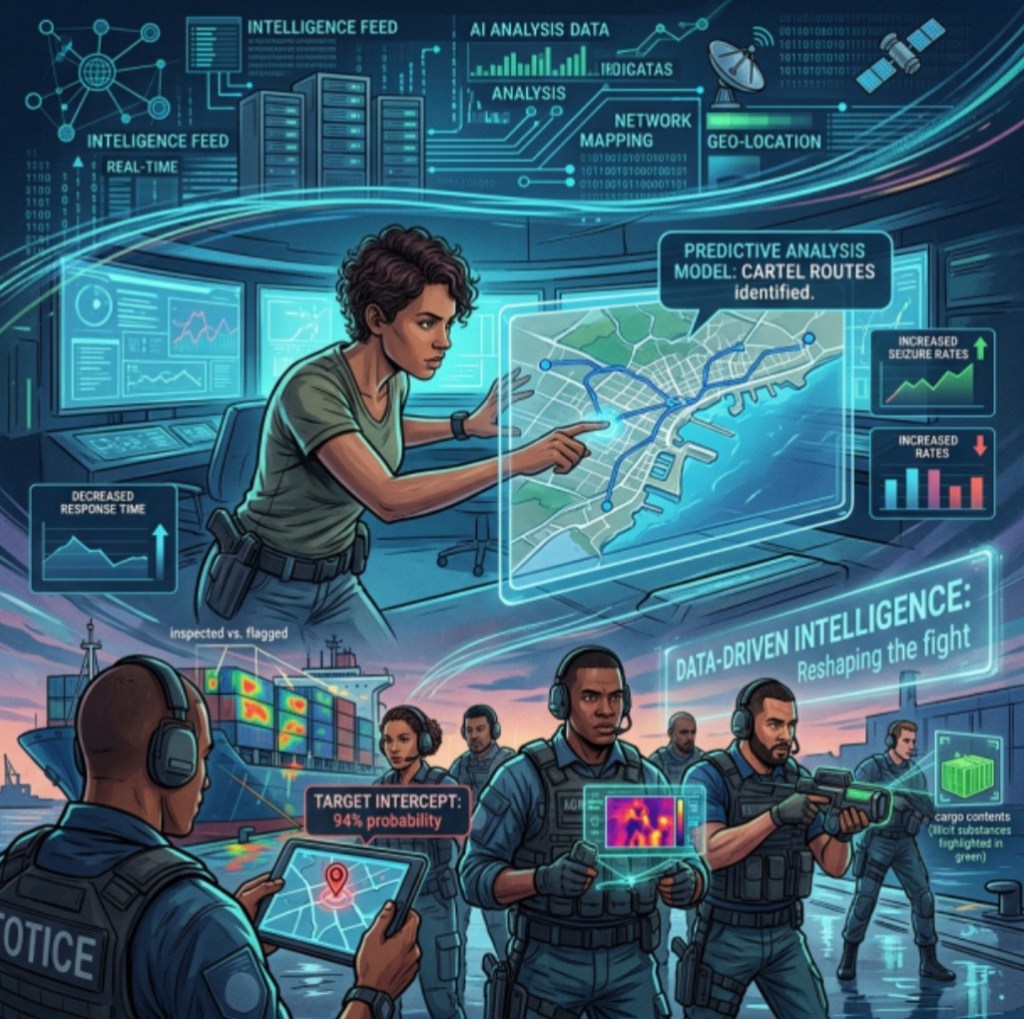
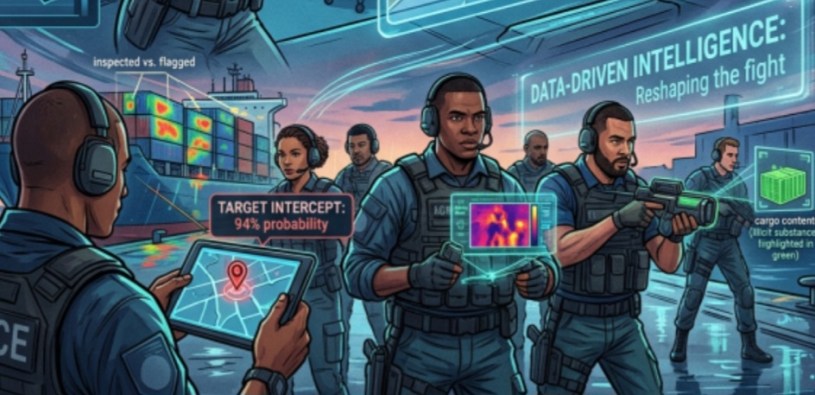
The counter-narcotics fight is entering a new era defined by data-driven intelligence. The U.S. Drug Enforcement Administration (DEA) has identified Open-source intelligence (OSINT), artificial intelligence (AI), and geospatial analytics to map trafficking networks, predict drug traffickers moves, and target cartel operations with precision.Emerging technologies are empowering a proactive, intelligence-driven approach to combating drug cartels and trafficking networks.
On the operational front, U.S. agencies are aligning around an intelligence-led strategy to dismantle cartel networks. The DEA’s latest National Drug Threat Assessment underscores that the synthetic drug crisis requires a new approach. This means U.S. law enforcement is increasingly focusing resources on mapping and targeting entire infrastructures, from kingpins and chemists to logistics and money launderers. The U.S. convened a Global Coalition to Address Synthetic Drug Threats—uniting over 140 countries to coordinate action against cartels and illicit financiers. After high-level diplomatic engagements, even China, the source of most precursor chemicals, agreed in late 2023 to re-engage on counter-narcotics, resulting in a new joint working group to disrupt precursor flows. The US government is investing heavily in analytics, AI, and machine learning capabilities to target drug cartels. The U.S. is pairing tougher laws with an intelligence-driven, multi-agency campaign to outmanoeuvre drug cartels.Modern drug trafficking networks have become tech-savvy and adaptive, hence enforcement and intelligence agencies need to embrace OSINT, AI, and geospatial intelligence (GEOINT) to illuminate cartel operations in ways that traditional methods could not. By fusing data from social media, sensors, financial records, and satellite imagery, authorities can uncover hidden patterns and pre-emptively strike at illicit networks.
Traffickers are switching to online platforms to coordinate and conduct business—and investigators, especially in the US are following them there. Social media and encrypted messaging apps are being used to advertise various kinds of synthetic drugs via Snapchat or WhatsApp and arrange sales without ever meeting in person. Hence, agencies are sharpening their OSINT tradecraft to monitor and infiltrate these digital marketplaces, often uncovering them through their online footprints on Facebook, Instagram, and other platforms.
By mining publicly available information, from suspect social profiles to dark web forum posts, investigators can map out distribution networks and identify key players who might otherwise remain anonymous. AI-enabled all-source intelligence platforms can scrape through voluminous data, de-anonymize the actors behind them, and map connections between supplier networks and cartel procurement agents.
Agencies are now deploying AI-driven analytics to probe global trade and communications data. By scanning huge datasets—shipping records, corporate registries, trade manifests—AI can pinpoint suspicious patterns, like a little-known exporter in Wuhan, China suddenly sending tons of pharmaceutical chemicals to an unknown entity in Bangladesh. Incidentally, Bangladesh has one of the fastest-growing pharmaceutical industries in Asia. India and China remain the dominant supply markets. This kind of predictive insight was nearly impossible before AI; now investigators don’t have to wait for drugs to hit the border, because machine learning models upstream can flag the components and people involved earlier in the process.
AI is also supercharging domestic drug interdiction through predictive policing. By feeding years of seizure data, drug seizures, cartel communications, and even seemingly unrelated data like local crime rates or social media trends into algorithms, agencies are starting to forecast hot spots and routes of emerging drug activity. For instance, machine learning models can easily analyse thousands of post parcel shipments and identify subtle indicators on packages, likely to contain narcotics, enabling Customs inspectors to intercept post parcels containing drug shipments.While AI is no silver bullet, it has become a force multiplier—uncovering hidden relationships in data, revealing clandestine supply chains, and essentially connecting the dots at a speed and scale that human analysts can never match. This data-centric approach flips the script on traffickers: their complexity—multiple shell companies, myriad routes—creates data points that intelligent algorithms can unite into a targetable picture.Drug trafficking has an inescapable geographic dimension—and modern mapping and sensor technology are giving authorities unprecedented visibility into that terrain. Geospatial analytics involves layering data on maps to spot trends and correlations in physical space. One powerful use is mapping drug trafficking routes and hotspots. By plotting drug seizure locations, and transportation corridors, analysts can literally draw the arterial map of cartel operations.
Geospatial analysis also integrates data from remote sensing: satellites, drones, and surveillance cameras. High-resolution satellite imagery can pinpoint large-scale drug crop cultivation in remote areas, or detect hidden labs that would have been invisible to ground patrols. Armed with these coordinates, law enforcement agencies can initiate action for interdiction. Using Geographic Information Systems (GIS), it is possible to map drug consuming enclaves to understand distribution patterns and proactively deploy interdiction resources.
Another application is tracking maritime and aerial trafficking in real time. Reconnaissance planes of Indian Navy can feed location data of suspect vessels in the Arabian sea into joint intelligence systems that plot their trajectories. By analysing those tracks geospatially, agencies can predict destinations and coordinate interceptions, such as of Dhows using the Southern Route to destinations in Lakshadweep islands and Maldives.
Overall, geospatial analytics turns the fight against drug trafficking into a war of maps and movement—giving enforcement agencies the high ground. The integration of OSINT, AI, and GEOINT is particularly potent. For example, if OSINT indicates a spike in chatter about a new drug trafficking route, and geospatial data confirms unusual activity on that route, then AI models can fuse those inputs to raise a red flag and even quantify the threat level. It enables what was once fantasy, into predicting and pre-empting traffickers moves, rather than a cat and mouse game.
Data-driven counter-narcotics strategies in Punjab and Jammu & Kashmir (J&K) have transitioned law enforcement from traditional perimeter-based security to high-tech, intelligence-led operations aimed at dismantling cross-border narco-terror syndicates. Agencies use the Narco Coordination Centre (NCORD) database to map spatial-temporal drone data. This coordinates district-wise flight paths, entry/exit points, and drop zones across Punjab, J&K, Haryana, and Rajasthan. Instead of treating seizures as isolated events, units like the State Special Operation Cell (SSOC) use digital data forensics on seized mobile phones and drone logs. This maps out the network of local receivers and international handlers. The flagship “Safe Punjab” WhatsApp chatbot (97791-00200) utilizes anonymous data ingestion. Achieving a conversion rate of over 41%, citizen-reported tips generated through the secure bot have directly translated into over 14,800 FIRs and thousands of targeted arrests.
Enforcement Directorate (ED) and the National Investigation Agency (NIA) run systemic data sweeps of banking records, cash deposits, and properties across J&K and Punjab border locations to isolate local over-ground facilitators. Punjab’s Yudh Nashian Virudh campaign leverages legally sustainable digital chains of custody and scientific evidence. This has propelled the state’s NDPS Act court conviction rate to 89%, the highest in India.
Data-driven counter-narcotics strategies utilizing mathematical modelling, network analysis, and AI to disrupt modern illicit supply chains, is the new weapon in the war on drugs.
The author Dr G Shreekumar Menon, IRS (Rtd) Ph. D (Narcotics), is
- Former Director General National Academy of Customs Indirect Taxes and Narcotics, and Multi-Disciplinary School of Economic Intelligence India
- Fellow, James Martin Centre for Non-Proliferation Studies, USA.
- Fellow, Centre for International Trade & Security, University of Georgia, USA
- Public Administration, Maxwell School of Public Administration, Syracuse University, U.S.A.
- AOTS Scholar, Japan
Dr Menon can be contacted at shreemenon48@gmail.com
