

Lalit Shastri

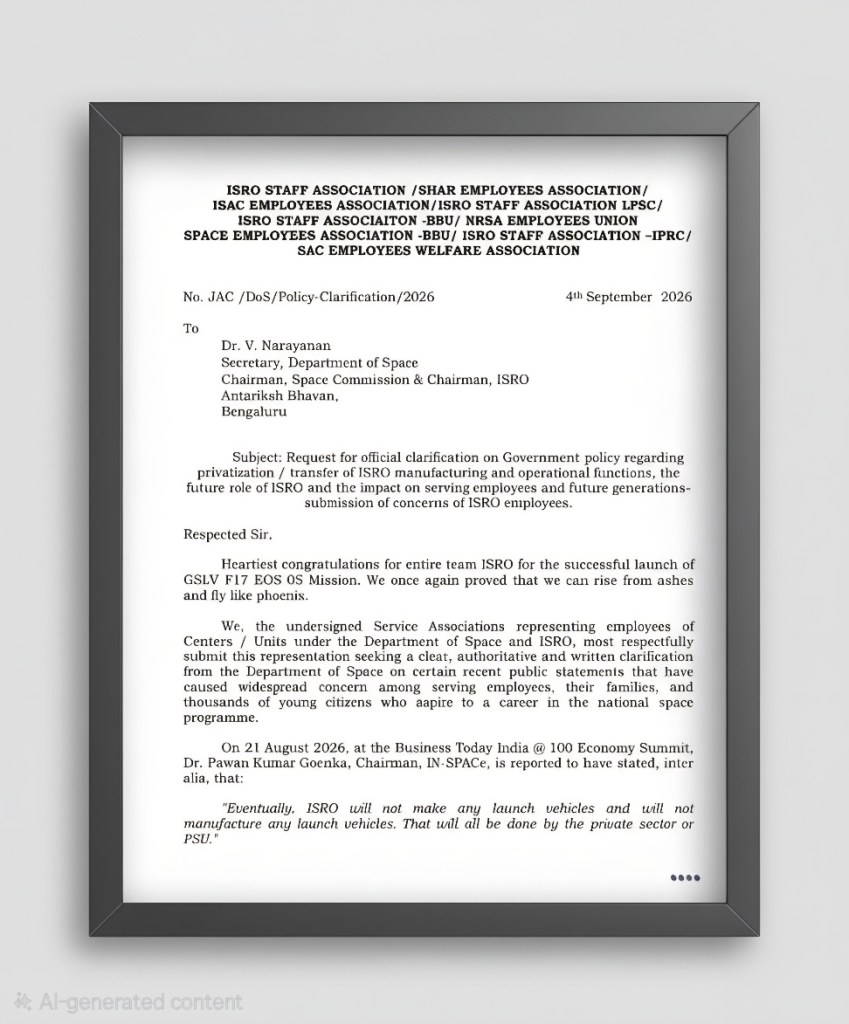
In a development that lends fresh weight to questions raised by ThisisNews in its recent investigations into the restructuring of India’s space programme, a joint representation by several service associations representing employees across ISRO centres and units has now sought an official, written clarification from the Department of Space on whether ISRO is actually being prepared for a progressive withdrawal from its core launch-vehicle and satellite-realisation functions. The letter, dated September 4, 2026 and addressed to Dr V. Narayanan, Secretary, Department of Space, Chairman, Space Commission and Chairman, ISRO, says recent public statements have created “widespread concern” among serving employees, their families and young people aspiring to careers in India’s national space programme.
The significance of the representation lies not merely in the concerns it expresses but in the fact that the employees’ associations are asking the Department of Space to distinguish between an officially approved government policy and statements made in the public domain by the Chairman of IN-SPACe. Referring specifically to Dr Pawan Kumar Goenka’s reported statement at the Business Today India @ 100 Economy Summit on August 21 that “eventually” ISRO would not make or manufacture launch vehicles and that this would be done by the private sector or PSUs, the associations have asked whether this represents an approved decision of the Government of India, the Space Commission or the Department of Space, or merely an expression of IN-SPACe’s promotional outlook. If it is an approved policy, they want its date, authority and text disclosed.
That is a significant institutional question. The employees’ associations point out that several other claims have appeared in the public domain: that the transfer already begun with SSLV, including technology and production rights handed to Hindustan Aeronautics Limited, is proposed to be extended to PSLV and LVM3; that public-sector undertakings may be excluded from the forthcoming procurement process for these vehicles; that routine satellite manufacturing is also to move out of ISRO; that operation of new launch infrastructure, including the Space Launch Complex at Kulasekarapattinam, is being opened to private entities; and that about 120 technologies have already been transferred from ISRO to the private sector. They say these statements have received wide publicity but have not been accompanied by an official Department of Space communication explaining the policy, its legal and administrative basis, its phasing or its consequences for the existing workforce and future recruitment.
The employees’ anxiety is rooted in something deeper than employment security. The representation argues that ISRO was built as a national scientific institution through public funds and for a public purpose, and that launch-vehicle design, realisation, integration, testing and launch operations cannot be treated merely as “manufacturing contracts”. In their view, these activities constitute the core competence, institutional memory and strategic capability of the organisation. They warn that a progressive withdrawal from launch-vehicle and satellite realisation could affect experiments after research, shrink in-house work, freeze or reduce sanctioned strength and close promotion and skill-development avenues across technical, scientific, administrative, stores, purchase, quality, safety and industrial cadres.
The representation goes further by putting a human face on what could otherwise appear to be an abstract restructuring exercise. It says employees working in ISRO’s own facilities could find themselves rendered surplus, redeployed or left without meaningful work while essentially the same tasks are performed by private contractors using publicly developed technology. It also raises concern over regular recruitment to Group A, B and C positions, which it says is already constrained by vacancies and attrition, arguing that any further restriction could deny meritorious young Indians the opportunity to regard ISRO as a public career of honour rather than employment with a private contractor. Families of serving employees, the associations say, had planned their lives around the stability and public character of ISRO service and now face uncertainty over the organisation’s future mandate.
There is also a strategic dimension to the representation. The associations warn that strategic autonomy, quality assurance, safety culture and accountability inherent in a national space agency could be diluted if core realisation and launch operations pass out of public control. But they take care to state that their concern is not hostility to Indian industry and not opposition to legitimate commercialisation through NSIL within a defined framework. Their objection is to what they describe as the absence of an official Department of Space policy document drawing a clear line between enabling private participation and dismantling ISRO’s own realisation capability.
That distinction is central to the larger debate. India’s space-sector reform was intended to encourage private participation, not necessarily to require the national space agency to progressively surrender capabilities it has built over decades. The associations are effectively asking whether the two propositions have now been conflated: that private industry should do more, and that ISRO should consequently do less. The first proposition can expand the national ecosystem; the second requires a separate policy justification.
Their seven requests for clarification expose the breadth of the uncertainty. They want the Department of Space to state what ISRO’s future mandated role will be and, specifically, whether design, development, realisation, integration, testing and launch of PSLV, LVM3, SSLV and successor vehicles will remain ISRO functions or cease to be so. They also want to know whether any decision has been taken to exclude PSUs from the proposed transfer of PSLV and LVM3 production and, if so, why. The associations further ask for clarity on the effect of the proposed shift on sanctioned strength, existing vacancies, recruitment calendars and induction of scientific, technical, administrative and industrial manpower over the next five to ten years.
Perhaps the most consequential question concerns the public assets behind the proposed transformation. The associations ask what institutional arrangement is contemplated for publicly created technology, test facilities, launch complexes and know-how built with taxpayer funds and through the labour of generations of ISRO employees when these are transferred or opened to private operation. They specifically ask about the respective roles of NSIL and IN-SPACe in such transfers. They also ask whether service associations will be consulted before any irreversible decision affecting ISRO’s mandate, structure, staffing or public character is implemented.
The employees’ associations then make a remarkable distinction between private participation and privatisation of institutional capability. They state that private participation in defined commercial activities can coexist with a strong, publicly owned ISRO. What they say cannot be accepted without debate is a policy that reduces ISRO to a residual R&D organisation while the realisation of the nation’s launch vehicles and the operation of its launch infrastructure pass out of public hands. This is almost precisely the distinction that has been at the heart of the questions raised in the earlier ThisisNews investigations.
The associations also put technology transfer at the centre of the issue. Their representation says that technology developed by ISRO is a national asset and that its transfer must be transparent, accountable and consistent with strategic, safety and employment considerations, rather than being presented to employees through newspaper reports. This is particularly significant in light of former ISRO chairman G. Madhavan Nair’s recent arguments that ISRO, NSIL and industrialisation should remain under unified direction, with commercialisation potentially pursued through joint ventures rather than simply transferring ISRO-developed technologies out of the institution.
The letter therefore brings the technology-transfer debate inside ISRO itself. If technologies developed through public investment are transferred to industry, the question is not simply whether the transfer is technically permissible. It is whether the originating institution retains the capability, institutional memory and strategic control necessary to develop the next generation of technologies. It is also whether the economic value created through public expenditure is being shared in a manner that strengthens the national space ecosystem rather than merely enabling private commercialisation.
There is another important element in the letter that deserves attention: the employees are not asking for the reform to be abandoned. They explicitly acknowledge that private participation in defined commercial activities can coexist with a strong public ISRO. Their submission is framed as a demand for clarity, consultation and protection against irreversible decisions being taken without the workforce being informed. They ask the Department of Space to issue a written clarification within a time-bound period, confirm that no irreversible transfer of core ISRO realisation and launch functions will take place before the workforce is formally briefed, initiate structured interaction with recognised service associations and reassure employees and their families about their service conditions, cadres and public employment status.
The tone of the closing section is equally revealing. The associations describe their representation as being made in a “constructive and democratic spirit” and say their loyalty to ISRO and the national space programme is not in question. Precisely because of that loyalty, they say, they consider it their duty to seek clarity before uncertainty hardens into irreversible policy. They have asked for an early written response and say the associations will jointly consider further action necessary to safeguard the interests of ISRO, its employees and their families and the future of India’s youth.
What makes this representation particularly significant is its timing. It comes immediately after ISRO’s successful GSLV-F17/EOS-05 mission and begins by congratulating the organisation’s team on the achievement. The employees’ associations are therefore not writing at a moment of institutional failure. They are writing at a moment when ISRO has once again demonstrated its capability and are asking what happens to that capability if the organisation is progressively removed from the very functions through which it acquired and retained its expertise.
The letter also provides an important answer to the argument that concerns about the future of ISRO are merely the anxieties of a few retired scientists or critics of privatisation. This is a collective representation from service associations representing employees across multiple ISRO centres and units. It does not establish that every employee shares every concern expressed in the letter, but it does establish that questions about the future mandate, staffing, recruitment, technology, infrastructure and public character of ISRO have now been formally placed before the organisation’s top leadership by employee representatives.
And that brings the debate back to the central question raised by this publication in its earlier investigation: who has actually decided the future architecture of India’s space programme? If the statements about ISRO’s eventual withdrawal from launch-vehicle manufacturing and the transfer or opening of major assets and technologies represent approved government policy, then the Department of Space should be able to put that policy on record. If they do not, then the government should say so equally clearly. Either way, the uncertainty now has an institutional cost.
There is also a larger policy question that cannot be avoided. India can and should have a powerful private space industry. But the measure of successful reform cannot simply be how much work is moved from ISRO to private companies. It must be how much new national capability is created. If private companies manufacture components, develop new launch systems, invest in research, create applications and compete internationally, the national ecosystem becomes stronger. If they merely inherit publicly developed technologies, infrastructure and capabilities while ISRO progressively loses the expertise needed to create the next generation, the country may simply be changing the ownership of existing capability.
The employee associations have now asked the most basic question of all: what is the approved policy, who approved it, what will ISRO’s future role actually be, and what happens to the people and institutional capabilities that made the programme what it is? Those questions deserve answers from the Department of Space, not interpretations through public statements, newspaper reports or corporate conferences.
There need be no conflict between a strong ISRO and a strong private space sector. India can and should have both. The real test of reform will be whether private participation grows around the national capability that ISRO has created, adding new capital, new research, new technologies and new markets, or whether it grows by progressively absorbing capabilities built through decades of public investment.
But whatever the answers to these policy questions, there is one thing that should not be lost in the debate. ISRO deserves full marks for yet another successful launch earlier today. The successful GSLV-F17/EOS-05 mission is a reminder that the institution being debated is not a relic awaiting replacement, but a living, high-performing national capability that continues to deliver. Reform should build upon that strength, not inadvertently diminish it.
