

Lalit Shastri
As ISRO prepares to launch GSLV-F17/EOS-05, a veteran of the organisation and founder of SISIR Radar reflects on the changing relationship between India’s space establishment and its young private space industry – and explains why his own start-up has deliberately chosen a different path.
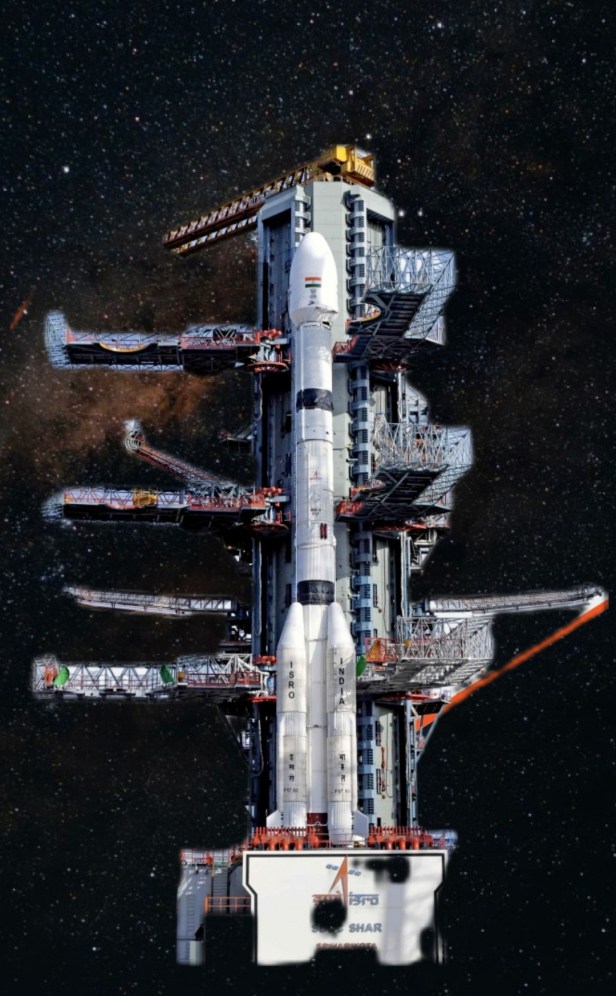
On the night of September 3 and 4, as India waits for another rocket to rise from Sriharikota, the more interesting story may not be what happens at the launch pad but what is happening around it. At 2:55 am on September 4, the Indian Space Research Organisation is scheduled to launch GSLV-F17 carrying EOS-05 from the Second Launch Pad at the Satish Dhawan Space Centre. It will be the 19th flight of the Geosynchronous Satellite Launch Vehicle, and EOS-05 will be India’s first imaging satellite from geosynchronous orbit, marking an important addition to the country’s Earth-observation capabilities.
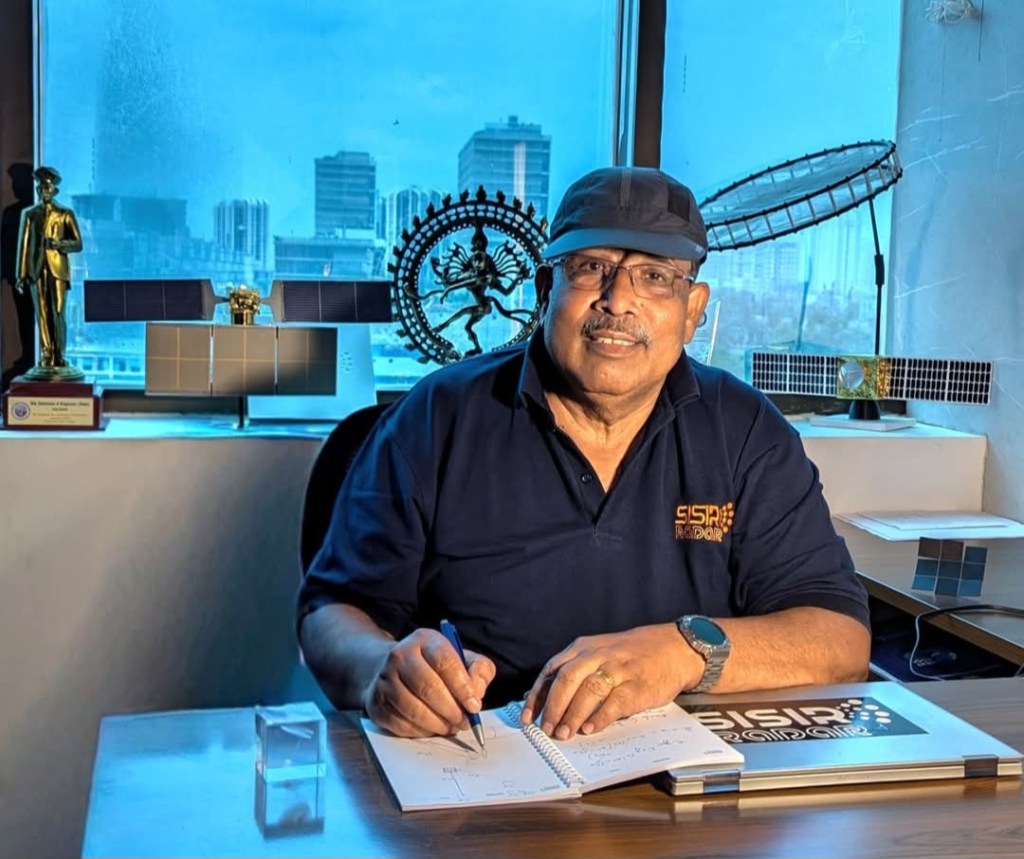
Yet, as Tapan Misra sees it, India’s space story is no longer confined to the achievements of ISRO. The country is witnessing the emergence of an ecosystem in which established institutions and a rapidly expanding private sector are beginning to interact in ways that would have been difficult to imagine only a few years ago. Misra is uniquely qualified to describe that transition because he belongs to both worlds. He spent more than three and a half decades in ISRO, served as Director of the Space Applications Centre, and also as Director of Physical Research Laboratory. He is now the founder of SISIR Radar, a space technology start-up pursuing innovations in synthetic aperture radar imaging.
His reflections after returning from the IEEE Space Conference-2026 in Bengaluru are therefore more than the observations of another participant at a technology conference. They are the reflections of a scientist who has lived inside India’s institutional space programme and has subsequently chosen to build a company in the new private space ecosystem. What he noticed in Bengaluru was, in his words, a distinct change in the atmosphere – a movement away from the indifference and scepticism that he had sensed when private space companies were still in their infancy towards something approaching bonhomie between the new entrants and the established players.
Misra describes the IEEE conference itself as “truly an Indian contribution”. Now in its third year, he believes it has grown from an idea that was “long overdue” into a full-fledged conference of international stature, and he expects it to make an even bigger international leap next year to Singapore. But what seems to have mattered to him most was not simply the conference’s growth. It was the evidence he saw there that the Indian space ecosystem is beginning to mature into something larger than the traditional institutional structure that dominated it for decades.
When the conference began, Misra recalls, the private space industry was still nascent. As a start-up founder, he could sense what he describes as a “bit indifferent” and “skeptic” attitude among established behemoths such as ISRO and DRDO towards companies whose capabilities were still unproven. There was no reason, perhaps, for institutions that had spent decades building sophisticated space and defence technologies to immediately place their confidence in start-ups that were only beginning to demonstrate what they could do. But Misra says that the mood he encountered this year was noticeably different. The distance appears to be narrowing, and the interaction is becoming less about an established establishment looking at outsiders and more about two parts of the same national technology ecosystem beginning to recognise each other.
The change has also been helped by results. Misra points to Skyroot’s recent achievement as an event that has raised expectations that more private players will accomplish similar feats in the near future. Skyroot’s Vikram-I, developed by the Indian space start-up, successfully achieved orbit in July 2026 from Sriharikota, becoming the first private Indian company to undertake an orbital rocket launch from Indian soil. ISRO itself described the achievement as a significant milestone in the Indian space programme and linked it to the space-sector reforms that opened space activities to private industry.
For Misra, the significance of such a development extends beyond the success of one company. Every genuine achievement by a private player changes the psychological landscape for the companies that follow. A sector moves from being judged by promises and presentations to being judged by hardware that actually flies, technology that actually works and missions that actually succeed. The result is a shift in expectations—not only among investors and entrepreneurs, but also within the institutions that have historically carried India’s space ambitions.
It was against this background that Misra was confronted at the conference with a question that takes the discussion much deeper. A woman who had made a significant contribution to the RISAT programme pointed out something that is increasingly visible across India’s private space ecosystem: retired ISRO experts are advising almost all the country’s space start-ups. Why, she asked, was there no retired ISRO expert in SISIR Radar, even though the company had innumerable well-wishers spread across ISRO?
Misra’s answer is revealing because it begins not with criticism of ISRO but with an affirmation of his deep attachment to it. He is emphatic that he has nothing personal against ISROites. He considers himself a “proud ISROite” and says he has immense respect for the experts who kept the Indian flag flying high. The distinction he makes is therefore not between competent and incompetent people, nor between the old space establishment and the new private sector. It is between different kinds of experience and, more importantly, between the different kinds of culture that may be necessary at different stages of technological development.
More than three and a half decades in ISRO, Misra says, made him understand the essence of expertise. His description is deliberately provocative: an experienced and alert mind, he says, is often the mind that keeps telling youngsters what not to do in life. In a conventional organisation, that is an enormous strength. Expertise is built partly through repeated encounters with failure. An expert knows the technical pitfalls, the approaches that have already failed, the assumptions that turned out to be wrong and the walls against which previous generations of engineers have already dashed themselves.
But Misra had a “sky-high ambition” for SISIR Radar, and that ambition required something different. He wanted to break new ground in SAR imaging through innovation and smart technologies. For that, he says, he wanted bright colleagues who had not yet experienced what it feels like to “dash against a wall”. He wanted young engineers and scientists who would surge ahead “gung-ho”, who would not hesitate to try new ideas and new imaginations, and who would not be overly bothered by failure even while remaining conscious of its possibility.
There is a subtle but important distinction here. Misra is not advocating ignorance of risk. He is advocating freedom from the psychological burden of inherited limitations. The young engineer who has not yet been told that an idea cannot work may be willing to attempt it. The experienced scientist, precisely because he knows how many things can go wrong, may instinctively begin by listing the reasons for caution. Both responses have value. The question is what a particular technological problem requires at a particular moment.
For an institution responsible for delivering a mission reliably, knowing what not to do can be indispensable. For a start-up trying to create a breakthrough technology, however, an excessive preoccupation with what has already failed can become a constraint. Misra’s point is not that failure should be ignored. It is that the possibility of failure should not be allowed to extinguish the possibility of discovery.
That is why he wants his colleagues to develop these qualities at the beginning of their careers. He wants experimentation to become instinctive before caution becomes deeply ingrained. He wants young scientists to understand that failure is part of the landscape of technological innovation rather than a verdict on their ability. And he wants them to retain the confidence to ask whether the wall in front of them is genuinely impenetrable—or merely a wall that nobody has yet found a way around.
It is this philosophy that explains the most memorable line in his response to the question about retired ISRO experts: “I need people who just tell them what to do, but not what not to do.”
Taken literally, the sentence could sound like a rejection of experience. It is not. In context, it is almost the opposite. Misra is acknowledging the immense value of experience while arguing that a young company should not allow experience to become a substitute for imagination. He wants mentors who can provide knowledge, methods and direction without inadvertently transferring the accumulated fear of failure that often accompanies decades of professional experience.
That distinction may become increasingly important as India’s private space sector expands. The government has created an institutional framework intended to enable private participation, and the number of Indian space-tech start-ups has grown substantially in recent years. The July 2026 success of Skyroot provided a powerful demonstration that the private sector can now move beyond concept and ambition to actual orbital capability.
But the success of a space ecosystem cannot be measured simply by the number of companies entering it. Nor can it be measured only by how many former ISRO or DRDO experts are now advising private enterprises. The deeper question is whether India can create an ecosystem in which different forms of expertise coexist without one culture overwhelming the other.
There is a danger, for example, that a start-up ecosystem drawing heavily from the established space establishment could reproduce the very institutional habits it was expected to disrupt. At the same time, there is an equally obvious danger in imagining that youthful enthusiasm alone can replace decades of hard-earned engineering knowledge. Rockets, satellites and sophisticated radar systems do not yield to optimism. They demand knowledge, discipline and an intimate understanding of failure.
India therefore needs both cultures. It needs the extraordinary institutional expertise that built ISRO into a globally respected space agency, and it needs young companies willing to take technological risks that a large, mission-driven organisation may not always be structured to take. It needs people who remember what failed, but also people who are prepared to ask whether the old failure still defines the limits of what is possible.
That is perhaps the more interesting meaning of the “bonhomie” Misra now sees between the established players and the start-up ecosystem. The objective should not be to make start-ups into smaller versions of ISRO. Nor should the objective be to weaken ISRO in order to make room for private companies. The real opportunity is to create an ecosystem in which each side does what it is uniquely capable of doing while learning from the other.
The timing of Misra’s reflections is particularly apt because GSLV-F17/EOS-05 represents, in its own way, the strength of the institutional system he came from. The mission will use the GSLV’s three-stage architecture to place EOS-05 into a Sub-Geosynchronous Transfer Orbit. ISRO says the spacecraft is India’s first imaging satellite from geosynchronous orbit.
It is a reminder of how much India has already learned to do.
But Misra’s story is about what India must learn to do next.
The country is entering a phase in which its space ambitions will no longer be carried by one institution alone. The launch pads may still belong to the national programme, and ISRO will remain central to India’s most demanding missions, but a growing number of private companies are beginning to develop launch vehicles, satellites, sensors, radar systems and applications. The boundaries between institutional capability and entrepreneurial capability are consequently becoming more porous.
And with that change comes a change in the meaning of experience.
For decades, India’s challenge was to acquire expertise. Today, it has a different challenge: how to use that expertise without allowing it to define the limits of imagination.
Tapan Misra’s answer is characteristically direct. He does not want to discard the lessons of the past. He wants young people to encounter those lessons without being imprisoned by them.
That is why the retired ISRO scientist who now runs a start-up offers such an intriguing perspective on the future of Indian space technology. He is not asking India to choose between ISRO and the start-ups. He is asking it to understand that the two may need to operate according to different instincts.
ISRO’s instinct has necessarily been to ask: How do we make this mission succeed?
A breakthrough-oriented start-up may sometimes have to ask a different question: What if the thing everyone assumes cannot be done actually can be done?
The first question protects hard-won capability. The second creates new capability.
India needs both.
And perhaps the real test of the country’s space-sector reforms will not be whether private companies can eventually replicate what ISRO already does. It will be whether they can do things that ISRO itself has never done.
That is where Misra’s philosophy becomes much larger than SISIR Radar.
He wants young scientists who know that failure is possible but are not paralysed by it. He wants them to experiment before they become too cautious, to imagine before they inherit the limits of conventional wisdom, and to acquire the confidence to challenge the walls that previous generations have accepted.
As GSLV-F17 prepares to carry EOS-05 into the early morning sky, the image of India’s space programme is therefore changing. One generation has built the launch vehicles, satellites and institutions that made the journey possible. Another is now being asked to imagine where the journey should go next.
The first generation can tell the second how far India has travelled.
But if Tapan Misra has his way, it will not be allowed to tell the second generation how far it is permitted to go.
Tell them what to do, he says. Not what not to do.
Perhaps that is exactly the mindset a country needs when it is no longer merely entering space – but attempting to redefine what it can do there.
