
Abhilash Khandekar*

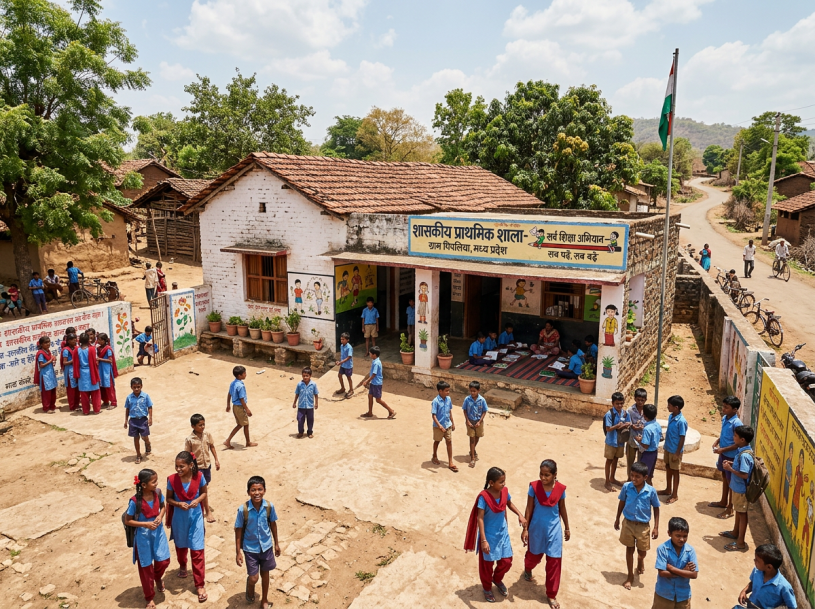
The mind-boggling number of government schools disappearing across India should be treated as a national crisis—nothing less. Equally alarming is the continuing dropout rate among schoolchildren. A decline of over 2.25 crore enrolments during the past decade is one of the startling findings of the NITI Aayog report on school education.
The report has come close on the heels of the inexplicable NEET examination paper leak that shocked students, teachers, parents and the entire nation, triggering widespread outrage over the state of our education system.
While it is indeed depressing that government schools are in decline, it is also a matter of some satisfaction that a public institution like NITI Aayog has placed before the nation an unvarnished picture of the past decade – a period that broadly coincides with the BJP-led government’s tenure at the Centre. At a time when many institutions are perceived to be under increasing political influence, and professionalism appears to be yielding ground to politics across several spheres of governance—from culture and education to the environment and even the armed forces – this report candidly holds up a mirror to the nation. So far, there has been little official explanation or response to its findings.
One hopes the report will encourage an informed national debate and help chart a way forward if educationists, parents, social workers and bureaucrats take its findings seriously. Politicians, however, rarely place education above electoral considerations.
Already, the chinks in the National Education Policy (NEP) 2020 are beginning to show, leaving many experienced teachers across disciplines deeply concerned. Several professors and lecturers have confided in me that the policy may prove to be far more damaging than anticipated, sooner rather than later. That said, the NEP deserves a separate and objective debate by independent experts now that it has completed five years.
Although the NEP’s deeper social impact will become evident only over time, the issues of school closures, declining enrolment, educational quality and the creation of a knowledge-based society in an increasingly competitive world depend fundamentally on how we strengthen primary and secondary education. The NITI Aayog report, School Education System in India: Temporal Analysis and Policy Roadmap for Quality Enhancement, points out that the decline in government schools over the decade works out to the equivalent of about 25 schools a day, owing to closures, mergers and rationalisation. Is this not enough to stir our collective conscience?
The figures are disturbing, even if the reasons vary from state to state. The number of government schools declined from 11.07 lakh in 2015 to 10.13 lakh by 2025. Government-aided schools have also shut down in significant numbers, with nearly 4,000 disappearing during the same period.
This does not mean that schooling facilities have vanished altogether. Social trusts continue to run schools, Christian missionary institutions remain active, and the RSS-backed Saraswati Shishu Mandir network has expanded across the country.
The decade has also witnessed a dramatic expansion of private educational institutions. How good and affordable they really are is anyone’s guess. Many parents complain of being fleeced by private schools while receiving substandard education – a concern privately acknowledged even by a senior IAS officer.
Is there a correlation between these two trends? Did the shrinking number of government schools create space for private institutions? Or have private schools simply outperformed the government system through better infrastructure and facilities? Certainly, established chains such as DPS have built impressive campuses. The disturbing trend, however, is that brands like Birla Open Minds are offering franchises to automobile dealers and builders with little or no background in education. One can only imagine the consequences.
I studied in a government school in Indore during the 1960s and 1970s. We travelled in comfortable school buses, enjoyed nutritious mid-day meals without fears of contamination, and studied in an atmosphere that inspired confidence. Today, reports of dead lizards, cockroaches and other contaminants turning up in meals served by contractors have become disturbingly frequent.
Not everyone had the privilege of studying at Indore’s Bal Vinay Mandir under the remarkable educationist Maitreyi Padmanabhan or at similar institutions elsewhere. I merely wish to underline how good government schools were until not very long ago.
Many of India’s bureaucrats, judges, journalists and scientists who came of age between the 1950s and 1970s studied in government schools. They were taught by some of the finest teachers, who, despite receiving modest salaries, remained deeply committed to their profession. The quality of education they imparted laid the foundation for countless successful careers. Sadly, that commitment appears to have become increasingly rare.
The questions raised by the report are therefore profound. Why is the government not treating education with the urgency it deserves? Why, despite year-on-year increases, has public expenditure on education still not reached the long-recommended 6 per cent of GDP? And what became of the Education Cess, introduced in 2004 at 2 per cent and subsequently raised to 4 per cent, which continues to be collected from income-tax payers?
No prizes for guessing which states top the list in the reduction of government schools: Madhya Pradesh and Uttar Pradesh – the traditional BIMARU states. With 29,410 and 25,126 schools respectively affected, these figures should ideally keep their chief ministers and education ministers awake at night. Instead, they appear content to look the other way.
State governments argue that many schools were merged or rationalised rather than simply shut down. Even if that explanation is accepted, it does little to answer the larger concerns highlighted by NITI Aayog – declining enrolment, poor learning outcomes, teacher shortages and schools functioning without teachers. Madhya Pradesh alone has 1,895 teacherless schools, according to a Comptroller and Auditor General (CAG) report.
Is India quietly embracing the privatisation of school education? Private schools have become a booming business, attracting even poor and middle-class families. The appeal of government schools continues to diminish while expensive commercial institutions flourish. Is this the promise of Amrit Kaal, or are we witnessing something far more troubling?
The NITI Aayog report should compel governments—both at the Centre and in the states—to identify what is fundamentally ailing India’s school education system and act decisively. Otherwise, such painstaking reports will amount to little more than an exercise funded by taxpayers’ money.
*Writer is a veteran journalist and political analyst.
