

By Lalit Shastri
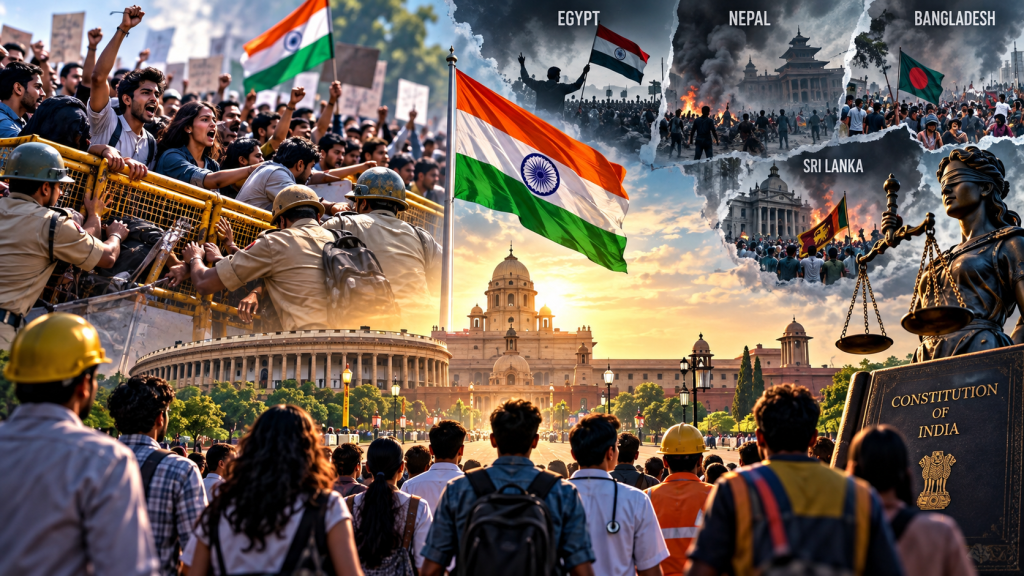
From the streets of Delhi to the corridors of power, a fundamental question confronts the Republic: can a democracy protect the right to protest without allowing politically motivated disruption to undermine the rights of ordinary citizens, the authority of the State and the dignity of its institutions?
There is something profoundly wrong when a country that prides itself on being the world’s largest democracy begins to behave as though the rights of a protesting group matter more than the rights of everyone else. The right to protest is an essential democratic freedom. But it cannot become a licence to paralyse public life, intimidate citizens, disrupt commerce or hold an entire neighbourhood hostage to a political cause.
Look at the disruption and losses suffered by traders and businesses in areas such as Connaught Place and Bengali Market in Delhi. Behind every shutter that remains closed, every customer who stays away and every day’s lost business are people whose livelihoods depend on the freedom to go about their work. Shopkeepers have employees to pay, families to support, bills to settle and commitments to honour. They are not necessarily participants in the political contest unfolding on their doorstep. Why should they be made to pay for it?
The same question applies to commuters, students, patients, daily-wage earners and ordinary citizens whose lives are disrupted by prolonged demonstrations. Their rights do not become secondary merely because they are not carrying placards or shouting slogans. The Constitution does not recognise a privileged class of citizens whose freedoms must be protected at the expense of everyone else’s.
A right exercised without regard for the rights of others can become an instrument of coercion. No democratic society can afford to ignore that distinction.
The right to protest is not the right to hold the country hostage
The issue is not whether citizens should be permitted to protest. They must be. The issue is whether any group, under the cover of a political or ideological cause, can decide for itself where public life will stop, how long it will remain disrupted and what price other citizens must pay.
There is a difference between assembling peacefully to express dissent and creating a situation in which the public is compelled to suffer until the protesters’ demands are met. There is a difference between criticising the government and paralysing the machinery of everyday life. There is also a difference between exercising a constitutional right and using that right as leverage against the rest of society.
These distinctions are not technicalities. They are the foundations of democratic coexistence.
The State has a duty to protect peaceful protest. It has an equally compelling duty to protect public order, freedom of movement, commerce and the ordinary citizen’s right to live without intimidation. When these duties collide, the answer cannot be to abandon one set of citizens in the name of another. The administration must act with judgement, firmness and restraint – but it must act.
The law must restrain the police when they act unlawfully. It must also empower them to act lawfully. If that distinction is lost, violent protesters will take the nation for a ride – and the ordinary citizen will pay the price.
I have seen mass mobilisation. This is not the same thing.
I have witnessed massive political mobilisation in Bhopal. I have seen rallies associated with Kanshi Ram and Mayawati, when BSP supporters descended on the state capital in such numbers that the city appeared almost besieged. Yet the sheer scale of those gatherings did not, in my observation, make them a threat to peace.
That experience is important because it establishes a distinction too often lost in today’s political discourse: a massive crowd is not necessarily a dangerous crowd. A movement can be large, its demands forceful and its political message uncompromising without turning into an assault on public order.
India’s history offers another instructive example. In October 1988, Mahendra Singh Tikait led a huge farmers’ mobilisation at Delhi’s Boat Club lawns. Hundreds of thousands of farmers gathered to press demands that included better sugarcane prices and relief on electricity and water dues. The demonstration became a landmark in India’s protest history. Its scale alone did not make it an assault on the State, although the experience of such massive gatherings contributed to subsequent restrictions on demonstrations at the Boat Club.
India has seen farmers’ agitations, labour struggles, movements for social justice and powerful campaigns against governments. Such mobilisation is part of democratic life. The State cannot treat every large gathering as a threat simply because it is politically inconvenient.
But neither can it assume that every future confrontation will remain peaceful because previous demonstrations did.
The distinction lies in the conduct of the participants and the nature of the confrontation. A peaceful crowd making demands is one thing. Vandalism, physical assaults, deliberate attempts to overwhelm security cordons and the humiliation of police personnel are quite another.
What are we to make of disturbing images in which police officers are allegedly dragged, kicked or physically attacked? What message does it send when such confrontations become viral spectacles, with the breach of a barricade presented as a political achievement?
These incidents must be examined on their facts, and responsibility must be established fairly. But the larger question cannot be dismissed by invoking the right to protest as though it settles every issue.
In a democracy, those in power remain open to criticism. But criticism is not a licence to assault public servants, vandalise property or force one’s way through security cordons. Political defiance does not place anyone above the law.
The question is not whether India should permit protest. It must. The question is whether those who organise demonstrations recognise any limits beyond the immediate demands of their campaign – and whether the State has the resolve to enforce lawful limits when those boundaries are crossed.
When repeated protests become rehearsals for escalation
There is another danger that the authorities cannot afford to overlook. Repeated confrontations with the police, attempts to breach barricades and the systematic testing of security cordons may not always be isolated episodes. Whatever the intentions of the organisers in individual cases, such confrontations can reveal weaknesses in security arrangements, test the response of law-enforcement personnel and embolden those who believe that the State can be pushed back through sustained pressure.
At what point does repeated confrontation cease to be merely a demonstration and become a test of the State’s capacity to defend its institutions?
This is not a question that intelligence agencies can afford to ask only after an incident has escalated. Nor should the administration wait for a serious security breach before examining whether recurring attempts to overwhelm police cordons form part of a wider pattern of mobilisation. Every episode must be assessed on its own facts, but patterns of escalation must not be ignored.
One cannot responsibly declare, without evidence, that a plan exists to target the Prime Minister’s residence, Rashtrapati Bhavan or Parliament. But neither can the possibility of attempts to threaten or breach security around the country’s highest constitutional institutions be dismissed as unthinkable. The responsibility of preventive security is precisely to assess credible risks before they materialise.
The government must prepare for the worst without treating every protester as an adversary. It must protect peaceful demonstrators while ensuring that those who attempt unlawful entry, threaten public safety or assault security personnel face proportionate action under the law.
The police must be trained to exercise restraint. Unnecessary force, intimidation and unlawful treatment of peaceful demonstrators have no place in a democracy. But restraint must not be confused with helplessness. Officers maintaining lawful security cordons must be able to perform their duties without being intimidated, physically overwhelmed or made to believe that every firm response will automatically be portrayed as repression.
Judicial scrutiny of police conduct is legitimate and necessary. But the principle that the police must not act with undue harshness cannot be converted into a public perception that they must hesitate even when confronted with a genuine threat.
The government must ask itself some urgent questions. Are repeated attempts to breach barricades being assessed collectively for signs of escalation? Are intelligence inputs reaching the relevant agencies in time? Are security arrangements around vital institutions being reviewed against credible threats? Do police personnel have clear, lawful protocols for responding proportionately when a crowd attempts to force its way through a cordon?
These are not questions of political convenience. They concern the security of the State and the continuity of constitutional governance.
Is the State afraid of enforcing its own laws?
A disturbing impression is taking hold that the government and the law-enforcement machinery can be pushed into hesitation by the prospect of judicial intervention, political controversy or a hostile media campaign. Officers are expected to maintain order, yet every consequential action may be followed by allegations of repression, demands for explanations and legal challenges. The result, when the system lacks confidence and clarity, can be dangerous paralysis.
This is not an argument for unchecked police power. But accountability cannot mean that officers become so apprehensive about the consequences of acting that they fail to prevent foreseeable disorder.
Nor can the government treat every difficult situation as a reason to retreat. Maintaining peace is not an optional administrative function. It is among the most basic obligations of a functioning State.
If public roads, business districts and essential civic spaces can be disrupted indefinitely without an effective response, what message does that send? It tells the law-abiding citizen that compliance is expected of them, while those prepared to create disorder may be rewarded with attention, leverage and concessions.
That is not the rule of law. It is a recipe for eroding public confidence in it.
The Supreme Court and the limits of intervention
The judiciary has an indispensable place in a constitutional democracy. It must protect fundamental rights, scrutinise executive action and intervene when the State crosses legal boundaries. No government should be permitted to silence legitimate dissent or use public order as a convenient excuse for suppressing criticism.
But constitutional protection for protest cannot mean that every claim advanced in its name must prevail over every competing public interest. Rights operate within a constitutional framework in which the rights of others and the requirements of public order also matter.
When demonstrations disrupt daily life, the immediate question should not be confined to the protesters’ freedom to assemble. It must also include the rights of those who cannot reach their workplaces, traders who lose business, patients who need access to medical care and residents who cannot move freely through their own neighbourhoods.
Judicial scrutiny of police action is legitimate and necessary. Yet there is a wider institutional question that deserves attention: does the system give adequate weight to the consequences of prolonged disruption for people who are neither protesters nor political combatants?
A democracy cannot function if its institutions appear to speak most urgently for those who disrupt public life while the citizens who bear the cost are reduced to an afterthought.
The government, too, must stop hiding behind the possibility of judicial intervention. If an administrative action is overturned because it is unlawful, the government must correct its failures. If an action is lawful, necessary and proportionate, it must be prepared to defend it with facts, sound procedure and constitutional confidence.
The objective must not be to insulate the executive from judicial review. It must be to ensure that lawful enforcement, judicial oversight and the protection of civil liberties reinforce rather than cripple one another.
What happened to intelligence and preventive policing?
There is another question the government cannot duck. When demonstrations escalate, when mobilisation appears unusually coordinated, or when there are credible indications of outside support or organised attempts to destabilise public order, what exactly are the intelligence and security establishments doing?
Are they anticipating trouble, assessing threats and advising the administration in time? Are they identifying the difference between a spontaneous public movement and a campaign deliberately organised to provoke confrontation? Are they tracking credible evidence of illegal financing or unlawful coordination? Or does the machinery wake up only after disruption has occurred and the damage is already done?
These are questions of public accountability, not invitations to invent conspiracies.
Claims of foreign funding, external influence or politically orchestrated mobilisation must not be treated as established facts merely because they are repeated loudly. References to George Soros, political networks or supposed toolkits are not substitutes for evidence. If credible evidence exists, investigate it, follow the money, establish the chain of responsibility and take action in accordance with the law. If the allegations cannot be substantiated, say so clearly. The country deserves facts, not insinuations and counter-insinuations.
But the absence of proof in the public domain should not become an excuse for failing to investigate credible leads. Nor should the existence of an investigation be used to brand every protester, critic or dissenter as an agent of hostile interests.
The distinction is straightforward: investigate evidence, not political labels; prosecute demonstrable offences, not inconvenient opinions.
The larger responsibility is to ensure that intelligence gathering, preventive policing and administrative planning work before a crisis reaches the streets. A State that repeatedly finds itself reacting to foreseeable disorder has a problem that cannot be solved through press statements after the event.
Talk of revolt and bloodshed cannot be brushed aside
Political rhetoric has consequences. Leaders and public figures are entitled to criticise the government, challenge its policies and mobilise peaceful opposition. But talk that appears to encourage violence, bloodshed or forcible confrontation cannot automatically be dismissed as harmless political theatre.
The precise words, the context in which they are used, the speaker’s intent and the available evidence must be examined. Where statements cross the legal threshold into incitement or other criminal conduct, the law must take its course. Where they amount to lawful dissent, the freedom to express them must be protected.
If political figures are making statements that credibly threaten public peace, the authorities must examine them promptly and impartially. If an offence has been committed, the appropriate legal process must follow. If no offence is disclosed, the matter should not be turned into a manufactured criminal case.
The government cannot demand public confidence in law and order while leaving citizens with the impression that the application of the law depends on who is speaking, which cause is being advanced or what political consequences might follow.
Gen Z or a manufactured political spectacle?
The same scrutiny must be applied to the fashionable claim that a visible group of young activists speaks for India’s younger generation.
Who exactly are these people being projected as the voice of Gen Z? Who gave them the mandate to speak for millions of young Indians who have never joined their demonstrations, endorsed their slogans or authorised them to represent their aspirations?
A television appearance is not a public mandate. A trending hashtag is not an election result. A crowded protest site is not a census of an entire generation. And a well-amplified political campaign cannot automatically be equated with a genuine nationwide movement.
India’s young people are not a single political bloc. They study, work, build businesses, conduct research, create art, develop technology, serve in uniform, labour in factories and fields, and struggle to secure a better future for themselves and their families. Many are concerned about jobs, education, opportunity, corruption, the environment and the direction of the country. They have every right to express their concerns, organise peacefully and demand accountability.
But the millions who are working towards their futures have as much claim to represent India’s youth as those who dominate television studios and social media feeds. Indeed, their quieter contribution to the country’s productive capacity and nation-building deserves at least as much recognition as the theatrical visibility of political activists.
The genuinely well-meaning youth of India cannot be reduced to a handful of demonstrators, nor can their aspirations be appropriated by those who happen to have mastered the art of making noise.
This raises a legitimate political question. Is the visibility of some of these groups proportionate to their actual public support, or is it being amplified by political patronage, organised campaigning and access to resources? Are we witnessing a movement with broad grassroots backing, or a spectacle in which a relatively small number of activists are projected as the authentic voice of an entire generation?
These questions deserve answers. They should not be dismissed merely because they are uncomfortable.
But neither should the possibility of organised political mobilisation be dismissed simply because it is inconvenient to investigate. Follow the evidence wherever it leads.
Those who have lost public confidence and see little prospect of recovering it through the voting machine may find it tempting to seek political relevance through perpetual agitation, manufactured crises and spectacular confrontations. That is a political possibility worth examining.
The real question is whether the claims made in the name of young India can withstand scrutiny. Who speaks for these activists? What is the extent of their public support? What are their objectives? And are they willing to accept the verdict of the people when it goes against them?
In a democracy, the answer to political disagreement is not to silence young people. It is to refuse to let any faction monopolise their identity.
The real voice of India’s youth is not necessarily the voice that shouts the loudest. It is also the voice that studies, works, builds, innovates and contributes – often without a camera in sight.
India is not Egypt, Nepal, Bangladesh or Sri Lanka
The political upheavals experienced by Egypt, Nepal, Bangladesh and Sri Lanka offer a sobering reminder of how public anger, political confrontation and institutional weakness can combine to produce a crisis. Each country has its own history, circumstances and causes. India should neither casually equate itself with these nations nor assume that it is immune to political turbulence.
But India must draw one unmistakable lesson: no politically motivated group, however visible on television or influential on social media, can be permitted to manufacture the impression that it speaks for an entire nation.
The danger lies not in young people raising their voices. It lies in the attempt to appropriate the identity of an entire generation, project a selected group of activists as the authentic voice of the people, and then use that manufactured claim to challenge the legitimacy of an elected government. A crowd is not a country. A protest is not a referendum. And a trending hashtag is not a substitute for the verdict of the electorate.
India’s political destiny cannot be determined by who occupies a street, dominates a television debate or succeeds in turning a confrontation into a spectacle. It must be shaped through democratic participation, constitutional processes and the freely expressed will of the people.
India is not merely the Opposition that failed to secure a majority in the electoral contest. Nor is it the preserve of left-liberal political formations whose repeated rejection by voters has left them searching for alternative routes to political relevance. They have every right to oppose the government, question its decisions and mobilise public opinion. What they do not have is the right to convert their political preferences into a claim that they alone represent India, its youth or its conscience.
The electoral system cannot be treated as sacrosanct when it delivers a favourable result and irrelevant when it does not.
Those who seek power through democratic politics must respect the electorate’s verdict even when it disappoints them. Opposition is essential to democracy; the perpetual delegitimisation of an electoral outcome simply because one dislikes it is not.
Nor should the government mistake electoral victory for a licence to ignore genuine grievances. Winning an election gives a government the authority to govern, not immunity from criticism. It must answer legitimate questions, correct failures and remain accountable. But those who lose an election cannot substitute street pressure for the mandate they failed to secure through the ballot.
The suggestion that India must follow the trajectory of another country’s political upheaval is equally misplaced. India’s constitutional institutions, electoral mechanisms, political diversity and democratic traditions must be strengthened, not undermined by those who mistake disruption for revolution and visibility for legitimacy.
India is not a country waiting to be spoken for by a crowd. It is a nation of more than a billion people whose voice cannot be appropriated by any political faction. Its future will not be decided by who shouts the loudest, but through the choices its citizens make and the institutions they have the right to hold accountable.
India must learn from the upheavals other countries have experienced, not invite a distorted imitation of them. It must never allow a politically motivated crowd to be passed off as the voice of India’s people – least of all the voice of its youth.
The government’s catch-22 is no excuse
There is a view in political and administrative circles that the courts can become a spoiler when the government attempts to act decisively, with subsequent judicial intervention embarrassing the executive or nullifying its actions. If that is the perception within the corridors of power, the government must confront it honestly.
But it cannot use this as an alibi for inaction.
The judiciary has a constitutional responsibility to review executive decisions. The government has a constitutional responsibility to govern. Neither can discharge its duties by blaming the other. The executive must ensure that its actions are lawful, evidence-based, proportionate and properly documented. The courts must examine those actions according to law. And the police must be able to enforce the law without political interference or unlawful pressure.
If the government repeatedly finds its actions overturned, it must examine why. Were the actions legally defective? Was the evidence inadequate? Were procedures ignored? Was the response disproportionate? Or was the decision challenged on grounds that do not withstand scrutiny? These questions require examination in each case.
What is unacceptable is a cycle in which the administration hesitates, disorder grows, the government blames legal constraints, protesters claim victory and the public is left to absorb the consequences.
Has the government developed a coherent plan to maintain peace and tranquillity while protecting the right to peaceful protest? No plan can guarantee that conflict will never arise. But a competent government should be able to explain how it will identify threats, prevent violence, protect vulnerable public spaces, maintain essential movement, safeguard businesses and respond lawfully when demonstrators cross the line.
The country needs a system that can distinguish peaceful dissent from coercion, spontaneous public anger from unlawful incitement, and legitimate mobilisation from demonstrable criminal conduct. It needs intelligence that works before the event, policing that is firm without being reckless, and administration that does not mistake indecision for restraint.
Above all, it needs political leadership prepared to accept responsibility for outcomes instead of searching for excuses after the damage has been done.
The government owes the country a plan, not another explanation.
The silent majority has rights too
There is a fundamental imbalance in the way public debate often unfolds. The protester is visible. The slogan is audible. The confrontation supplies dramatic images for television and social media. The citizen whose business has suffered, whose journey has been obstructed or whose daily wage has disappeared is far less likely to command the same attention.
Yet it is this citizen who sustains the economy and keeps the country moving.
A democracy cannot measure the legitimacy of a cause by the volume of its slogans, the duration of its demonstrations or the ability of its organisers to dominate the news cycle. Nor can the State assume that people who remain at work, run their shops, attend classes and fulfil their responsibilities have consented to the disruption of their lives simply because they are not protesting against it.
Silence is not surrender. Going about one’s work is not political indifference. And the desire for peace and normalcy is not evidence of hostility to democratic freedoms.
The right to protest is real. So are the rights to livelihood, movement, security and dignity. A constitutional democracy must protect them together, not allow one to become a weapon against the others.
The government must govern. The police must enforce the law lawfully. Intelligence agencies must anticipate credible threats. Courts must protect constitutional freedoms and scrutinise abuses of power. Political leaders must be held to the same standards regardless of their affiliations. Protest organisers must recognise that their rights do not erase the rights of fellow citizens.
India does not need a choice between democracy and order. It needs the confidence to defend both.
The ultimate test of democracy is not how much disruption the State can tolerate, nor how loudly a group can demand attention. It is whether the law can protect the right to dissent without sacrificing the rights of everyone else.
Let India pass this test
India must now pass this test – it must pass it by protecting the right to peaceful protest, holding those who resort to violence accountable, safeguarding the institutions of the Republic and defending the rights of citizens who simply wish to live and work in peace.
It must pass it by protecting the right to peaceful protest, holding those who resort to violence accountable, safeguarding the institutions of the Republic and defending the rights of citizens who simply wish to live and work in peace.
Let the government demonstrate firmness. Let the courts protect liberty without weakening lawful enforcement. Let the police uphold the law with courage and professionalism. Let intelligence agencies do their work before a crisis erupts, not merely explain their failures after the event.
Let those who aspire to govern India demonstrate that they respect the people’s verdict, even when they disagree with it. Let those who organise protests demonstrate that democratic freedom carries responsibilities as well as rights. And let every institution of the Republic remember that its ultimate obligation is to the Constitution and the people of India, not to any political faction.
India must show the world that its democracy is strong enough to accommodate dissent, mature enough to distinguish protest from disorder, and resolute enough to prevent either political ambition or mob pressure from holding the nation to ransom.
India is a democracy, not a hostage.
The right to protest must be protected. The right of the people to live, work, move freely and earn their livelihood must be protected with equal determination.
Let the nation pass this test – and convey to the whole world that India is not merely the world’s largest democracy, but a mature democracy that has the confidence, wisdom and institutional strength to defend its freedoms without surrendering its peace, its sovereignty or the rule of law.
