

By Lalit Shastri
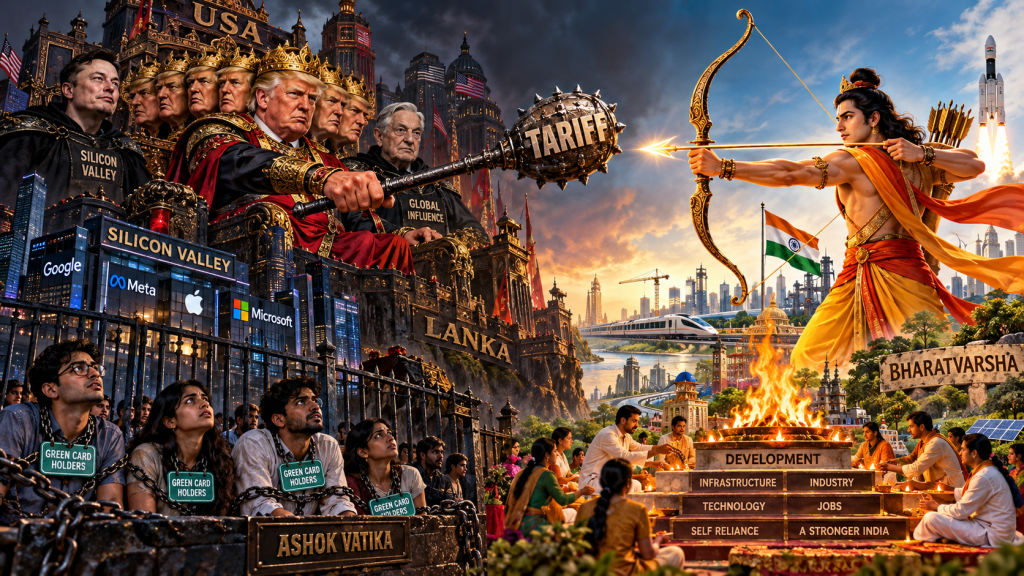
There is something strikingly familiar about the arrogance of a king who mistakes power for righteousness. In the ancient epic, Ravana ruled Lanka, a kingdom of immense splendour whose brilliance was overshadowed by the moral blindness of its ruler. Today, the spectacle unfolding in the United States under Donald Trump invites an uncomfortable analogy with that ancient Lanka. The names have changed, the weapons have changed, and the battlefield has shifted to the corridors of power in Washington and the technological citadels of Silicon Valley. But the old temptation remains: to bend the world to the will of one man and call the exercise of power a virtue.
In this modern retelling, Trump is the Ravana who believes that the world must bow because he commands the throne. His weapon is no longer the celestial arsenal of the demon king but the tariff, the threat, the ultimatum and the calculated uncertainty that he unleashes against nations that refuse to walk to his tune. Where Ravana relied on the terror of Lanka’s might, Trump wields the economic coercion and military might of a superpower. The underlying presumption is the same: that the powerful have the right to dictate terms, and that those who resist must be punished.
But Bharatvarsha is not a kingdom waiting to be conquered. It is a civilisation that has survived emperors, invaders, colonial masters and the conceit of those who imagined that India could be permanently subdued. The path associated with Lord Ram is not one of intimidation but of dharma, restraint, duty and the courage to stand upright in the face of overwhelming power. If India is engaged in the great yagya of national development, the question is whether those who claim to champion freedom and prosperity will respect that endeavour or seek to disrupt it whenever Indian independence of judgment becomes inconvenient.
And here the analogy acquires its sharpest edge. In the Ramayana, Ravana’s abduction of Sita was the defining act of his arrogance: he presumed that his power entitled him to possess what was not his. In this contemporary allegory, the threatened autonomy of Indian professionals in America becomes a metaphor for another kind of captivity. The Indian engineer, scientist or technology worker who travels to the United States in pursuit of opportunity is not a captive of Lanka. He or she is a skilled individual who contributes knowledge, labour, innovation and enterprise to the country of residence. Yet when immigration status becomes a lever of political intimidation, and the prospect of insecurity is used to keep people compliant, the promise of opportunity begins to resemble the shadow of Ashok Vatika (it is in Ashok Vatika that Ravana held Sita captive after her abduction).
The comparison is deliberately uncomfortable. No one should mistake the situation of Indian green-card holders for Sita’s abduction but there is a legitimate question that the analogy forces us to confront: can a country that celebrates liberty but treats the people whose talent helps sustain its prosperity as instruments to be summoned, threatened or discarded at political convenience? The dignity of workers cannot be made conditional on their nationality becoming useful to a ruler’s domestic political theatre.
Silicon Valley, in this telling, becomes a modern Ashok Vatika – a place of extraordinary ingenuity where the fruits of human intelligence flourish, yet where the political climate can threaten to turn opportunity into apprehension. The irony is profound. America built much of its technological supremacy by attracting talent from across the world, and more particularly India. To treat that talent as a captive resource, or to suggest that the security and future of immigrants can be manipulated to extract political concessions, would be to undermine the very openness that helped make American innovation formidable.
Then there are the billionaires and power brokers who loom over this drama. Elon Musk and George Soros occupy very different positions in American public life, and their kind of politics, interests, influence, and interference in other countries’ affairs is a matter of serious concern. In the vocabulary of this satire, they can be cast as powerful figures in a court where the interests of ordinary people risk becoming secondary to the ambitions of the mighty. Musk’s immense influence in technology and politics, and Soros’s long-standing political interventions in many different countries make them legitimate subjects of scrutiny. In the Ramayana, the rakshasas who disrupted the sages’ yagya were condemned for their deeds.
For Bharat’s yagya is not a dharmic ritual performed by a ruler. It is the continuing work of building roads, strengthening industry, expanding scientific capability, improving livelihoods, developing indigenous technology and securing a place for India in a changing world. No foreign power has to agree with every Indian decision. But disagreement is not a licence for coercion, and economic strength does not confer moral ownership over another nation’s choices.
Tariffs, in this drama, become Ravana’s latest declaration of might. They are presented as instruments of national advantage, yet when deployed indiscriminately as threats against sovereign partners, they can become weapons of disruption, raising costs, unsettling supply chains and poisoning relationships that took decades to build. The king may imagine that every tariff is another head of his formidable power. He may discover instead that each act of coercion produces another reason for nations to diversify their partnerships, strengthen their own capabilities and reduce their dependence on his favour.
That is the great irony of modern Lanka. Ravana’s ten heads symbolised formidable power, but none could save him from the consequences of his own arrogance. A superpower, too, can possess extraordinary wealth, technology, military reach and financial leverage while remaining vulnerable to the oldest weakness in politics: the inability to distinguish obedience from respect.
Lord Ram did not defeat Ravana merely because he possessed weapons. He prevailed because the epic places righteousness above brute force, and because Lanka’s splendour could not absolve its ruler of his transgression. Bharatvarsha’s answer to intimidation must likewise be neither panic nor imitation. It must be self-confidence, strategic patience, economic resilience and an unwavering commitment to national interest.
Trump may imagine that tariffs can make Bharat bend. The more consequential question is whether he understands that a civilisation cannot be bullied into surrendering its judgment. India can negotiate, cooperate, compete and disagree. It can welcome partnerships without accepting subordination. It can value its citizens abroad without confusing their contributions with a debt of political obedience.
In the end, the lesson of the Ramayana is not that every adversary must be called a demon or every dispute converted into a war between Ram and Ravana. It is that power without restraint carries within it the seeds of its own defeat. Ravana’s tragedy was not that he lacked strength. It was that he believed strength placed him beyond the reach of dharma.
And if today’s ruler of modern Lanka believes that the road to Bharatvarsha runs through fear, tariffs and the insecurity of Indian talent, he would do well to remember how the old story ended. Lanka was magnificent. Ravana was mighty. Yet neither splendour nor might could make injustice invincible.
