
Lalit Shastri

Closer home in India, television news presents a troubling picture of a medium that appears to have increasingly lost sight of its primary responsibility: to inform citizens through accurate reporting, independent investigation and reasoned examination of issues that affect public life.
Much of the daily news output across channels is strikingly similar. News agency feeds and reports already in circulation are reproduced across competing networks, often leaving little to distinguish one channel’s coverage from another. In a fiercely competitive market, exclusive reporting and serious investigative journalism remain essential to the credibility of the medium, yet they appear increasingly overshadowed by the sheer volume of routine news and studio-driven programming. The number of channels has multiplied, but that multiplication does not necessarily translate into greater diversity of reporting, depth of inquiry or originality of thought.
The prime-time debate has become a defining feature of this television news culture. Political party spokespersons and self-described political analysts appear repeatedly to argue positions that audiences have heard many times before. The same faces return year after year, often taking the same predictable stands and repeating the same arguments. Viewers can frequently anticipate what a panellist is going to say before the person has uttered a word. Familiarity has become a substitute for discovery, while the promise of fresh insight, independent expertise and evidence-based scrutiny recedes into the background.
This recycling of commentators raises a fundamental question about the purpose of televised debate. Is the objective to deepen public understanding, test competing claims and introduce audiences to new evidence and perspectives? Or has the format become a closed circuit in which familiar participants rehearse established positions for an audience already accustomed to their ideological preferences? A commentator is entitled to hold consistent views. But when the same opinions are repeated without meaningful engagement with evidence, changing circumstances or opposing facts, the exercise risks becoming a ritual rather than an inquiry.
Television anchors, who should be responsible for ensuring that discussions remain fair, informed and focused on facts, frequently become part of the same spectacle. Instead of testing assertions, demanding evidence and distinguishing substantiated claims from political rhetoric, some anchors dominate discussions, interrupt participants, signal their own preferences or turn disagreement into confrontation. The moderator becomes another combatant, and the distinction between questioning an argument and promoting a position becomes blurred.
The resulting cacophony often leaves viewers with more heat than light. Competing voices talk over one another, accusations replace argument, and rhetorical aggression is mistaken for incisive journalism. The spectacle may hold attention, but attention is not the same as understanding. Nor does a studio crowded with opposing political representatives automatically produce balanced or informed discussion. Where the format rewards confrontation above all else, the loudest voice can prevail without having the strongest evidence.
The problem extends beyond the conduct of individual anchors and panellists. Views ranging from the ultra-right to the ultra-left, along with positions advanced in the name of liberalism, are projected into the public domain with an intensity that can leave little room for nuance, verification or dispassionate examination. Ideological conviction is not itself a failing; democracy depends on the freedom to express competing ideas. The failure occurs when ideological allegiance takes precedence over facts, when assertions are treated as established truths without scrutiny, and when the presentation of a partisan position is confused with journalism.
The commercial pressures of television cannot be ignored. In the pursuit of television rating points (TRPs), confrontation can become a programming strategy, familiar faces a convenient production choice, and controversy a reliable means of holding an audience. Original reporting, painstaking verification and investigations that may take months demand resources, patience and editorial independence. A studio confrontation can fill an hour of prime time with considerably less effort. The danger is that the economics of attention begin to dictate the priorities of journalism itself.
Yet television news has an enormous public responsibility. It can expose wrongdoing, scrutinise the exercise of power, bring neglected issues to the forefront and give citizens access to information that would otherwise remain beyond their reach. It can introduce audiences to credible specialists, independent researchers and people with direct knowledge of the issues under discussion. It can challenge conventional wisdom, correct misinformation and make public institutions more accountable. These are not peripheral functions of journalism; they are central to its purpose.
The issue, therefore, is not whether television should host political debates or provide space for competing opinions. It is whether these programmes contribute to public understanding or merely reproduce the divisions and prejudices already present in society. It is not whether anchors should ask difficult questions, but whether they apply the same standards of scrutiny to all claims, including those with which they personally agree. And it is not whether commentators should have strong opinions, but whether those opinions are tested against facts and remain open to evidence.
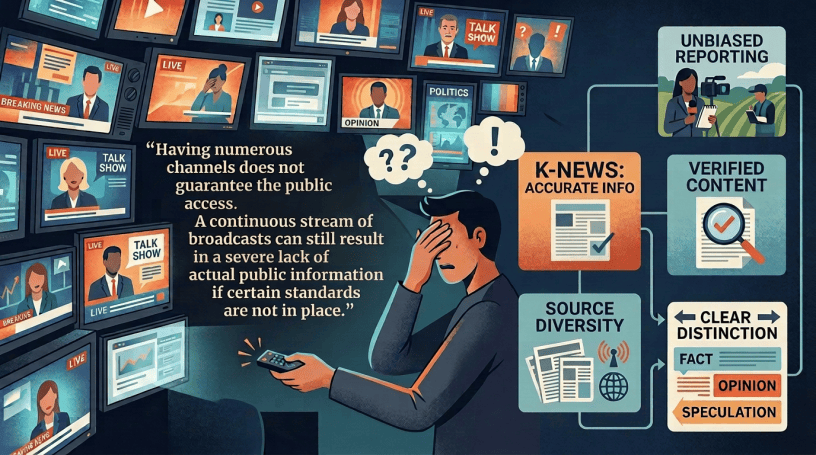
Above all, the abundance of television channels must not be confused with the public’s meaningful access to news. A citizen’s right to news is not fulfilled merely because information, commentary and political argument are available around the clock. Access to reliable news requires independent reporting, verification, a diversity of credible sources and a clear distinction between fact, opinion and speculation. Without these safeguards, a continuous stream of television output can coexist with a serious deficit in public information.
When the same stories are repeated across channels, the same commentators recycle familiar arguments, and anchors join the contest instead of illuminating it, the public is left to navigate an avalanche of sound without necessarily gaining a clearer understanding of events. Television may continue to call it prime time. But journalism must be judged by a more exacting standard: not how loudly a subject is discussed, how many times a face appears on screen or how fiercely opinions collide, but how much verified knowledge the audience gains.
The public does not need more noise masquerading as news. It needs journalism that respects its intelligence, serves its right to know and places facts above spectacle. That is the difference between filling airtime and fulfilling the responsibility of the press.
