
Lalit Shastri
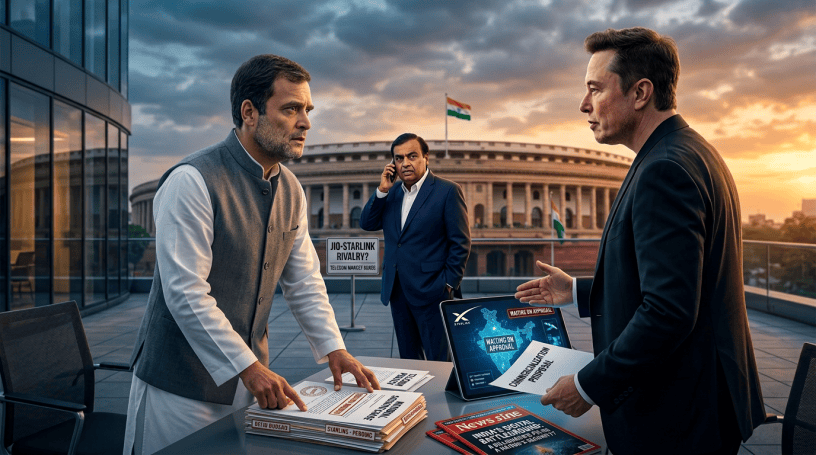
One billionaire wants a bigger slice of India’s digital pie. Another has a formidable stake in the telecom market. An opposition leader still wants the Prime Minister’s chair. And national security? That can wait until the next political convenience.
Elon Musk has never been a man to enter a market quietly. He arrives with a grand vision, a disruptive business model and an appetite for changing the rules of the game. India, with its vast digital market and millions of potential Starlink subscribers, is obviously too attractive a prize to ignore. But entering India is one thing; expecting the regulatory landscape to move at the speed of one’s ambition is quite another.
Musk has another formidable instrument at his disposal: X, the platform he owns and uses not merely to communicate, but to intervene in public debates, challenge institutions and project his preferences to an audience that stretches across the globe. In his hands, X is both a business asset and a megaphone. The line separating the two can become remarkably thin.
And then there is Mukesh Ambani, whose Reliance Jio has established a commanding presence in India’s telecom market. Any serious expansion of satellite-based internet services will take place in a market where established players have immense commercial stakes and where the allocation of spectrum and the terms of access have consequences extending well beyond the fortunes of individual companies.
Viewed through this lens, the Starlink controversy begins to look less like a simple contest over internet connectivity and more like a struggle over market access, commercial advantage and political influence. Musk may want Mukesh out of his way, at least in the metaphorical sense of clearing a path for a larger share of India’s digital market. That is a reading of the competing commercial interests, not proof of a secret pact or a personal campaign against Ambani. The stakes, however, are real.
Enter Rahul Gandhi, who has his own unfinished business with Narendra Modi. After repeated electoral defeats at Modi’s hands, the Congress leader remains determined to dislodge the Prime Minister. There is nothing improper about an opposition leader aspiring to occupy the highest political office. That is the essence of democratic competition. But the road to the Prime Minister’s chair runs through the electorate, not through violent, obscene and ugly protests near the seat of power in New Delhi or every controversy that can be turned into an attack on the government.
This is where the Starlink episode acquires its political irony.
Congress had raised questions about national security in the context of Starlink’s proposed entry into India. Such concerns are neither frivolous nor automatically partisan. Satellite communications, spectrum allocation, data security and strategic infrastructure deserve rigorous scrutiny. A government should not be expected to grant commercial access merely because a powerful global entrepreneur wants to move quickly.
Yet the political emphasis appears to have shifted. The delay in resolving Starlink’s entry is now being presented as an issue of corporate influence and the alleged protection of powerful business interests. The very process that had attracted questions about security is being recast as evidence of political favouritism. The question is unavoidable: if national security was a genuine concern yesterday, why should the delay required to address such concerns become an indictment of the government today?
The government may be criticised for its decisions, its delays or the consistency of its policies. But the standards applied to satellite services cannot change simply because a political party finds a different line of attack more useful. If security scrutiny is necessary, it must be allowed to run its course. If the process is being manipulated to favour one business over another, that charge must be supported by evidence. Neither proposition can be established by political insinuation alone.
Congress might also pause before presenting itself as the unblemished custodian of India’s satellite resources. The Devas–Antrix scandal remains a reminder of how valuable satellite capacity was committed to private commercial interests under the UPA government headed by Manmohan Singh and politically led by Sonia Gandhi, with questions over national security and strategic interests coming sharply into focus later. The agreement was eventually annulled. That episode is hardly irrelevant when the party now invokes the national interest in a dispute over satellite communications.
National security cannot be a slogan brought out when it suits the opposition and put away when it complicates a political attack. Nor can the allocation of strategic resources be judged by one standard under one government and another under its successor.
There is, meanwhile, an uncomfortable feature of Musk’s expanding influence that deserves attention in its own right. X is not a neutral public square floating above commercial and political interests. It is a privately controlled platform whose owner can shape its rules, amplify his own interventions and use the reach of the service to press his views. Musk’s ambition to expand his business interests in India and his ability to command attention through X are two sides of a larger story about the concentration of private power.
The platform has also become a space in which political actors, business interests and personalities with sharply conflicting agendas can find themselves in temporary alignment. Strange bedfellows are a dime a dozen on X. Shared hostility towards a government, however, does not establish a common conspiracy. It does, though, make it necessary to examine claims of corporate influence with the same scepticism, regardless of who makes them.
Rahul Gandhi is entitled to challenge Modi. Musk is entitled to pursue business opportunities in India, subject to Indian law and regulation. Ambani is entitled to compete for customers and protect his commercial interests.
The test is whether the rules are transparent, the regulatory process is fair, and national security is treated as a substantive requirement rather than a convenient political prop. If Starlink meets the applicable requirements, its entry should be considered on that basis. If it does not, no billionaire’s impatience, social-media following or political connections should secure it an exemption. The same principle must apply to every competing corporate interest.
That leaves us with an intriguing triangle. Musk wants access to a vast market and the freedom to expand his commercial empire. Ambani already occupies a powerful position in that market. Rahul Gandhi wants Modi removed from office. Each has a distinct interest; each operates through a different kind of power. The temptation is to read every development as part of one grand design. The more useful exercise is to ask who stands to gain, what evidence supports the claims being made, and whether the national interest is actually being served.
For Congress, the immediate problem is one of credibility. A party cannot invoke national security to question Starlink’s entry and then treat regulatory delay as proof of corporate favouritism without explaining how the two positions fit together. It cannot demand scrutiny when scrutiny helps its argument and dismiss the implications when it does not. That is not principled opposition. It is political convenience.
And for Rahul Gandhi, there is a more fundamental democratic lesson. Modi’s removal cannot be treated as the answer to every public controversy, any more than Musk’s commercial ambitions can be treated as the measure of India’s digital future. A political leader who wants to become Prime Minister must persuade voters that he can govern better, not merely turn every decision of the incumbent into another instalment of a permanent campaign.
The irony is that a debate ostensibly about satellite internet has become a revealing test of political consistency. The real issue is not whether Musk, Ambani or Rahul gets the better of the others. It is whether India’s strategic resources and regulatory decisions will be governed by transparent rules and national priorities, or reduced to ammunition in the rivalries of billionaires and politicians.
In this contest, everyone appears to want something: Musk wants a bigger opening, Ambani wants to retain his position, and Rahul wants Modi out. Those ambitions are hardly mysterious. What remains to be seen is whether national security will be treated as a serious principle by all concerned, or given a go-by.
India’s spectrum is not a bargaining chip in a billionaire’s business strategy. Nor is national security a prop in a politician’s campaign. And the Prime Minister’s chair is not won by outrage on X. In a democracy, commercial power must answer to the law, political ambition to the electorate, and both to the national interest.
