

Lalit Shastri
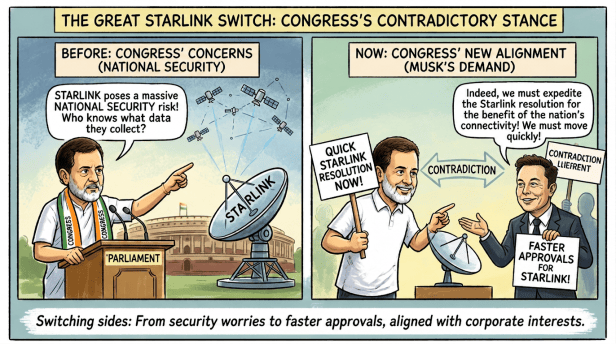
The irony is that Congress is now attacking Narendra Modi on the issue of satellite internet service, Starlink developed by Elon Musk’s aerospace company SpaceX by invoking the influence of powerful corporate interests, while its own intervention has aligned it politically with Musk’s demand for a quicker resolution. That shows that Congress has abandoned its earlier concerns about national security.
The Congress party’s position on Starlink raises a question that goes beyond the merits of a dispute over a satellite internet service. It concerns the consistency of political principle. When Congress questioned Starlink’s proposed entry into India, national security was among the concerns it raised. Yet, as the government continues to consider the regulatory and security implications, the party has shifted its political emphasis to the delay in the company’s commercial rollout.
This raises an obvious question: have the security concerns that Congress considered important ceased to matter, or have they become inconvenient to its present political argument?
The government cannot be faulted merely for examining national-security implications before permitting a foreign satellite communications provider to commence commercial operations. Equally, it must be answerable for its regulatory decisions and the time taken to reach them. But these are separate questions. A demand for timely regulatory action does not require the abandonment of security scrutiny, just as the invocation of national security cannot become an indefinite justification for delay.
Congress has a responsibility to explain how its present position reconciles with its earlier objections. If the security concerns remain valid, why has its political intervention centred on the delay rather than on whether those concerns have been adequately addressed? And if the party believes that the delay is unjustified, what evidence does it have that the regulatory process is being manipulated to protect particular corporate interests?
The irony is that Congress is now attacking Narendra Modi by invoking the influence of powerful corporate interests, while its own intervention has aligned it politically with Elon Musk’s demand for a quicker resolution. That shows that Congress has abandoned its earlier concerns about national security. Now the burden is on the party to explain why the security questions it previously considered significant have receded from the centre of its argument.
Question arises, Congress party’s shifting stand, is it part of an over all strategy funded by Soros to destabilise a legitimate government?
Political opposition does not require a party to endorse the government’s every decision. Nor does it require a party to defend every regulatory delay. But consistency demands that national security be treated as a principle, not as an argument to be deployed when politically convenient and set aside when it obstructs an attack on the government.
The question Congress must answer is straightforward: does it want Starlink’s entry to be governed by a rigorous and impartial security framework, or does it want the political advantage of opposing the government over the delay while leaving its earlier security objections unexplained?
A credible position would insist on both security and regulatory accountability. Anything less risks making the party’s stand appear less a matter of principle than an extension of its political contest with the Modi government.
