
By Lalit Shastri
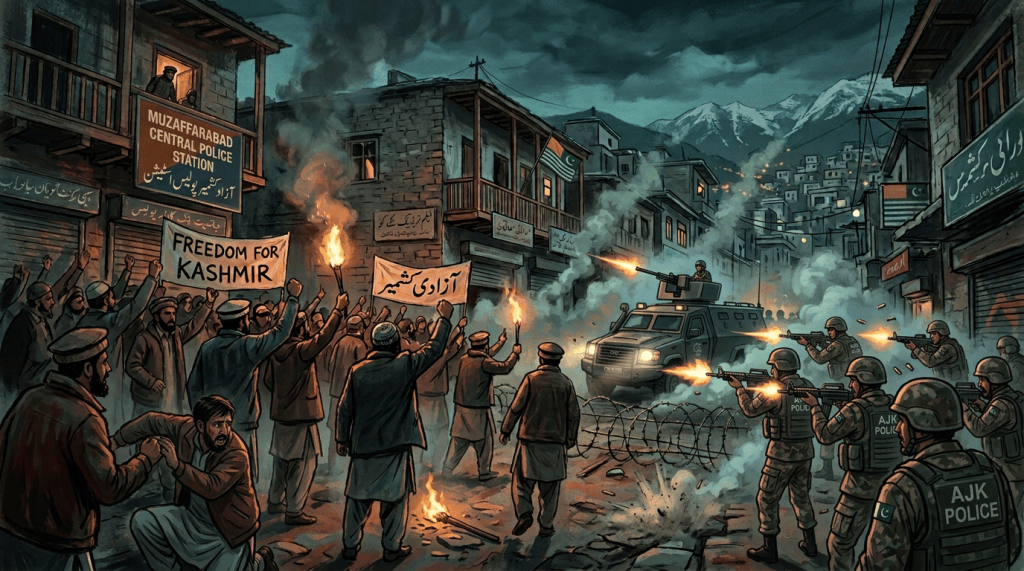
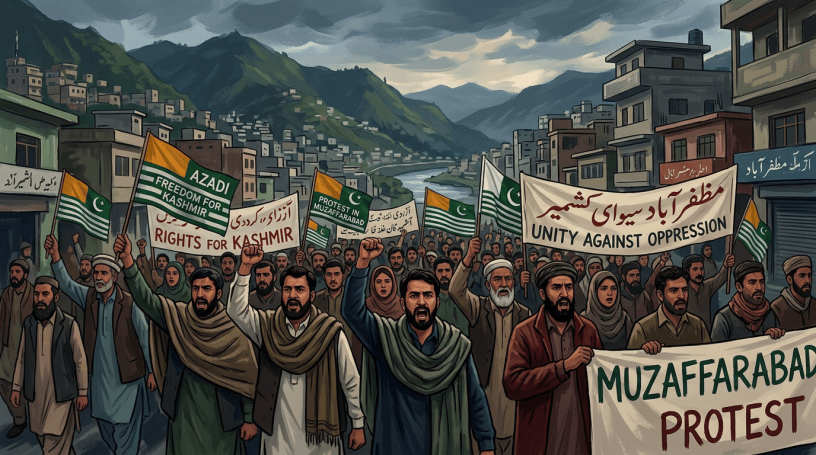
The turmoil in Pakistan-occupied Jammu and Kashmir has now acquired a significance that India would be foolish to treat as merely another episode of popular anger against Islamabad. For months, people have been protesting against Pakistan’s political and economic control, demanding rights and accountability and, increasingly, challenging the very legitimacy of the Pakistani presence. In July, a prominent movement leader publicly described the territory as neither “Azad” nor disputed but occupied. In September, at a large gathering in Mandhol, close to the Line of Control, protesters called for the LoC to be removed and the historic routes to Poonch and Mendhar on the Indian side to be reopened. Organisers claimed that around 25,000 people attended.
That development deserves to be watched carefully. It would be a mistake to assume that instability in Pakistan-occupied Jammu and Kashmir will automatically work in India’s favour. It would be an even greater mistake to imagine that the political vacuum developing there cannot be exploited by the same forces that have used Kashmir for decades as an instrument against India.
There is another reason for caution. Pakistan has never regarded Kashmir merely as a territorial question. Over the decades, it has converted the issue into an ideological and jihadist project. If the political order on the other side of the Line of Control begins to weaken, the consequences may extend far beyond the grievances that have brought ordinary people onto the streets.
To understand the danger, India needs to go back much further than 1947.
Kashmir was already in the crosscurrents before Pakistan existed
The history did not begin with the creation of Pakistan. The political currents that eventually produced Pakistan were already reshaping the subcontinent, and Kashmir had already been drawn into them.
The agitation against the Dogra administration that erupted in Jammu and Kashmir in 1931 had genuine political and social causes. The grievances of Kashmir’s Muslim population regarding representation, employment and governance were being raised forcefully, and the government Maharaja Hari Singh was compelled to respond to them. The Glancy Commission recommended political reforms, and the Muslim Conference was established in 1932. But the politics did not remain confined within the State. The Kashmir-Punjab frontier increasingly became a zone through which political and communal currents travelled. Historical research records the interaction between the Kashmir movement and the wider nationalist politics of British India, including the growing involvement of the Congress and the eventual split between Sheikh Abdullah and Chaudhry Ghulam Abbas.
The decisive development came when the Muslim Conference itself split over the direction in which Kashmiri politics should move. Sheikh Abdullah’s leadership increasingly sought to transform the movement into a broader political organisation, open to all communities. In 1939 the organisation became the National Conference and moved closer to the Congress-linked All India States Peoples’ Conference. Ghulam Abbas and other leaders who opposed this secularisation revived the Muslim Conference in 1941. The division was not merely organisational. It represented two increasingly different conceptions of political Kashmir.
The National Conference was moving towards a conception of Kashmir as a territorial political community in which political rights would not be determined by religion. Its 1944 Naya Kashmir programme envisaged responsible government, sweeping social and economic reforms and a constitutional monarchy in which Maharaja Hari Singh would remain the head of State.
The Muslim Conference was moving in another direction, increasingly aligning itself with the Muslim League and the political current represented by the Two-Nation Theory.
That distinction is essential. Pakistan did not yet exist. But the politics that would produce Pakistan did. Jinnah’s Kashmir intervention was not incidental
Muhammad Ali Jinnah’s intervention in Kashmir in 1944 therefore deserves far greater attention than it generally receives.
Jinnah arrived in Kashmir on 10 May 1944 and remained there for more than a month. He met leading political figures and on 17 June addressed the Muslim Conference. The contemporary record shows that he argued for the Muslim Conference as the representative organisation of the State’s Muslims and subsequently sent emissaries to advance the Muslim League’s position in Kashmir.
This was not simply a politician visiting a picturesque princely State. Jinnah was intervening in a political contest over the very basis on which Kashmir’s political identity would be defined.
The National Conference was trying to build an inclusive Kashmiri political identity around the State and its people. Its Naya Kashmir programme envisaged constitutional government under the Maharaja as head of State. Jinnah, by contrast, threw his weight behind the Muslim Conference as the representative vehicle of the Muslim majority.
In other words, the question was becoming larger than whether Hari Singh should surrender his autocratic powers. It was becoming a contest between two competing ideas of political nationhood: Kashmir as a territorial political community of all its inhabitants, or Kashmir as a political entity whose future was to be determined principally through the religious identity of its Muslim majority.
Jinnah’s preference was clear. And there is a remarkable contemporary document that captures the atmosphere.
On 17 May 1944, while Jinnah was in Kashmir, my father, Anant Maral Shastri, was writing in Lahore in his regular column, Sheharpanah Ke Kangure Se, in Milap, of which he was then editor. What was satire in 1944 acquires a different historical resonance today. The column was written before Pakistan existed, before Partition and before anyone could know the catastrophe that lay ahead. Yet it was observing Jinnah’s political predicament and his movement towards Kashmir at precisely the moment when he was becoming actively involved in the contest over Kashmiri political representation.
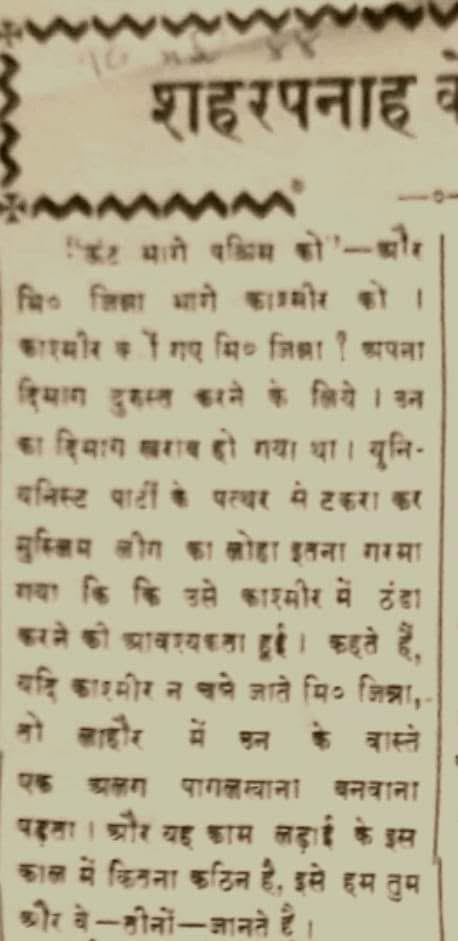
That little newspaper clipping is therefore not merely a family keepsake. It is a contemporary window into a political moment that later history would profoundly transform.
The undercurrents were becoming dangerous
By the mid-1940s, the political environment surrounding Kashmir had become increasingly communalised.
This is where it is important not to rewrite history backwards and attribute everything to a state called Pakistan that did not yet exist. The more accurate historical proposition is more compelling: the ideological and political currents that would later be inherited and weaponised by Pakistan were already active before Pakistan came into being.
The revived Muslim Conference increasingly aligned itself with the Muslim League. Jinnah’s intervention strengthened that political direction. Meanwhile, events in Punjab and the adjoining frontier were making the atmosphere progressively more combustible.
By 1946-47, contemporary British reporting was recording deeply troubling developments along the Kashmir frontier, including reports of anti-Hindu mobilisation and preparations for a religiously framed armed intervention. Accounts of the period record reports that the Pir of Manki Sharif had sent agents towards the Kashmir frontier to prepare Muslims for a “holy war” after the British departure.
And then there is the extraordinary telegram dated 14 April 1947 – months before Partition and six months before the invasion.
The document records the arrival in Sialkot of 62 Muslims from the Kotli area, having entered through Mirpur and Jhelum. It mentions Ahrars, an announced intention to organise jatha bandi with Kotli Muslims after Eid prayers, and efforts by the authorities of Jammu and Kashmir to arrange the return of the Kotli people through Bhimber.
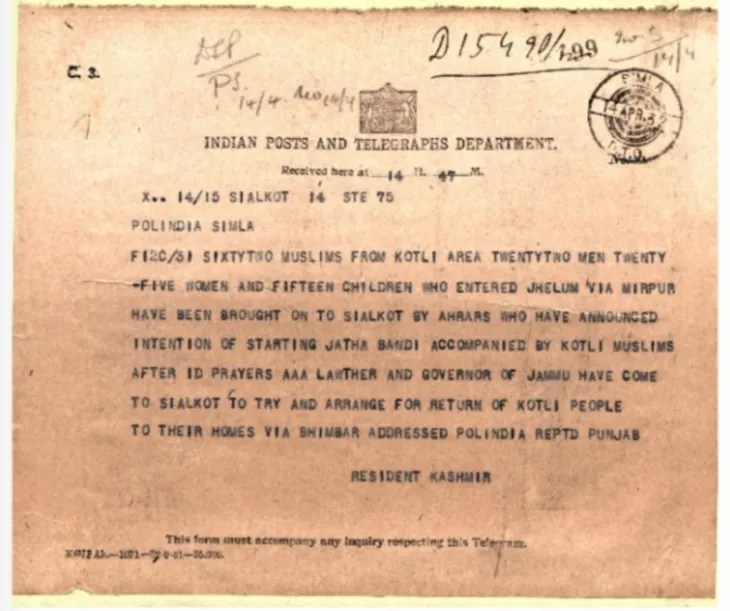
One should not turn that single document into proof of a fully formed Pakistani invasion plan. Pakistan did not yet exist. But neither should the document be dismissed. It is contemporary evidence of something highly significant: Kashmir, Punjab, communal mobilisation and organised political activity were already interacting across the frontier before Partition. That is the historical context in which August 1947 must be understood. Kashmir was not a blank space that suddenly became a dispute when the British left. It had already become one of the arenas in which the larger struggle over the political future of the subcontinent was being fought.
Then came the invasion
October 1947 transformed the political contest into war.
Pakistani regulars, operating alongside tribal lashkars and initially under the cover of an irregular invasion, crossed into Jammu and Kashmir. Villages were attacked and looted, civilians were killed and the invading forces advanced towards Srinagar.
Faced with the advancing enemy, Maharaja Hari Singh ordered the State Forces to resist. A contingent commanded by Brigadier Rajinder Singh, Chief of the Jammu and Kashmir State Forces, was sent to hold back the invaders. Rajinder Singh and his men fought a desperate delaying action against a vastly bigger force, holding the advancing enemy at enormous cost and buying precious time at a moment when the fate of the State hung in the balance. Brigadier Rajinder Singh laid down his life along with many of his men. His sacrifice has too often been reduced to a footnote in the larger Kashmir narrative. It should not be. The defence of Jammu and Kashmir did not begin when Indian troops landed at Srinagar. The State Forces were already fighting the invaders, and the Dogra soldiers who stood in their way paid for that resistance with their lives.
Maharaja Hari Singh signed the Instrument of Accession to India. India accepted the accession. Indian troops were then airlifted into Srinagar and began pushing back the invaders. The advance on Srinagar was stopped, but by then large parts of the State had already been overrun and remained under Pakistani control. Contemporary military histories place the accession on 26 October and the arrival of the first Indian troops at Srinagar on 27 October.
The sequence matters because it has been repeatedly inverted in political narratives. There was an invasion. There was resistance. There was accession. There was Indian military intervention. There was a war. And a portion of the State was left under Pakistani occupation.
The Indian Army did not enter Jammu and Kashmir to acquire a territory whose status was still awaiting political settlement. It entered after accession to defend a State that had acceded to India and to repel an armed invasion. That is the historical foundation that cannot be wished away.
From invasion to jihad
Pakistan’s strategy did not end with the 1947-48 war. It evolved.
Conventional military confrontation was supplemented, and increasingly substituted, by infiltration, militant recruitment, religious radicalisation and terrorism. The objective was not merely to capture territory. It was to make Indian governance impossible, weaken the State from within, create communal polarisation and generate the impression that India could not hold Jammu and Kashmir.
The strategy was asymmetric by design. If Pakistan could not defeat India conventionally, it could bleed India through terrorism. If it could not seize Kashmir outright, it could destabilise the Valley. If it could not remove Indian sovereignty militarily, it could attempt to delegitimise it politically and socially.
Kashmir became the principal theatre for this strategy.
The late 1980s: jihad acquired political space
It is important to get another part of the chronology right. The jihadist mobilisation did not suddenly begin after V. P. Singh became Prime Minister in December 1989. It had already begun consolidating during the Rajiv Gandhi years. The militant infrastructure, radical political networks and religious mobilisation were already taking shape in the Valley.
But the fall of the Rajiv Gandhi government and the arrival of V. P. Singh changed the political environment dramatically.
Mufti Mohammad Sayeed became Union Home Minister. The militants acquired increasing room to operate, and the State’s ability to contain the rapidly expanding insurgency deteriorated. What had been building during the preceding years now gathered extraordinary momentum.
The result was not simply an insurgency. It became a campaign of intimidation, targeted killings and religious radicalisation. And then came the exodus of the Kashmiri Hindus.
Families abandoned ancestral homes. Property was left behind. Temples and neighbourhoods were deserted. A community that had been part of Kashmir’s social and cultural landscape for centuries was driven out in a process that turned Kashmiri Hindus into refugees in their own country.
This cannot be reduced to a footnote in the Kashmir story. Nor can the word “dispute” make it disappear.
When terrorism drives an entire community from its ancestral homeland, something more than a political disagreement has taken place. There has been demographic transformation. There has been civilisational rupture. And there has been a human cost that India cannot afford to forget.
The Kashmir strategy was never only about territory
This is why describing Kashmir merely as a “dispute” between India and Pakistan is inadequate. The issue has never been simply what Pakistan claims. It is what Pakistan has repeatedly done to pursue that claim.
The use of jihadist organisations, infiltration and terrorism transformed Kashmir into an instrument of asymmetric warfare. The target was not only the Indian security establishment. It was the social fabric of Jammu and Kashmir. The objective was to deepen religious divisions, generate fear, create separatist sentiment, weaken public confidence in the Indian State and ultimately make the governance of Jammu and Kashmir untenable. The ultimate prize was therefore larger than territory.
It was the weakening of India itself. That is why the ideological dimension cannot be separated from the security dimension. A campaign that invokes religion, recruits in its name and directs violence against civilians is not merely a territorial campaign.
And now Pakistan-occupied Jammu and Kashmir is moving
This is what makes the present developments across the Line of Control so important.
The people of Pakistan-occupied Jammu and Kashmir have their own grievances against Islamabad – political, economic and constitutional. The current agitation has grown around demands for rights, accountability, economic relief and an end to what protesters describe as political domination from Pakistan. But increasingly, sections of the movement are also questioning the very structure imposed on them by Pakistan.
That is why the calls for opening the LoC and reconnecting with Poonch and Mendhar on the Indian side deserve attention. The Mandhol gathering in September, close to the LoC, reportedly drew around 25,000 people according to organisers and included demands to remove the LoC and open traditional routes.
This is not a development India should either celebrate irresponsibly or dismiss casually. A weakening political order in Pakistan-occupied Jammu and Kashmir creates possibilities. Some of those possibilities may be peaceful and democratic. Others may not be.
The danger India must anticipate
The possibility that the present turmoil could be exploited to create a new security crisis in the Indian State of Jammu and Kashmir cannot be dismissed.
A strategy to destabilise Jammu and Kashmir need not begin with a conventional military operation. It could begin with the revival of dormant networks, renewed recruitment, propaganda, infiltration, political fronts, communal mobilisation and the exploitation of genuine local grievances.
Pakistan’s experience with asymmetric warfare gives it the infrastructure and institutional memory to attempt precisely such a strategy. The objective could be to recreate the conditions that produced the insurgency of the late 1980s and early 1990s.
There is also a geographical dimension that cannot be ignored. The security architecture along the Line of Control and the international border has for decades made infiltration considerably more difficult. Any major political upheaval or change in control across the LoC could alter that security environment.
India has already seen what happens when jihadist networks are given political and operational space. It produced terrorism. It produced displacement. It produced demographic change. And it drove Kashmiri Hindus from their homes.
India cannot wait for the same sequence to repeat itself before recognising the danger.
The old narrative must not be allowed to return
The most dangerous mistake would be to reduce everything once again to a political argument over “Kashmiri aspirations” while ignoring the forces that have repeatedly tried to manipulate those aspirations. That is precisely what history teaches.
The political currents that shaped the Kashmir question existed before Pakistan. Jinnah intervened in Kashmir before Pakistan existed. The ideological contest over the political identity of Kashmir predated Partition. Cross-border political mobilisation was visible before the British left. The armed invasion followed. The jihadist strategy came later. The Kashmiri Hindu exodus followed the consolidation of that strategy.
This is not a sequence that can honestly be reduced to a symmetrical dispute between two equal claimants. The historical record tells a different story.
The unfinished business is not what Pakistan says it is
The State of Jammu and Kashmir acceded to India in 1947 in the wake of an armed invasion. India intervened militarily to defend the accession and repel the invaders. Pakistan retained control over a portion of the State.
Instead of accepting that historical reality, Pakistan made Kashmir the centrepiece of a sustained campaign against India. First came the armed incursion of 1947. Then came conventional wars in 1965 and 1971, followed by the Kargil conflict in 1999. When conventional military options failed to deliver the desired outcome, Pakistan increasingly relied on non-conventional warfare – infiltration, jihadist mobilisation and terrorist attacks – as a sustained instrument against India. This was followed by the attempt to alter the demographic and political character of the Valley.
India has lived with the consequences for nearly eight decades. That history matters now because Pakistan-occupied Jammu and Kashmir may be entering a period of political uncertainty in which old assumptions are being challenged. The people there have every right to demand dignity, representation, prosperity and freedom from coercive rule.
India, however, has a responsibility of its own: to ensure that legitimate aspirations are not hijacked by jihadi and separatist elements and converted into another theatre of jihad against the Indian State of Jammu and Kashmir. In a constitutional democracy, political and developmental aspirations have democratic avenues for expression and redress; what cannot be allowed is for religiously driven separatism and jihadist violence to masquerade as the legitimate voice of the people. That requires vigilance, not complacency.
Beware the second phase
There is no reason for India to desire the suffering of the people living under Pakistani occupation. There is every reason for India to recognise the strategic implications of what is happening there. If the old political order weakens, someone will attempt to fill the vacuum.
The question is: who? Will it be democratic Kashmiri voices demanding an end to Pakistani domination? Or will it be Pakistan’s security establishment and the jihadist networks it has nurtured for decades, seeking to convert political instability into another campaign against India?
India must prepare for both possibilities. The old strategy may change its form without changing its objective. Destabilise Kashmir. Deepen communal divisions. Revive militancy.
India has paid too high a price already. It should not wait for another generation of Kashmiri Hindus to become refugees, another generation of young men to be recruited into jihad, or another generation of soldiers to die defending what should never have been under attack in the first place.
The developments in Pakistan-occupied Jammu and Kashmir therefore deserve neither triumphalism nor complacency. They demand strategic vigilance. Because the next battle for the Indian State of Jammu and Kashmir may not begin where the last one ended.
It may begin in the political vacuum opening up on the other side of the Line of Control.
