

ThisisNews Network
A forgotten 1996 investigation by The Hindu’s Lalit Shastri (Editor-in-Chief ThisisNews.org) reveals how sustained journalism, public scrutiny and legal intervention helped prevent the world’s diamond giant from gaining control over a vast diamond-bearing tract of undivided Madhya Pradesh
BHOPAL, September 17, 2026:
Long before environmental journalism became an established genre in India, a series of investigative reports in The Hindu raised a fundamental question about the proposed entry of De Beers, then the world’s dominant diamond company, into a vast and ecologically sensitive landscape of undivided Madhya Pradesh.
Nearly three decades later, the episode offers an extraordinary reminder of what journalism can accomplish when it goes beyond reporting an event and relentlessly follows the money, the official files, the political decisions and the environmental consequences.
At the centre of the controversy was De Beers’ bid for diamond prospecting and mining rights in the diamond-bearing areas of Deobhog, Mainpur and Gariaband in the then Raipur district. A Geological Survey of India survey had identified a vast belt of nearly 3,476 sq km containing half-a-dozen diamond-bearing kimberlite pipes – a geological formation capable of attracting one of the world’s most powerful diamond corporations.
What followed was not simply a contest for a mining lease. It became a test of whether the mineral wealth of a largely forested and environmentally fragile region would be handed over to a global mining giant without adequate scrutiny of the ecological, economic and strategic consequences.
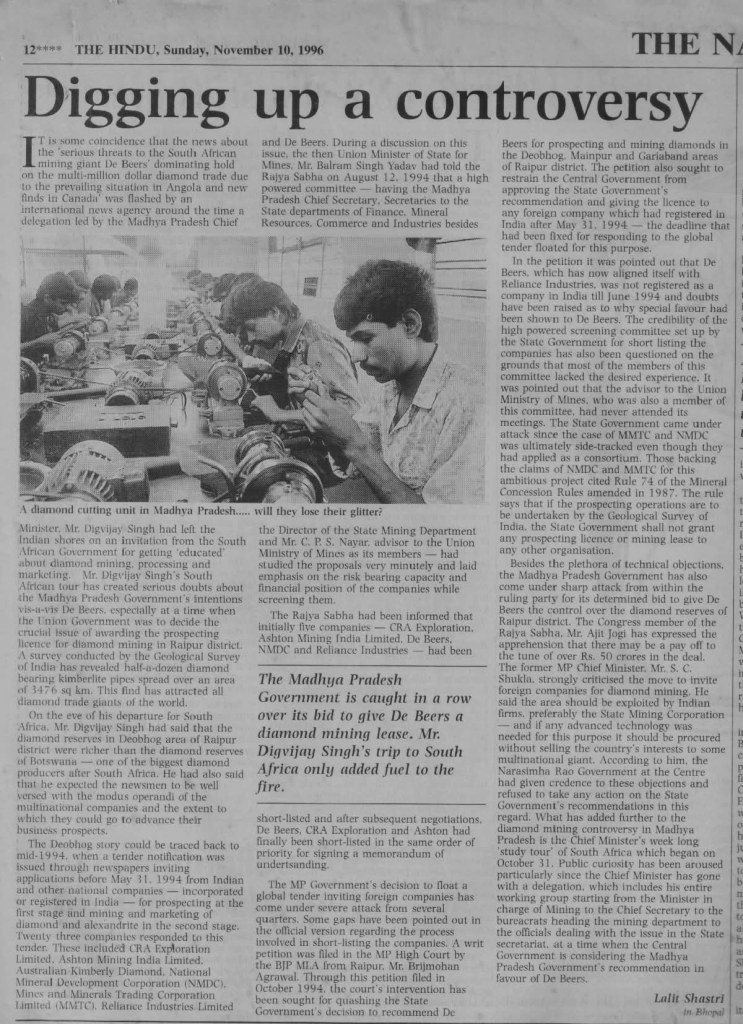
The issue was investigated extensively by Lalit Shastri, then Madhya Pradesh Bureau Chief of The Hindu. His Sunday article published on November 10, 1996, under the headline “Digging up a controversy”, brought together a series of questions that had until then remained largely confined to government files and official deliberations.
The report revealed that the controversy could be traced back to 1994, when the Madhya Pradesh Government floated a tender inviting applications for prospecting for diamonds and alexandrite. Twenty-three companies responded. Among them were major Indian and international mining interests, including CRA Exploration, Ashton Mining India, De Beers, NMDC, MMTC and Reliance Industries.
The Government’s decision to invite foreign companies into the race immediately attracted opposition.
The issue was particularly sensitive because the proposed exploration area was enormous. The geological survey had identified diamond-bearing kimberlite formations spread over thousands of square kilometres. What appeared on paper as a search for diamonds therefore carried the potential of opening up an extensive landscape to exploration, extraction, infrastructure and associated mining activity.
And journalism began asking the questions that mattered.
Why was the State Government pushing for a foreign mining company? Had the process of short-listing the bidders been sufficiently transparent? Why had a powerful screening committee itself become the subject of questions? Had the Centre adequately examined the implications of handing a strategically valuable mineral resource to a multinational corporation?
The investigation also exposed the political dimensions of the proposal.
Then Chief Minister Digvijay Singh’s visit to South Africa, at the invitation of the South African Government, during which he was briefed about diamond mining and processing, had intensified questions surrounding the State Government’s intentions. The article noted that the Chief Minister had spoken of the diamond reserves of Raipur district being richer than those of Botswana, one of the world’s major diamond-producing countries.
The language of the controversy was revealing. This was not being treated as an ordinary mining concession. The Government itself was dealing with a resource that could potentially transform the economic and physical character of the region.
By August 1994, according to the report, a high-powered committee had been constituted, while officials from Finance, Resources, Commerce and Industries and senior mining officials examined the competing proposals. The companies were eventually short-listed, with De Beers, CRA Exploration and Ashton Mining emerging as the leading contenders.
But by then the issue had moved beyond the Government’s control.
A writ petition was filed before the Madhya Pradesh High Court challenging the Government’s decision to recommend De Beers. The petition sought to restrain the Central Government from granting the company a licence for prospecting and mining diamonds in the Deobhog, Mainpur and Gariaband areas.
The challenge was not merely about procedure. It went to the heart of the question of who should control India’s natural resources and under what conditions.
The opposition pointed out that De Beers had aligned itself with Reliance Industries and had not even been registered in India by the stipulated deadline. Questions were also raised about the composition and experience of the State screening committee and about the manner in which the recommendations had been arrived at.
There was another crucial dimension.
The State Government was itself facing criticism from within the political establishment. Congress Rajya Sabha member Ajit Jogi had questioned the proposal and alleged that there was a payoff involved in the deal. Another Congress member, S.C. Shukla, strongly opposed inviting a foreign company to undertake diamond mining and argued that the resource should preferably be exploited by an Indian entity, such as the State Mining Corporation.
The controversy had therefore acquired several layers – environmental, economic, political, administrative and strategic.
And at its centre was journalism.
Shastri’s reporting did something that official proceedings alone could not do: it brought the buried details of a complicated mineral concession into the public domain and connected the individual decisions into a larger story about the ownership and protection of natural resources.
That sustained scrutiny mattered.
The proposed De Beers venture did not ultimately become the massive mining operation that its scale had threatened to create in the diamond-bearing landscape of undivided Madhya Pradesh.
The episode is therefore worth remembering today, particularly when the country is once again debating the balance between mineral extraction, economic development and environmental protection.
The geography itself has changed since 1996. Undivided Madhya Pradesh has given way to Madhya Pradesh and Chhattisgarh, and the areas referred to in the old reports now fall largely within Chhattisgarh. But the fundamental question remains unchanged: when an ecologically sensitive landscape contains a valuable mineral resource, who speaks for the generations that will inherit that landscape after the mineral has been extracted?
In 1996, there was no social media, no digital investigative ecosystem and no instant public reaction to a government decision. A determined journalist had to obtain information, examine government documents, follow official meetings, speak to political and administrative sources, understand geological reports and then put the entire story before the public.
That is precisely why the De Beers episode deserves to be remembered.
It is also why old newspaper archives matter.
The yellowing page of The Hindu from November 10, 1996, is more than an old newspaper clipping. It is a record of a moment when journalism intervened in a contest over India’s natural wealth – and when sustained public scrutiny helped prevent an ecologically sensitive landscape from becoming another frontier for multinational mining.
The diamonds remained underground.
And perhaps that is the most important part of the story.
By Lalit Shastri
Journalism is often judged by the stories it breaks. It should also be judged by the disasters it helps prevent.
The De Beers episode is one such story. It reminds us that the work of a journalist does not end when a report is published. Sometimes its real value lies in forcing institutions to pause, reconsider and act in the larger public interest.
Nearly three decades later, the lesson is as relevant as ever: natural resources belong not merely to the generation that discovers their commercial value, but to generations yet unborn. Journalism has a responsibility to speak for them.
