
Lalit Shastri
Who appointed the Mayor of New York as the ideological gatekeeper for Indians?
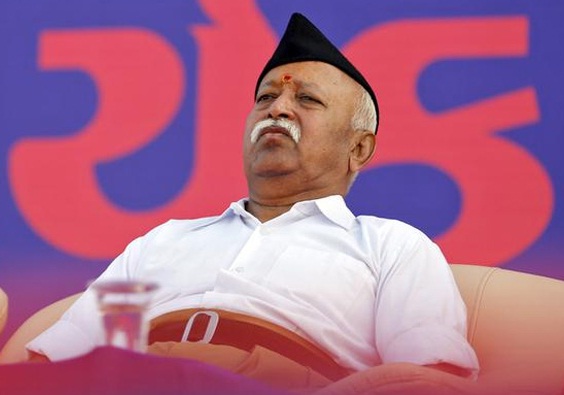
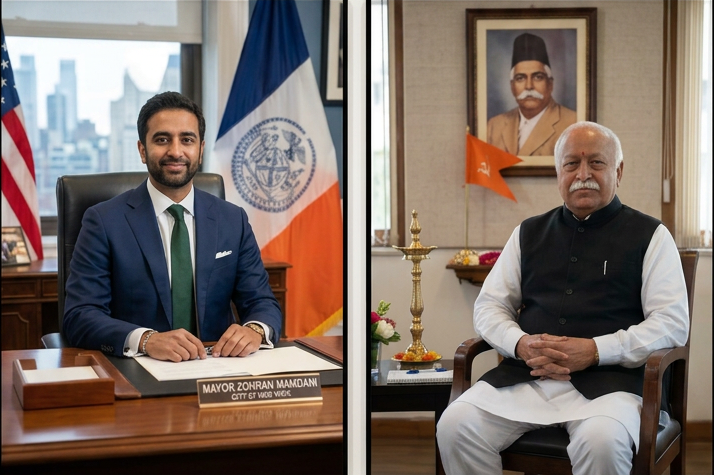
New York Mayor Zohran Mamdani has made it clear that he does not approve of RSS chief Mohan Bhagwat addressing an event in New York. There is, however, something rather strange about the Mayor of New York publicly passing judgment on an Indian organisation and an Indian ideological movement, particularly when he does so in the name of “pluralism”.
Mamdani says the India he grew up knowing was a pluralistic and secular republic in which everybody belonged, and he has expressed concern over the rise of what he describes as an “exclusionary” movement.
But having chosen to enter this Indian ideological debate so publicly, Mamdani’s own political record and positions inevitably become open to scrutiny as well. His positions on Israel and Palestine, and particularly the questions surrounding his stand on Hamas, have been the subject of intense political criticism. Hamas is today led by Khalil al-Hayya, a known hardliner who was named the overall leader of Hamas and chairman of its Political Bureau in July 2026. Reuters has reported that al-Hayya is regarded as more hardline than his principal rival, Khaled Meshaal, and that his elevation could signal a tougher Hamas position on disarmament and armed struggle.
Now consider the organisation that Mamdani has chosen to single out. The Rashtriya Swayamsevak Sangh is a pan-India social and cultural organisation with a vast network of volunteers and decades of committed social and community activity. Given its massive following, organisational strength, ideology, political influence and relationship with the BJP, it is hardly surprising that the RSS faces determined opposition across India from the Congress and its alliance partners. The debate over the RSS, its ideology and its political influence is fundamentally an Indian democratic debate. Yet the Mayor of New York has chosen not merely to express an opinion about the RSS, but to publicly oppose an event at which its chief is scheduled to speak.
The event itself has been presented by its organisers as the “Universal Oneness Celebration”, while the RSS has described it as a multicultural and interfaith gathering. In response to Mamdani’s opposition, the organisation has invited everyone interested in understanding its worldview to attend. An organisation that the Mayor has accused of being “exclusionary” is effectively saying: come, listen, understand and decide for yourself. And the Mayor? He has already decided. Perhaps that is Mamdani’s idea of pluralism. But pluralism cannot mean that a politician first determines which ideology is acceptable and then permits only what he considers an acceptable version of diversity to occupy public space. Genuine pluralism means allowing people to hear arguments with which they may even disagree. The RSS does not require the Mayor of New York’s approval to speak, and Indian Americans certainly do not require his permission to listen.
What makes the episode even more revealing is the reaction in India. Instead of asking why an American mayor is inserting himself into an Indian ideological controversy, sections of the Congress leadership have welcomed or echoed Mamdani’s position against Bhagwat and the RSS. That raises a very simple question: why does an Indian political party need the Mayor of New York to make its argument against an Indian organisation? Congress has always opposed the RSS and has repeatedly taken political positions against the Sangh Parivar. It continues to oppose Hindutva, with Rahul Gandhi leading much of that political attack from the front. Opposition parties within the INDI Alliance have also openly pursued positions that critics see as hostile to Sanatan Dharma and have repeatedly attacked India’s cultural and spiritual legacy. In September 2023, DMK leader Udhayanidhi Stalin went so far as to call for Sanatan Dharma to be “eradicated”, comparing it with social diseases. There was no significant protest from Congress against that statement. It was only later, in 2026, that the DMK left the INDI Alliance after Congress joined forces with actor Vijay’s TVK to form the government in Tamil Nadu.
If Congress wants to defeat the RSS politically, it will have to do so in India, through arguments, votes and public debate. It hardly needs an American mayor as ideological reinforcement.
And then the real contradiction appears. Consider what happened when Donald Trump called the Indian economy a “dead economy”. Rahul Gandhi did not tell Trump to mind his own business. He did not object to an American president passing judgment on India. He embraced the statement. “Yes, he is right,” Rahul Gandhi said, adding, “I am glad that President Trump has stated a fact.” Gandhi went on to repeat the “dead economy” description and blamed the Modi government for allegedly destroying the Indian economy.
An American politician commenting on India, therefore, apparently did not constitute a problem when the comment suited Rahul Gandhi’s political argument. But when Trump subsequently said something favourable about the Election Commission of India, the tone changed. And when Mamdani attacked the RSS, Congress leaders were suddenly happy to welcome an American politician’s intervention in an Indian ideological debate.
This is where the issue stops being merely about Mamdani and becomes a question of principle. When did foreign interference become objectionable only when the foreigner says something Congress does not like? When Trump says India’s economy is “dead”, Rahul Gandhi says, “Yes, he is right.” When an American mayor attacks the RSS, Congress finds common ground with him. But when the American president says something positive about India and its electoral system, the lecture about sovereignty and minding one’s own business suddenly returns. That is not consistency. It is political convenience.
The question Congress cannot escape is therefore straightforward. If an American politician is entitled to pronounce upon an Indian organisation because he claims to be defending pluralism, why was Rahul Gandhi so eager to endorse an American politician’s devastating judgment on India’s economy? If foreign politicians should stay out of India’s affairs, why is Mamdani’s intervention being welcomed? If foreign politicians are entitled to comment on India, why was Trump’s favourable comment treated differently? Which is it, Congress? Is foreign intervention wrong, or is it wrong only when the foreigner says something you dislike?
And that brings us back to Mamdani. The issue is not whether Mamdani likes the RSS. The issue is the extraordinary confidence with which a foreign mayor has chosen to pronounce upon the ideological legitimacy of an Indian organisation in an Indian-American community. Mamdani says he is defending pluralism. But pluralism is not the political privilege to decide which Indians represent an acceptable India. The RSS will be judged by Indians. The BJP will be judged by Indians. Congress will be judged by Indians. Mohan Bhagwat will be judged by those who listen to him. That is democracy. That is pluralism. It is not a mayor deciding who should be heard.
Mamdani can oppose Bhagwat. Congress can oppose Bhagwat. Anyone can oppose Bhagwat. But neither an American mayor nor an Indian political party gets to turn opposition into a veto over somebody else’s right to speak. And perhaps the most revealing fact is that Mamdani himself admits that he does not know whether New York City has any jurisdiction to cancel the private event. If that is so, perhaps the answer is remarkably simple: the event should not be cancelled, silenced or gatekept. Let Bhagwat speak, let his critics speak, let people listen, and let people decide. Because the moment “pluralism” becomes a licence to determine whose ideas deserve a microphone, the word itself loses its meaning.
And the final irony belongs to Congress. It cannot demand that foreign politicians “mind their own business” when they praise India and then cheer when a foreign politician attacks an Indian organisation it dislikes.
You cannot have two rules –
Foreign interference when it washes away your politics; enlightenment when it hurts your political opponent
Yes — parts of that response can be editorialised into a postscript, but I would not reproduce the contact’s wording wholesale. The strongest factual material is actually narrower and more defensible.
The Mahmoud Khalil episode is usable. Mamdani publicly opposed Khalil’s deportation and framed the case as a First Amendment/free-speech issue; the NYC mayor’s own office records that position. Khalil had been accused by the US government of supporting Hamas, while reporting also documents his affiliation with Columbia University Apartheid Divest, a coalition that had endorsed the October 7 attack and supported designated terrorist organisations. However, Khalil himself has denied supporting attacks on civilians. (nyc.gov)
The father allegation needs much greater care. Mahmood Mamdani did write that suicide bombers should be understood as a category of soldier and argued that suicide bombing should be analysed as a form of modern political violence rather than simply dismissed as barbarism. But a scholar interviewed by Forbes specifically cautioned that the book analyses rather than advocates suicide bombing. So saying “Mamdani’s father supported suicide bombers” would go beyond the evidence. (forbes.com)
And I would absolutely drop “The Democrats support Islamists to further their socialist agenda while the Islamists support them to advance their jihadi agenda.” That’s an enormous causal assertion about millions of people and two political movements, and it isn’t necessary to strengthen your article. It would turn a sharply argued postscript into an easily attacked partisan generalisation.
The factual material can instead produce a rather good postscript that extends your existing argument:
Postscript
There is another episode worth recalling before the debate over Mamdani’s version of pluralism is closed. When Mahmoud Khalil, the Columbia University activist whom the US government sought to deport over allegations connected to Hamas and his political activism, faced deportation proceedings, Mamdani came out strongly in defence of his right to remain in the United States and characterised the case as an attack on constitutional rights and free expression. Mamdani later hosted Khalil and his family for an iftar at Gracie Mansion.
There is also a relevant part of Mamdani’s family and intellectual background that has attracted scrutiny. His father, Columbia professor Mahmood Mamdani, wrote in his 2004 book Good Muslim, Bad Muslim that suicide bombers should be understood as a category of soldier and that suicide bombing should be examined as a form of modern political violence rather than simply dismissed as barbarism.
