

Lalit Shastri
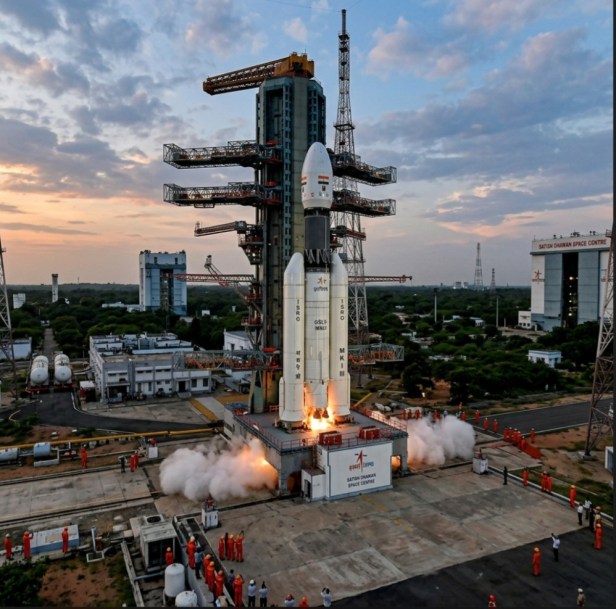
India’s space programme has reached a curious crossroads. The government wants a much larger private-sector presence in space, and there is little argument that Indian industry should play a greater role. But the proposal to progressively move ISRO out of launch-vehicle and routine satellite production raises a more fundamental question: is India expanding its space ecosystem, or is it beginning to dilute capabilities that took ISRO decades to build?
Private industry in India has not invested in special alloys and formulations like maraging steel, aircraft grade aluminium, radiation hardened chips, advanced electro optics etc. Even the small advances were made by ISRO developing such technologies by supporting PSUs like Mishra Dhatu Nigam Limited (MIDHANI) and by investing in R and D in critical areas like electro-optics and transferring them to the industry. Today liquid propellants like n2o4 (Dinitrogen tetroxide), storable liquid oxidizer used in rocket propulsion, or Unsymmetrical dimethylhydrazine (UDMH), a high-performance, storable liquid rocket fuel that spontaneously ignites upon contact with an oxidizer like dinitrogen tetroxide, and solid rocket motors are made with technology developed and indeginised by ISRO and transferred to industry. One spin off has been the missile technology in which the private sector is very much involved. A Skyroot also did not reinvent a wheel and many in the Electronics Manufacturing Services (EMS) industry owe their establishment and success to ISRO.
Given the nascent space industry, ISRO invested in machinery in the industry work centers, hand held them and even gave them free issue materials to make the industry stand on its legs. Today the defence and aerospace Eco system and “Atmanirbhar Bharat’ is reaping it’s benefits
The question is no longer theoretical. IN-SPACe Chairman Pawan Kumar Goenka has said that ISRO will no longer manufacture launch vehicles and that the work will be taken up by the private sector or PSUs. The stated objective is to allow ISRO to concentrate on research, advanced technologies, scientific missions and infrastructure.
Former ISRO chairman G. Madhavan Nair has now questioned the viability of that approach. His central point is striking: Indian industry is already deeply embedded in ISRO’s launch-vehicle production. Nair has pointed out that industry handles much of the manufacturing, while ISRO continues to undertake the critical functions of final assembly, integration, testing and launch.
That raises a simple question: if private industry is already manufacturing most of the hardware, what exactly is gained by moving the remaining critical functions away from ISRO?
Private participation is not the problem
There is a tendency to treat any questioning of the privatisation push as opposition to private enterprise. That is a false choice. India needs a strong private space industry. It needs entrepreneurs, capital, new technologies, competition and commercial applications. The question is not whether private industry should grow. The question is what additional capability it should bring to the national space programme.
There is a fundamental difference between building a new capability and taking over a capability painstakingly developed by a public institution. India’s space programme has evolved through a long partnership with industry. Private companies already manufacture a large proportion of the components and systems used by ISRO.
ISRO itself has long described industry as integral to the space programme’s development.
Nair’s latest intervention reinforces that history. If industry is already performing much of the manufacturing, then the argument that ISRO must withdraw from manufacturing simply to “enable” industry becomes less convincing. The industry is already enabled. The real issue is the remaining layer of responsibility.
The critical last mile
Manufacturing a component is not the same as integrating an entire launch vehicle. A launch vehicle is a system in which thousands of components and subsystems have to function together under extraordinarily demanding conditions. Final assembly, integration, testing, mission assurance and launch are not merely another set of manufacturing activities. They represent the point at which responsibility for the entire system converges. ISRO has been performing these functions with a demonstrated record of reliability.
That distinction matters enormously. If private industry already makes most of the components, then the question is not why it should be allowed into launch-vehicle production. It is already there. The question is why the critical functions that remain with ISRO should also be transferred.
Nair has also questioned the economics of creating an industrial establishment capable of replicating the full range of ISRO’s capabilities. He has argued that the investment required would be enormous, while the more attractive commercial opportunity may lie in space applications and services rather than simply reproducing existing launch-vehicle capabilities.
If private capital is limited, why should it be directed towards duplicating a capability India already possesses? Why not direct that capital towards capabilities India does not yet possess?
What should private capital actually create?
This is where the Indian debate needs greater intellectual honesty. The country’s space startups deserve encouragement. But the ecosystem is also being built on a platform created by public investment – policy reform, regulatory facilitation, access to government infrastructure, technology transfers, launch facilities and public support.
There is nothing unusual about this. Space programmes everywhere have required government support. But there should also be an expectation in return. If ISRO is asked to withdraw from established launch platforms and production and concentrate on research and advanced technology, why should the private sector not be expected to invest substantially in basic and translational research itself?
Why should the IITs not be encouraged – and challenged – to take up serious space research? Why should India’s major industrial groups not commit significant resources to propulsion, advanced materials, reusable launch systems, electronics, artificial intelligence and other technologies that will determine the next generation of space capability? If the private sector wants the commercial opportunity created by India’s public investment, it should also be expected to create new technological capital for India. That would be genuine participation.
Look at the international experience
The argument that a strong private space sector requires the national space agency to withdraw from core capabilities is not borne out by the experience of other major space powers. Europe’s Ariane programme has developed through a close relationship between governments, the European Space Agency and major industrial groups. ArianeGroup itself is owned by Airbus and Safran. The model is not one in which government simply disappears once private industry arrives.
The American experience is even more instructive. SpaceX is undeniably a private company, but its development has occurred within a substantial government-private ecosystem, including NASA contracts and public institutional support. The lesson is not that India should copy either model. The lesson is that private participation and strong national space institutions are not mutually exclusive. The successful model is partnership.
Why disturb an institution that works?
This is perhaps the most uncomfortable question in the present debate. ISRO is one of the relatively few Indian institutions that has achieved sustained global credibility while operating with comparatively modest resources. Its achievements in launch vehicles, satellites, planetary exploration, remote sensing and space applications are a matter of national record.
ISRO did not need to be persuaded that industry should participate. It has been working with industry for decades. Nair has recalled that nearly 60 per cent of ISRO’s budget historically went to industry for sourcing systems and components. His point is therefore not that industry was excluded from the space programme. It was already an integral part of it.
So what precise problem is being solved by removing ISRO from functions it has performed successfully? That question has not received a sufficiently persuasive public answer.
A policy change ISRO did not ask for
The decision to open India’s space sector and the decision to reduce ISRO’s operational role are not necessarily the same decision. The 2020 reform opened the door to private participation across the space value chain. That was a policy choice designed to unlock untapped industrial capability.
But opening the door does not necessarily require the institution standing behind it to move out. There is a difference between saying, “Let private industry do more,” and saying, “Let ISRO do less.” The first can strengthen the ecosystem. The second needs much stronger justification. That distinction lies at the heart of the present debate.
The PSU question cannot be brushed aside
There is another question that deserves a straightforward answer. If launch-vehicle production is to be transferred from ISRO, why should the alternatives be limited to a particular category of private enterprise when the policy itself says the work can also go to PSUs? And where a specific facility or operational function is opened to private participation, what is the policy rationale for excluding capable public-sector enterprises?
If the objective is efficiency, capability and reliability, the test should be competence, not ownership label. A PSU that can demonstrate the required capability should be able to compete with a private company. Similarly, a private company that can demonstrate superior capability should be allowed to compete with a PSU. That would be genuine competition.
The technology question is different from the production question
The debate also needs to distinguish between technology transfer and technological capability. ISRO has developed technologies through decades of publicly funded research. NSIL was created to commercialise ISRO’s technologies and services. IN-SPACe was created primarily to promote, enable, authorise and supervise non-governmental space activities.
Former ISRO chairman Madhavan Nair has argued that ISRO, NSIL and industrialisation should remain under one roof with unity of direction and command, while NSIL could form joint ventures with interested companies rather than simply transferring ISRO-developed technologies.
That is an important distinction. A joint venture can allow private capital to participate while retaining an institutional stake in the technology and its future development. An outright transfer can produce a very different outcome. The question therefore should not be whether technology must reach industry. It should be how it reaches industry, on what terms, with what safeguards and with what continuing benefit to the national space programme.
What happens when the regulator becomes too close to the operator?
This is where the institutional concerns raised in the earlier ThisisNews investigation remain relevant. IN-SPACe was created as a regulator and facilitator for non-governmental space activity. If the regulatory institution begins taking decisions that determine who gets access to ISRO-developed technologies, public infrastructure or operational capabilities, the distinction between regulation, commercialisation and execution requires careful scrutiny.
Nair has made precisely this broader argument in relation to IN-SPACe, saying that the regulator should not go beyond its mandate by calling bids for ISRO technologies and assets.
The issue is not whether private companies should receive access. They should. The issue is who decides, under what authority, and with what institutional accountability. That is why the absence of a comprehensive Space Act becomes increasingly important.
The political debate has now arrived
What began largely as an institutional and policy debate has now entered mainstream politics. On August 24, Congress general secretary Jairam Ramesh accused the government of pursuing an “aggressive privatisation agenda” for the space programme and questioned the rationale for limiting ISRO’s role while promoting private startups. He alleged that ISRO’s role in rocket development and manufacture would be severely limited and that satellite-related assets could be transferred to private companies. He also raised questions about the proposed second spaceport in Tamil Nadu.
These are political allegations and should be treated as such. They do not by themselves establish that the government’s policy will weaken ISRO. But the timing is significant. A former ISRO chairman has now questioned the viability and logic of transferring established capabilities. An opposition party has raised concerns about the consequences for ISRO. And television news has begun devoting prime-time attention and panel discussion to the issue. The debate is no longer confined to space-sector insiders.
The question the government must answer
The government has a legitimate case for private participation. It should make that case. But it should also answer some equally legitimate questions. If ISRO works, what precisely is the problem that requires it to withdraw? If industry already manufactures most of the components, what additional capability is created by transferring the remaining critical functions? If private companies are capable of taking over these activities, how much of their own capital will they invest in creating new technologies rather than commercialising technologies developed through public expenditure?
If ISRO is to concentrate on research, who else is going to fund and perform basic research at the scale required? Why should IITs, major industrial houses and private research institutions not be expected to share that responsibility? And if PSUs are considered capable participants, why should ownership determine access to particular opportunities?
These are not questions against reform. They are questions about whether the reform is designed to build capability or merely redistribute existing capability.
Don’t confuse commercialisation with national capability
There is a deeper danger in equating the success of a private space company with the technological strength of the national space programme. A company can be commercially successful without possessing the entire ecosystem required for national space sovereignty. A national space programme must retain capabilities even when they are commercially unattractive but strategically essential.
It must retain people who know how systems fit together. It must retain testing and integration expertise. It must retain institutional memory. It must retain the ability to respond when something goes wrong. And it must retain the ability to develop the next generation of technology rather than merely operate the current generation.
Once such capabilities are dispersed, rebuilding them may be far more expensive than preserving them. Nair’s earlier argument that ISRO, NSIL and industrialisation should remain under one roof with unity of direction and command is relevant here. His suggestion that NSIL could form joint ventures with interested companies rather than simply transferring technologies offers a model in which industry can gain commercially while the national space programme retains an institutional stake.
That is a very different proposition from simply asking ISRO to step aside.
The opportunity is much bigger than launch vehicles
There is an irony in the present debate. The greatest commercial opportunity for Indian space companies may not lie in reproducing what ISRO has already mastered. It may lie downstream – in satellite applications, Earth observation, communications, navigation, data services, climate intelligence, agriculture, disaster management, logistics and thousands of other applications.
Nair has argued that applications offer a much larger global economic opportunity than hardware manufacturing alone.
That is precisely where a much larger private ecosystem can emerge without requiring ISRO to surrender the capabilities it has built. Imagine an ecosystem in which ISRO continues pushing the scientific and technological frontier; NSIL commercialises mature technologies and forms joint ventures; private companies develop new launch systems and compete globally; PSUs participate where they can provide scale and reliability; IITs and private institutions undertake basic research; and all of them share infrastructure and markets. That would not be a retreat from privatisation. It would be a more intelligent form of it.
Fine-tune the reform, don’t hollow out ISRO
India’s 2020 space-sector reform was intended to unlock enormous untapped potential. There is no reason to reverse it. But reform should be judged by whether it increases India’s total space capability, not simply by how much activity is transferred from government to private hands.
The success of a private company should count as an addition to India’s space capability. It should not automatically count as a reason to subtract capability from ISRO. The country can have both. Indeed, it needs both.
The right question is therefore not public sector or private sector. It is what each should contribute that the other cannot. If private industry brings capital, innovation, speed and new markets, let it flourish. If ISRO brings decades of scientific knowledge, mission experience, integration capability, infrastructure and strategic technological depth, preserve and strengthen those assets. If IITs bring research capability, give them a larger role. If PSUs can bring scale and reliability, let them compete. And if major industrial groups want a larger role in India’s space future, let them put substantial capital into the research that will create tomorrow’s technologies.
That is how a national ecosystem becomes stronger. India should not be asking how quickly it can move functions away from ISRO. It should be asking how quickly it can build enough new capability around ISRO that the national space programme becomes larger, deeper and more powerful than it is today.
ISRO has already shown the world what India can achieve. The challenge now is not to replace that achievement with a different ownership label. The challenge is to make India’s private sector capable of matching it – and then taking the country further. That is what genuine space-sector reform should mean.
