
Lalit Shastri
The Saudi-Pakistan-Turkiye defence pact may look formidable on paper. But its real test will come when the interests of the three partners collide—and nowhere is that contradiction more apparent than in the India-Pakistan equation.
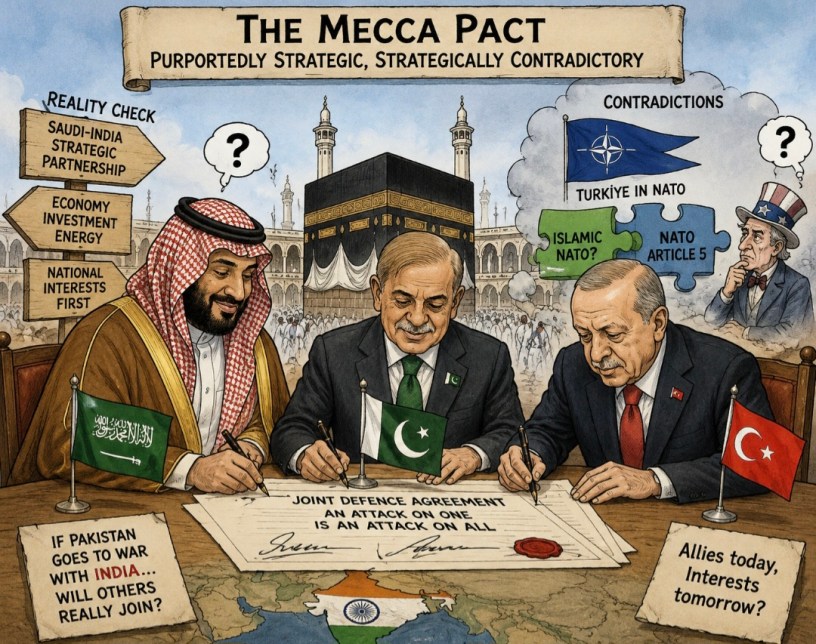
The signing of the Mecca Joint Defence Agreement by Saudi Arabia, Pakistan and Turkiye has understandably generated speculation about the emergence of an “Islamic NATO”.
That description, however, may be more dramatic than the reality.
The agreement signed in Mecca on August 7 declares that an armed attack against any one of the three countries will be regarded as an attack against all. It undoubtedly sends a strong political and strategic signal. But alliances are ultimately tested not by the language of their founding documents, but by what their members are prepared to do when their individual national interests collide.
And that is precisely where the Mecca Pact begins to look purportedly strategic, but strategically contradictory.
Will Saudi Arabia really go to war for Pakistan?
The most obvious question concerns Saudi Arabia. If India and Pakistan were to go to war, would Riyadh actually enter the conflict on Pakistan’s side? The answer is far from self-evident.
Saudi Arabia has certainly deepened its defence relationship with Pakistan. But Riyadh has simultaneously developed a substantial strategic, economic and political relationship with India. Saudi Arabia has no obvious interest in allowing its relationship with Pakistan to destroy its expanding relationship with one of the world’s largest economies.
This is where the distinction between a defence pact and an automatic military commitment becomes important.
If India were to go to war with Pakistan, Riyadh could well find itself caught between the political language of the Mecca agreement and the realities of Saudi national interest.
My assessment is that Saudi Arabia would be extremely reluctant to enter a direct military confrontation with India merely because Pakistan invoked the pact.
The real strength of the Mecca agreement, therefore, may lie more in deterrence and political signalling than in an automatic commitment to wage war.
The Turkiye contradiction
The Turkiye dimension makes the arrangement still more complicated. Turkiye is a NATO member. This has encouraged some commentary to suggest that the Mecca Pact could somehow acquire the backing of the wider NATO alliance.
That is a considerable leap.
NATO’s Article 5 does establish the principle that an armed attack on one member is considered an attack on all. But it does not prescribe an automatic military response of identical form by every member. Each Ally determines what action it considers necessary. NATO itself also points out that Article 5 operates within the geographical framework of the North Atlantic Treaty.
More importantly, NATO is a collective-defence alliance. It is not a mechanism through which one member can enter an unrelated conflict of its choosing and automatically summon the rest of the Alliance to fight that war.
So the equation is not as simple as: The neat equation – Pakistan drawing in Turkiye, Turkiye drawing in NATO, and NATO drawing in Europe against India – simply does not withstand geopolitical scrutiny. The reality is considerably more complicated.
Turkiye may be in India’s sights
India, meanwhile, is hardly sitting back waiting to discover what the Mecca Pact means. Ankara is clearly on New Delhi’s strategic radar.
India’s growing defence relationship with Greece and Cyprus acquires an important dimension in this context. An Indian Council of World Affairs analysis published last month explicitly identifies the management of the Turkey-Pakistan defence relationship among the shared strategic interests encouraging India, Greece and Cyprus to deepen cooperation. It describes the Eastern Mediterranean as an increasingly important arena for India’s strategic engagement.
This is significant because it moves India beyond the idea of merely “recalibrating” its relations with Turkiye. India is quietly developing a strategic counterweight on Turkiye’s western flank.
But New Delhi’s response goes much further than Greece and Cyprus. India’s relationship with Europe has been expanding across several fronts. The India-UK Free Trade Agreement entered into force on July 15, 2026, creating a deeper economic relationship with Britain.
At the India-EU level, New Delhi and Brussels adopted a Comprehensive Strategic Agenda in January 2026, reinforcing the relationship across political, economic, security and defence domains.
And the bilateral relationships with key European powers are acquiring still greater strategic depth.
India and France upgraded their relationship to a Special Global Strategic Partnership in February 2026.
In May, India and Italy elevated their relationship to a Special Strategic Partnership, accompanied by an India-Italy Defence Industrial Roadmap.
These developments matter when viewed against the Turkiye-Pakistan alignment.
India is not constructing an anti-Turkiye alliance in Europe. Nor does it need to.
It is doing something considerably more sophisticated: building enough strategic depth across Europe to ensure that Turkiye’s growing military alignment with Pakistan does not translate into a wider European alignment against India.
Turkiye is NATO. But NATO is not Turkiye.
This distinction needs to be kept firmly in mind. Turkiye may be a NATO member, but NATO is not Turkiye—and Europe is not Turkiye. European countries have their own national interests, their own economic relationships with India and their own assessments of the strategic balance.
Would Europe contemplate an offensive war against India because Turkiye chose to support Pakistan? That proposition stretches strategic credibility. India is not a NATO adversary. Nor is there any obvious European strategic interest in opening a military confrontation with India, a country with which major European powers are simultaneously expanding trade, defence, technology and diplomatic cooperation.
Indeed, Britain’s new free trade agreement with India, the strengthening of the India-EU strategic relationship and the elevation of India’s partnerships with France and Italy point in the opposite direction. Europe’s relationship with India is becoming deeper, not more distant.
The alliance’s biggest weakness is also its biggest strength
The three members of the Mecca Pact have genuine reasons for coming together. Saudi Arabia wants greater strategic autonomy and stronger security arrangements. Pakistan wants military and diplomatic backing, strategic depth and stronger defence partnerships. Turkiye wants to expand its influence across the Muslim world while strengthening its position as a major defence-industrial power. Their interests overlap. But they are not identical.
Saudi Arabia’s principal security concerns are rooted in the Gulf and West Asia. Pakistan’s overriding strategic concern remains India. Turkiye’s ambitions extend across West Asia, the Caucasus, Central Asia and the wider Muslim world, while its NATO membership simultaneously anchors it in a Western security architecture. The three countries therefore do not face one common enemy. Nor do they necessarily share one common definition of aggression. That distinction could become decisive in a crisis.
India should neither panic nor underestimate the pact
New Delhi should not dismiss the Mecca agreement.
Closer Saudi-Pakistani-Turkish defence cooperation could have real consequences for India’s security environment, particularly through Pakistan’s access to Turkish military technology and Ankara’s increasingly explicit political support for Islamabad.
But neither should India fall into the trap of treating the three countries as an indivisible military bloc. India’s response should be strategic composure combined with strategic preparation. The country is already deepening its relationships with Europe, strengthening its defence-industrial partnerships, expanding its economic engagement and building new strategic connections in the Eastern Mediterranean.
This gives India options. It also gives India something more valuable than a counter-alliance: strategic room for manoeuvre.
The Mecca Pact may prove useful as a deterrent arrangement for its three members. But its real test will come when the interests of those members diverge. If India and Pakistan were ever to go to war, the question would not simply be whether the pact says “an attack on one is an attack on all”. The real question would be:
Who would actually be willing to fight?
And that is where the carefully crafted appearance of an “Islamic NATO” could collide with the messy realities of geopolitics. The Mecca Pact is purportedly strategic. But strategically, it is full of contradictions.
