
Dr. G. Shreekumar Menon
India faces a severe shortage of medical education capacity, characterized by extreme competition where over 22 to 24 million students register annually for the National Eligibility-cum-Entrance Test (NEET-UG) competing for roughly 137,000 total undergraduate MBBS seats. Around 2.2 to 2.4 million candidates take the NEET-UG exam each year, but fewer than 5% manage to secure an MBBS seat.
The National Medical Commission (NMC) notes a total of approximately 137,000 MBBS seats across more than 800 medical colleges nationwide, with government options making up roughly 52,000 of those spots. Government medical seats are affordable, but private college MBBS tuition can range from ₹80 lakhs to ₹1.5 crore or more. The bottleneck continues past graduation, as postgraduate (PG) medical training seats are roughly half the number of available undergraduate training slots.
The above is a very piquant situation for the nation and for medical education aspirants. The Central government has expanded MBBS seats in government medical colleges, but the real challenge is ensuring expert faculty, good infrastructure and quality education. Though the number of MBBS seats has more than doubled, rising from around 51,000 in 2013-14 to over 1.18 lakh by 2024-25, and the number of medical colleges has also grown significantly, the phenomenal demand for medical education is without any parallel, elsewhere in the world. Between 2020-21 and 2024-25 alone, though undergraduate medical seats increased by nearly 39%, yet it is unable to cater to the demand. Since an MBBS programme spans five and a half years, including a compulsory internship, the impact of the current seat expansion on the healthcare workforce will only be seen after a decade.
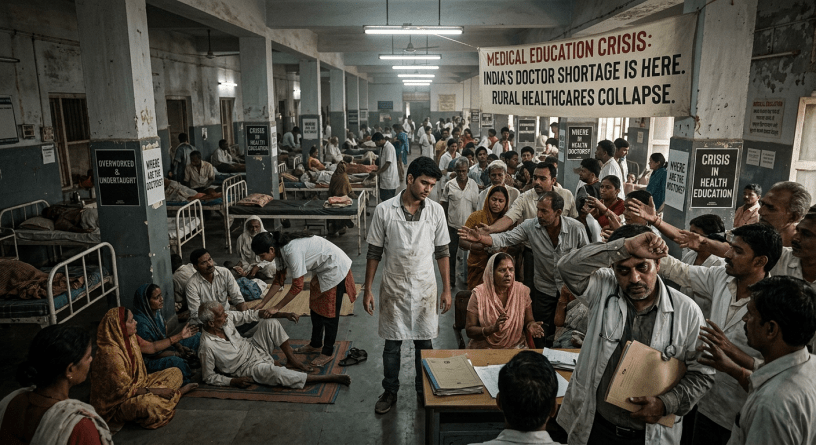
Expansion of capacity due to heavy pressure to cater to the demand, can adversely impact the quality of medical education. Most government medical colleges in India grapple with poor infrastructure, severe staff shortages, and heavy patient crowding.
Recent surveys show that up to 89% of medical institutions face basic setup deficiencies, affecting student learning and patient care. Nearly nine in ten medical colleges report poor infrastructure alongside issues of overwork and inadequate mental health support among medical staff, as per findings in a nationwide survey conducted by the Federation of All India Medical Association (FAIMA). The study, conducted across major institutions including AIIMS, PGIMER and JIPMER, collected over 2,000 responses, of which 90.4 per cent were from government colleges and 7.8 per cent from private ones. The survey has revealed alarming deficiencies in India’s medical education system. According to the FAIMA-Review Medical System (FAIMA-RMS) survey, 89.4 per cent of colleges cited poor infrastructure, 73.9 per cent of residents reported excessive clerical duties, and 40.8 per cent described their work environment as toxic.
The acute shortage of medical seats in India, has compelled students to explore overseas opportunities.
Studying medicine overseas is a highly viable alternative to Indian private colleges. Medical colleges in Russia, China, Germany, Kazakhstan, Kyrgyzstan, Georgia, Philippines, offer medical programs at reasonably affordable rates. Programs in USA, UK and Canada are very expensive, time consuming and rigorous, hence not attractive. Upon return, graduates are required to clear the Foreign Medical Graduate Examination (FMGE) or the upcoming National Exit Test (NExT) to obtain a medical license in India.
India today faces dual challenges: (1) It needs to improve its health services, and (2) simultaneously, develop high tech interventional/curative medical services both for its own people and also for its international programmes such as medical tourism and drug trials. The former needs health workers, not necessarily physicians, but the latter needs highly skilled physicians and physician-scientists. Much of present day impasse can be reasonably tackled if the requirement of medical doctors, especially in rural areas, is addressed. Shortage of medical doctors is a universal problem, and it will be enlightening to know how other developed countries addresses this issue.
Healthcare professionals known as “nurse doctors” are formally called Nurse Practitioners (NPs) or Advanced Practice Registered Nurses (APNs). Nearly 70 countries globally have implemented these advanced roles where nurses perform medical tasks like diagnosing and prescribing, led by nations such as the United States, Canada, and Australia.
In USA certain categories of nurses can treat patients, but their specific treatment powers depend on their exact license level. Registered Nurses (RNs) provide direct clinical care and carry out medical plans, while Advanced Practice Registered Nurses (APRNs) like Nurse Practitioners (NPs) can independently diagnose conditions and prescribe medications. Nurse practitioners are advanced practice registered nurses (APRNs) who have undergone extensive training to treat their own patients. A nurse practitioner (NP) is a blend between a clinician and a nurse. They can examine, diagnose, and treat their own patients, and in some states, they can also write and dispense prescriptions. Nurse practitioners (NPs) are at the highest level of nursing. They often work in physician’s offices, and some states even allow them to open their own practices. Education and certification separate NPs and RNs. A nurse practitioner is a nurse who has completed at least a master’s degree and passed an exam from an NP certifying board. They should have also completed additional training in their nurse practitioner area of specialty, such as family healthcare or paediatrics.
Registered nurses must hold an associate’s or bachelor’s degree and pass the NCLEX-RN exam. Nurse practitioners can assume greater responsibilities than RNs, including making diagnoses, prescribing medications, and ordering lab work and diagnostics tests. In addition, while RNs treat patients of physicians, NPs can have their own patients and an RN supporting them.
The United Kingdom, Ireland, Finland, the Netherlands, Norway, Sweden, Denmark, Cyprus, Estonia, France, Poland, and Spain have established laws allowing advanced clinical assessment and nurse prescribing. Switzerland recognizes regional advanced practice structures (such as in Canton Vaud).
In Asia, countries including Singapore, South Korea, Thailand, and Indonesia have adopted or are expanding formal advanced practice nursing roles within their healthcare frameworks.
India does not have the institution of nurse practitioners due to strong medical opposition. State nursing councils and national laws do not give nurses the legal right to prescribe modern medicine independently. But India needs to adopt sensible practices being followed in many countries across the world. Nurses with ten years of experience, are as good as any MBBS/MD doctor, due to their intense hospital experience and strong familiarity with modern medicines and practices. The country can effectively tide over the current shortage of medical doctors by simply empowering senior nurses to make diagnoses, prescribe medications, and order lab and diagnostics tests.
The International Council of Nurses (ICN) emphasizes that Nurse Practitioners roles are shaped by local contexts and regulatory frameworks, resulting in diverse interpretations and applications across healthcare systems. Globally, Nurse Practitioners are increasingly recognized as key contributors to healthcare delivery, particularly in addressing provider shortages, expanding access to care, and improving patient outcomes. While the scope of practice, educational requirements, and professional autonomy vary significantly across countries, the overall trend indicates a growing reliance on Nurse Practitioners to lead clinical innovation, support integrated care models, and respond to evolving population health needs. The World Health Organization (WHO) emphasizes the vital role of Advanced Practice Nurses (APNs) in achieving Universal Health Coverage, particularly in underserved regions.
Unlocking the potential of utilizing Nurses to augment the shortage of medical doctors, is a cheaper and quicker option for India, rather than straining resources to open new medical colleges and increasing medical seats (which are already brimming to capacity).
Today, many Americans use Nurse Practitioners (NPs) for much of their health care needs and NPs are now fully accepted by both health care consumers and most other care providers as a critical component of a modern health care system. If India adopts this concept, it will be a game changer in the health care sector.
The author Dr G Shreekumar Menon, IRS (Rtd) Ph. D (Narcotics), is Former Director General National Academy of Customs Indirect Taxes and Narcotics, and Multi-Disciplinary School of Economic Intelligence IndiaFellow, James Martin Centre for Non-Proliferation Studies, USA.Fellow, Centre for International Trade & Security, University of Georgia, USA Public Administration, Maxwell School of Public Administration, Syracuse University, U.S.A.AOTS Scholar, Japan
Dr G Shreekumar Menon can be contacted at shreemenon48@gmail.com
