
ThisisNews Network
Jabalpur/Bhopal: In a landmark judgment with far-reaching implications for civil liberties, the High Court of Madhya Pradesh has awarded compensation of ₹10 lakh to Ajay Singh, who was jailed for 57 days in a narcotics case triggered by a faulty airport explosive trace detector (ETD) indication that later turned out to be completely baseless.
The judgment, delivered by Justice Deepak Khot in Writ Petition No.17529/2011, strongly criticised the failure of State forensic infrastructure and held the State vicariously liable for violation of the petitioner’s fundamental right to personal liberty under Article 21 of the Constitution.
Senior Advocate Ajay Gupta, appearing for the petitioner along with advocate Rajeev Mishra, played a pivotal role in securing the relief after a prolonged legal battle spanning nearly 15 years. Gupta forcefully argued that the petitioner had suffered incarceration, humiliation and reputational damage solely because of defective investigative mechanisms and inadequate scientific infrastructure.
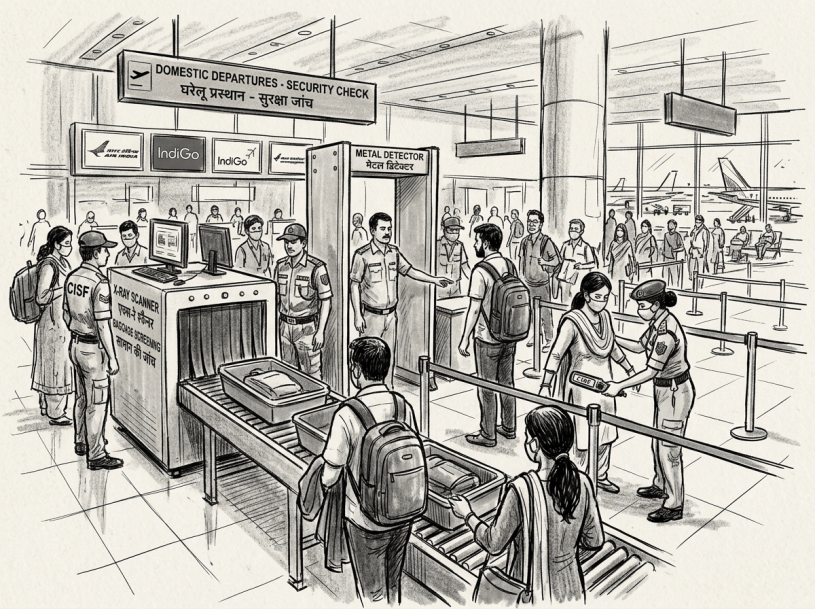
The case dates back to May 2010, when Ajay Singh was detained at Bhopal airport while travelling to Delhi en route to Malaysia. During security screening, ETD machines allegedly detected traces of heroin and MDEA in packets of branded aamchur and garam masala powder being carried by him. Based on the machine-generated suspicion, Singh was arrested under the NDPS Act and remained in judicial custody for 57 days.
However, subsequent forensic examination by the Central Forensic Science Laboratory, Hyderabad, conclusively found that the seized substances contained no contraband whatsoever. The prosecution later filed a closure report, and the petitioner was released.
During the hearing, Senior Advocate Ajay Gupta argued that the ETD machines used at airports were merely indicative devices and could not form the sole basis for depriving a citizen of liberty. He also highlighted that the Regional Forensic Science Laboratory in Bhopal lacked the capability to test the alleged substance, causing massive delay and resulting in prolonged incarceration of an innocent man.
The High Court accepted the substance of these arguments and observed that although the initial suspicion may have justified inquiry, the State machinery failed in promptly verifying the allegations through scientific means. The Court noted that the mobile forensic unit was “useless” in the case and the RFSL lacked the equipment and expertise necessary for examination of the seized material.
In a significant observation, the Court held:
“Because of the lethargy and not having the standard laboratories in the State of M.P., the petitioner had to suffer incarceration for 57 days.”
The Court further ruled that the ETD machine manufacturer and the Airport Authority of India could not be directly blamed because the machines were only designed to provide indicative alerts, not conclusive evidence. The real failure, the Court held, lay in the State’s inability to rapidly conduct proper scientific examination.
Relying extensively on the Supreme Court’s landmark rulings in D.K. Basu v. State of West Bengal and other compensation jurisprudence, the High Court reaffirmed that monetary compensation is an appropriate constitutional remedy for unlawful deprivation of liberty.
Apart from awarding compensation, the Court also issued sweeping directions to the State Government. The Chief Secretary of Madhya Pradesh has been directed to inspect all Regional Forensic Science Laboratories within one month and ensure deployment of modern equipment and qualified personnel to prevent recurrence of such incidents.
Legal observers say the judgment could become an important precedent in cases involving wrongful prosecution, defective forensic systems and constitutional accountability of the State.
The ruling is also being viewed as a strong reminder that technological suspicion without scientific corroboration cannot override the constitutional guarantee of personal liberty.
