
ThisisNews Network

I’ve Walked the Less Travelled Roads
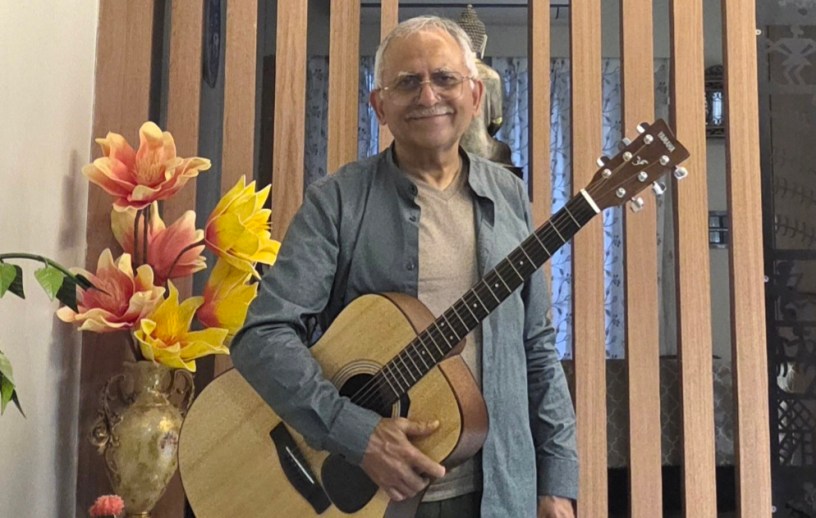
Songwriter, Singer, and Guitarist – Lalit Shastri
I’ve walked the less travelled roads
Chasing paths no one else chose
Through silent nights and broken dreams
I found my way through fading pastsThrough forests deep and mountains high
Under stormy winds and restless skies
I lost myself, then learned to fly
And found the strength I held insideI’ve walked through fire, I’ve felt the scars
I’ve carried wounds that shaped my heart
But every fall, every bend
Brought me closer to the endNow I see the light ahead
No more fear and no more dread
Every road that made me bend
Led me back to life againIf I break, I’ll rise once more
Stronger than I was before
Every shadow, every fight
Turned my darkness into light
In an age dominated by algorithm-driven music, overproduced hooks, and disposable lyrics, a quietly emerging song recorded on a smartphone in the solitude of morning hours carries an unexpected emotional force.
“I’ve Walked…” is not merely a song. It is a lived narrative.
Written and performed by veteran journalist and storyteller Lalit Shastri, the composition belongs unmistakably to the bardic tradition — where music is not manufactured for trends, but shaped from memory, struggle, introspection, and emotional truth.
There is something deeply human about the song’s conception itself. No glittering studio. No engineered perfection. No synthetic emotionality. Just a man, a guitar, accumulated years of observation, and emotions finally finding melody.
For over four decades, Lalit Shastri has chronicled politics, power, injustice, human suffering, social contradictions, and the fragile resilience of ordinary lives through journalism. But somewhere between deadlines and datelines, another voice appears to have quietly evolved within him — the voice of a bard.
That evolution becomes visible in “I’ve Walked…”
The song carries the emotional fatigue of someone who has travelled through life’s storms without surrendering tenderness. It does not seek sympathy. It seeks recognition — the kind that comes when listeners hear their own silent battles reflected back at them.
Unlike contemporary songwriting that often announces emotion loudly, this composition appears to trust restraint. The pauses matter as much as the lines. The silences seem inhabited. The emotional texture emerges not through dramatic vocal acrobatics, but through sincerity. And perhaps that is where the song’s greatest strength lies.
The bardic genre thrives on authenticity — on the feeling that the singer is not performing a role but narrating fragments of a real inner journey. In “I’ve Walked…”, the emotional landscape feels personal yet universal. The song seems to belong equally to the solitary traveller, the wounded idealist, the ageing dreamer, the survivor of emotional ruins, and the human being still searching for light after darkness.
There is also an old-world honesty in the creative process itself.
The first rough recording was reportedly done on a smartphone — not as a commercial exercise, but as an emotional release. Ironically, that rawness may ultimately become the song’s defining aesthetic strength. Some songs lose their soul under excessive polishing. This one appears born to breathe through imperfections.

What makes the composition especially moving is the convergence of Lalit Shastri’s multiple identities – the journalist who witnessed society’s fractures, the poet shaped by emotional observation, the late-blooming guitarist discovering music with childlike sincerity, and the reflective human being attempting to transform lived experience into healing narrative.
That layered life experience gives the song emotional gravity.
One senses that the composition is still evolving — not mechanically, but organically. Each rendition may reshape the emotional intensity of the narrative. That is often the hallmark of true bardic music: it remains alive.
It is about a man discovering that after a lifetime of reporting the world, he still carried an unwritten song within himself.
For listeners exhausted by superficiality, “I’ve Walked…” may feel less like a performance and more like someone sitting beside them and quietly saying:
“I understand the road you have travelled.”
And perhaps that is what bardic music has always done through centuries:
transform private wounds into collective healing.
What makes this artistic emergence especially moving is that Lalit Shastri has embraced this deeply personal musical journey at the age of seventy.
At a stage in life when many people quietly surrender their unrealised dreams to memory, he has chosen instead to begin anew — with a guitar in hand, a smartphone recording, and emotions accumulated over a lifetime finally finding voice through melody.
There is no trace of artificial reinvention here. No attempt to imitate youth. No desperation for relevance.
Instead, there is something profoundly human:
a man who spent decades reporting the world now turning inward to narrate the emotional landscapes within himself.
That is what gives “I’ve Walked…” its quiet power.
The song reminds us that creativity does not belong to age. Nor does vulnerability. Nor the need to express love, pain, longing, hope, fatigue, or healing.
Some songs are written early in life. Others wait patiently for seventy years.
In the end, “I’ve Walked…” is not merely about melody or lyrics. It is about a man discovering that after a lifetime of witnessing history, conflict, relationships, silence, and survival, he still carried an unwritten song within himself.
And now, finally, he has begun to sing it.
