
By Dr. G. Shreekumar Menon
Hindu society is facing a leadership crisis. We are making a mistake when we look to political leaders for Hindu society rejuvenation, and also for uplifting the priestly class. Political leaders and political parties are working for the general population, which includes many other religions, both indigenous and foreign. So it is unwise to look towards political leaders to sort out the innumerable problems facing Hindu society.
The Absence of Dedicated Religious Leadership
We only need to look at the two foreign religions operating in India – Islam and Christianity. They have two distinct kinds of leadership – one for spearheading their political goals and another for protecting and enlarging their religious ambitions. For achieving political goals, they nurture political parties, like the Muslim League, All India Majlis-e-Ittehadul Muslimeen (AIMIM), and Kerala Congress. The Hindu community does not have such pure dedicated political parties to take care of only their interests. The Hindus are always looking towards general political parties to champion their interests, which cannot yield satisfactory results. What the Hindus should plan for like the two foreign religions is a two-pronged set up – one to safeguard their political interests and another to safeguard their religious interests.
Presently, the BJP is championing the political interests of the Hindu community but there is a leadership vacuum on the religious front. This is the reason why Hindus keep looking towards political parties to solve problems like protection from religious conversion, multiple types of Jihads directed against them, Temple liberation from government control, anti-Hindu dress codes in private companies and neglect of Sanskrit language. We Hindus need a strong transformational religious leadership like those prevailing in Churches and Mosques.
Comparing Institutional Strengths
The Church leadership is a strong cementing force for the Christian community, leveraging them into a solid vote bank that dictates to political parties. The Mosque leadership is a powerful entity that controls their political outfits. Hindus just don’t have a powerful religious leadership that can dictate to political parties. A few scattered Hindu Gurus, Swamis and Ammas, are busy accumulating wealth, but will not utter one word to protect Hindu interests. This is because they are strongly focussed only on wealth generation and accumulation.
The Need to Rejuvenate the Priestly Class
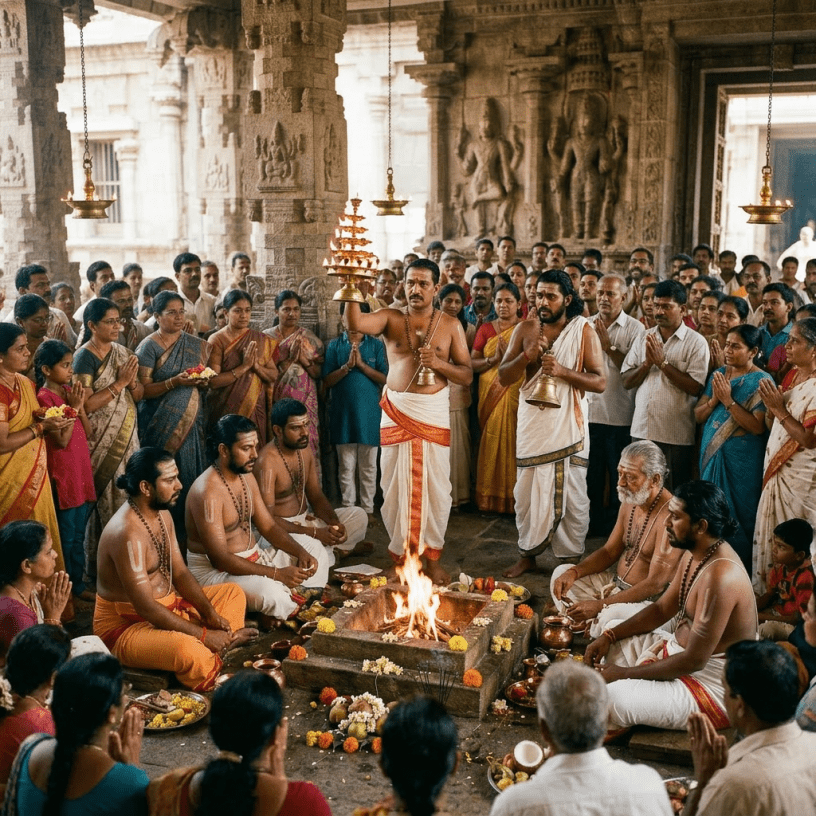
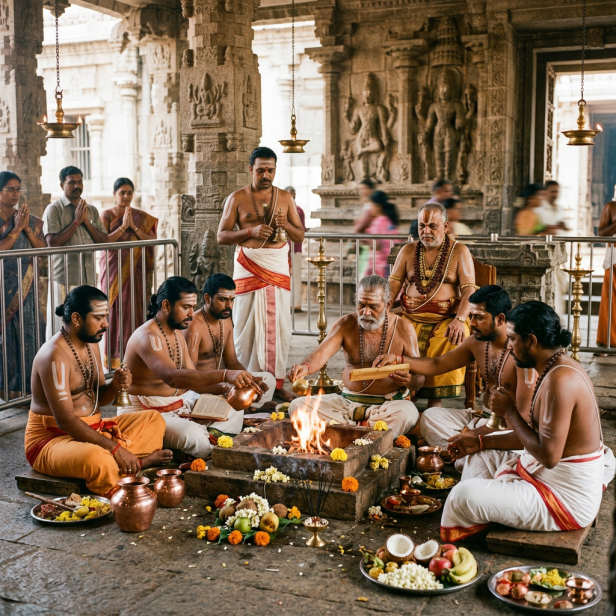
To overcome this religious leadership vacuum, Hindus need to concentrate on building a strong, enlightened, and politically aware priestly community. The Hindu priestly class has to be rejuvenated for this purpose. Presently, the priests in Temples have been downgraded into being just traders in Temple Prasad, merely collecting some small money from devotees wanting some Temple Prasad. In big Temples, the priests make fabulous sums of money, but have become money-minded and selfish. In view of this, the priestly class has diminished in importance and credibility in Hindu society and among the political classes. The Hindu priestly class needs to be rejuvenated and built up like the Church and Mosque leaders.
Proposed Roadmap for Strengthening Hindu Religious Leadership
For this, Hindu organizations need to work in the following direction:
1. Establish Dedicated Theological Institutions
Set up at least one theological school, college and university in every State to groom Hindu religious leaders-cum-priests.
2. Expand the Curriculum Beyond Religious Texts
The syllabus should include, apart from religious texts, grooming in public speaking, motivation, public relations, effective communication, ethics, morality and Temple management.
3. Encourage Specialized Traditional Knowledge
Specialization should include proficiency in select Vedic scriptures, Sanskrit language, Hindu Temple arts and sciences, music, Ayurveda and Astrology.
4. Introduce Discipline-Oriented Training
The theological schools should be modelled on the lines of Sainik Schools, to impart military discipline and leadership.
5. Revive Indigenous Martial Traditions
Skill in traditional Hindu martial arts like Kalaripayattu, Silambam, Gatka, Thang-Ta and Musti Yuddha should also be imparted.
6. Cultural and Temple Arts Training for Women
Women students should additionally get trained in Hindu Temple dances.
7. Develop Counselling Capabilities
All students should be given training to be efficient counsellors to handle marital issues, drug and alcoholism, stress and health issues.
8. Groom Future Political and Social Leaders
All students should be trained in political leadership, including a combination of strategic vision, high-level communication, emotional intelligence and unwavering integrity. Key skills should include decisive action, fostering public trust through authenticity, navigating complex conflicts and building strong stakeholder coalitions.
9. Focus on Intelligence and Community Awareness
Intelligence gathering techniques to detect conversions to foreign religions, and steps to counter multiple types of Jihads, also need to be taught.
10. Reinforce Ethical and Human Values
Other qualities to be developed include humility, compassion, integrity, courage and cooperation.
Leveraging Existing Infrastructure
For implementation of the above, existing Hindu institutions can make available space in their facilities. Utilizing existing educational infrastructure, leveraging current physical buildings, laboratories and digital systems to launch new educational programs for uplift of priests, attracting new entrants without the high costs of new construction, needs to be explored in right earnest.
For immediate implementation, virtual and blended learning techniques can be adopted. Institutions can utilize existing IT infrastructure — computers and internet connectivity — to introduce blended learning, which combines face-to-face instruction with online courses, reducing the need for new physical classrooms.
A Call for Deliberation and Reform
All Hindu organizations need to deliberate about ways and means to rejuvenate the existing priestly class, attract fresh talent from various Hindu communities to the priestly profession, and build a class of religious leaders that can handle the complex challenges emerging in democracies due to the hyperactivity in religious conversions being thrust upon the country by foreign funds.
