
Lalit Shastri
Two Maps, Two Mindsets
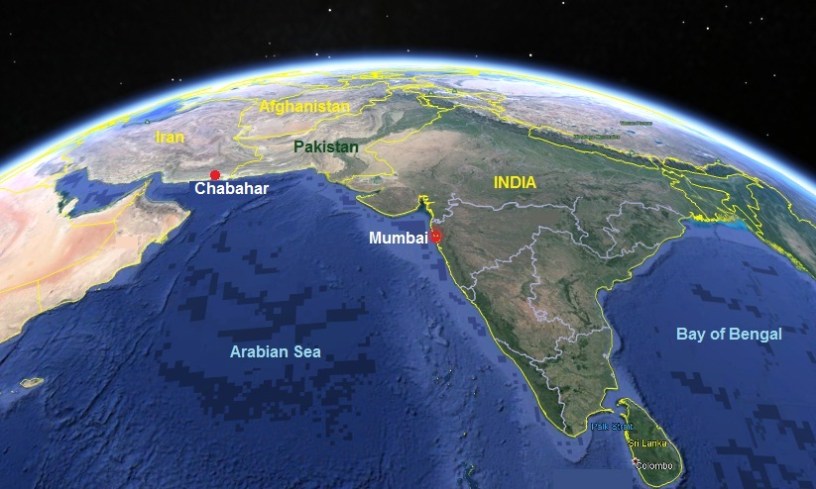
Across the same geography, two sharply divergent strategic imaginations are unfolding. One seeks to convert geography into leverage through rapid alignment and expansive infrastructure. The other treats geography with caution, calibrating every move against risk, pressure, and long-term sustainability. The contrast between Pakistan’s Gwadar-centric approach and India’s Chabahar-led strategy is not merely about ports or trade routes—it is about doctrine, credibility, and the ability to sustain power in a volatile world.
“Strategy is not what you build—it is what you choose to depend on.”
Pakistan: Ambition Without Anchor
Pakistan’s doctrine is built on ambition accelerated by external alignment. Through the China-Pakistan Economic Corridor and the development of Gwadar Port, Islamabad has positioned itself as a potential transit hub linking regions, markets, and energy flows. On the surface, this is a bold and forward-looking vision.
But beneath that ambition lies a structural contradiction. Pakistan seeks to draw heavily from Chinese investment while maintaining a functional—if uneasy—relationship with the United States, even as it keeps channels open with Iran in ways that increasingly test the limits of American sanctions policy. This is not balance in the classical sense; it is a continuous act of tactical adjustment.
“Hedging without clarity does not create flexibility—it creates doubt.”
Over time, this pattern has shaped a perception that is difficult to ignore. For Washington, Pakistan often appears cooperative only when compelled. For Beijing, despite deep financial stakes, the concerns are more operational—security risks, delays, and uneven delivery. Gwadar, envisioned as a flagship, now reflects this deeper problem: ambition unaccompanied by consistent execution.
India: Restraint With Purpose
India’s doctrine stands in contrast—not because it lacks ambition, but because it disciplines it. New Delhi stayed out of Gwadar entirely and instead developed Chabahar Port as an alternative corridor into Afghanistan and Central Asia. Yet even here, India has refused to overextend. It has not exited Chabahar, but it has consciously limited its exposure in response to sanctions pressure and shifting geopolitical realities.
This is not hesitation—it is strategic design.
“India’s doctrine is not to avoid corridors—but to avoid becoming captive to them.”
By completing commitments without escalating risk, India has preserved its most valuable asset: flexibility. It remains engaged, but not entangled; present, but not dependent.
Connectivity Without Credibility
The divergence becomes sharper when viewed through the lens of connectivity. Pakistan has prioritised speed—building corridors quickly in the expectation that infrastructure will generate momentum and economic gravity. India has prioritised control—ensuring that connectivity aligns with broader geopolitical realities before scaling up.
The consequence is telling. Gwadar is physically impressive but operationally uncertain, constrained by inconsistent connectivity and fragile supporting ecosystems. Chabahar is slower, more measured, but insulated from sudden shocks.
“Connectivity creates opportunity—but only credibility sustains it.”
The Security Faultline
No doctrine can escape the realities of the ground. In Balochistan, insurgent groups such as the Balochistan Liberation Army have repeatedly targeted infrastructure linked to Gwadar and the wider corridor network. These are not isolated incidents; they are part of a sustained challenge to state control and economic projects in the region.
For Pakistan, this introduces a persistent layer of unpredictability into its grand strategy. For investors and partners alike, the question is no longer about potential—but about reliability.
India’s challenge in Chabahar is different, shaped by sanctions rather than insurgency. Yet the response again reveals doctrinal clarity. Where Pakistan pushes forward despite volatility, India pauses, recalibrates, and reduces exposure.
“Risk in strategy is inevitable. The question is whether you manage it—or ignore it.”
Between Power and Pressure
The broader geopolitical context further exposes the limits of Pakistan’s approach. Gwadar sits at the intersection of Chinese strategic expansion and American strategic suspicion. Any role it plays in facilitating flows that dilute sanctions risks placing Pakistan directly in the crosshairs of competing power centres.
India, by contrast, has maintained a careful equilibrium. Its engagement with Iran through Chabahar is balanced against its wider strategic convergence with the United States, ensuring that participation does not escalate into provocation.
“The difference between leverage and liability lies in how you position yourself between power centres.”
Doctrine and the Question of Trust
What ultimately separates the two approaches is not infrastructure or even ambition—it is credibility. Pakistan’s doctrine, shaped by overlapping alignments and shifting postures, creates the impression of a state seeking advantage in every direction without committing firmly in any. Whether engaging with the United States, deepening dependence on China, or navigating proximity to Iran, Islamabad increasingly appears as a variable—useful in moments, but difficult to rely on over time.
“In geopolitics, the problem is not choosing sides—it is being trusted by none.”
India’s approach, slower and less dramatic, projects a different signal. By staying out of Gwadar Port and limiting its exposure even in Chabahar Port, it has emphasised consistency over opportunism. In doing so, it reinforces a principle often overlooked in grand strategy: credibility is not built through scale, but through steadiness.
To Sum Up
Pakistan may possess geography, infrastructure, and external backing, but it struggles with the one asset that ultimately determines strategic success—trust. And without trust, no corridor, however ambitious, can become a reliable conduit of power.
