
Lalit Shastri
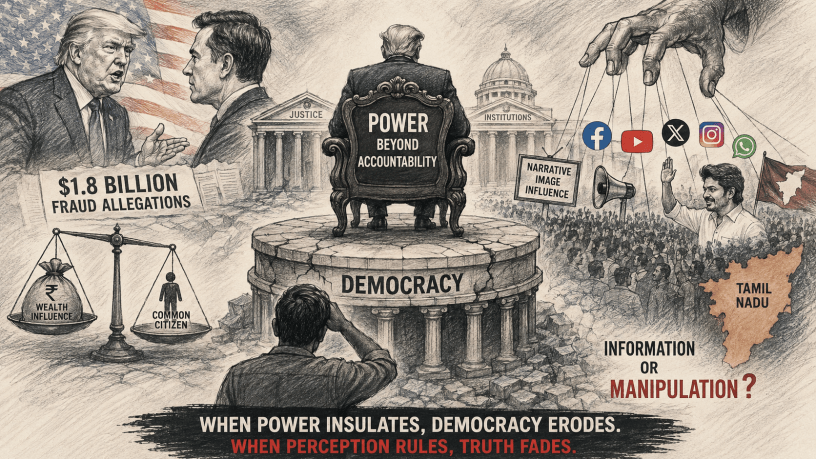
The viral exchange involving U.S. Senator Patty Murray aggressively questioning acting U.S. Attorney General Todd Blanche over the staggering President Trump linked $1.8 billion fraud allegations has once again brought to the surface an uncomfortable truth that citizens across the world silently carry within them: power has increasingly become synonymous with insulation from consequences.
Whether in Washington, Moscow, Delhi, Beijing, Islamabad, London, or countless smaller political theatres across the globe, the pattern is disturbingly familiar. Systems rooted in constitutions, democratic ideals, judicial traditions, and institutional accountability often appear formidable on paper — yet strangely fragile when confronted by entrenched power, political patronage, corporate influence, or money.
The only thing that changes from country to country is the scale of the numbers involved.
The common citizen watches. Reads. Reacts. For a few moments, social media erupts. Prime-time debates rage. Experts dissect. Political camps weaponise outrage selectively. Then life resumes. The powerful remain powerful.
The helplessness is universal.
The modern citizen has perhaps never been more informed, yet never felt more powerless.
Across democracies, investigative agencies are accused alternately of being too weak or selectively weaponised. Courts are either glorified as saviours or condemned as delayed theatres of procedural exhaustion. Political parties condemn corruption in opposition and rationalise it in power. Corporations speak the language of ethics while mastering the art of regulatory navigation. Public morality itself has become deeply transactional.
This is not merely about one politician, one business empire, one country, or one ideological camp. It is about a larger crisis of credibility.
The frightening reality is that public outrage no longer necessarily translates into public consequence.
In earlier decades, exposure itself carried moral weight. Today, scandal often becomes content. The news cycle monetises outrage before replacing it with fresh outrage within hours. Citizens consume corruption almost as a form of entertainment fatigue. Repetition has numbed democratic sensitivity.
The erosion is psychological before it becomes institutional.
And therein lies the real danger.
When ordinary people gradually begin believing that “nothing changes anyway,” democracy itself starts hollowing from within. Participation weakens. Faith declines. Cynicism becomes wisdom. Silence becomes survival.
That silence is visible everywhere.
The farmer battling local bureaucracy, the middle-class taxpayer trapped between inflation and compliance burdens, the honest officer sidelined for refusing compromise, the journalist facing pressure for working to ensure accountability and transparency, the entrepreneur crushed by selective enforcement, and the young citizen watching privilege consistently overpower principle — all experience versions of the same silent disillusionment.
Power structures survive not merely because they are strong, but because public exhaustion becomes stronger.
Ironically, every political system still invokes “the people” as its ultimate source of legitimacy. Yet the people themselves often remain spectators to decisions that shape their economic futures, freedoms, legal vulnerabilities, and social realities.
The spectacle of accountability has become more visible than accountability itself.
Televised hearings, leaked documents, dramatic raids, parliamentary uproars, courtroom battles, and endless digital commentary create an illusion of institutional action. But citizens increasingly ask a more fundamental question: how much truly changes for those at the very top?
This growing gap between public expectation and visible consequence is creating a dangerous democratic vacuum worldwide.
The phenomenon, however, is no longer confined merely to corruption or concentration of power. Increasingly, public opinion itself is being manufactured, redirected, and emotionally engineered. Electoral outcomes are now shaped as much by digital influence ecosystems, celebrity culture, algorithmic amplification, perception management, and narrative warfare as by traditional political ideology or governance performance.
The recent rise of actor-politician Vijay and the overwhelming electoral success of his party in the Tamil Nadu Assembly elections illustrates this changing democratic landscape. Notwithstanding the fact that silver screen icons have historically dictated Tamil Nadu politics — from the towering influence of M.G. Ramachandran and J. Jayalalithaa to the enduring intersection of cinema and political mobilisation in the state — it still needs to be underscored that Tamil Nadu has traditionally prided itself on political awareness, high literacy, strong social indicators, industrial growth, and a deeply evolved electoral consciousness.
Yet even in such a politically mature state, modern influence machinery — combining celebrity appeal, emotional connect, digital mobilisation, media projection, aspirational branding, influencer ecosystems, and algorithm-driven narrative building — appears increasingly capable of reshaping voter behaviour at scale.
This is neither an endorsement nor a criticism of any individual leader. Rather, it underlines a deeper transformation in democratic politics itself.
The voter today is no longer influenced only by manifestos, ideological debates, economic policy, or governance track records. Public perception is now continuously curated through social media ecosystems, influencers, carefully crafted narratives, targeted messaging, visual symbolism, emotional storytelling, and relentless digital engagement. Politics has entered the age of psychological communication.
The concern is not that people are making democratic choices. The concern is whether those choices are being shaped through informed political understanding or through sophisticated perception engineering capable of bypassing rational scrutiny altogether.
History repeatedly shows that societies do not collapse merely because of corruption. They weaken when citizens lose faith that correction is possible through legitimate systems.
That is the crossroads many democracies appear to be approaching today.
The challenge before modern societies is therefore not merely legal or political. It is moral, technological, and civilizational. Can institutions remain genuinely independent when power, wealth, media, and digital influence become deeply intertwined? Can democratic societies preserve informed citizenship in an age where algorithms increasingly shape public thinking? Can media remain fearless when survival itself depends upon political and corporate ecosystems? Can citizens continue believing in constitutional promises when accountability appears selective and perception often overrides reality?
These are no longer abstract philosophical questions.
They define the future stability of democratic societies.
The tragedy is that ordinary citizens still carry the emotional burden of systems they no longer fully trust. They continue paying taxes, obeying laws, voting periodically, and hoping against experience that somewhere, somehow, truth and fairness will prevail.
Hope survives — but increasingly with fatigue.
And perhaps that is the most dangerous stage any democracy can reach: not anger, not protest, but quiet resignation.
Because once citizens stop believing their voice matters, power stops fearing the people altogether.
Closer home in India, the situation remains equally delicate, though held together by civilizational resilience and institutional continuity. Our political structure survives through a constantly negotiated balance among caste equations, religious identities, regional aspirations, linguistic diversities, economic interests, and countless social pressure groups. A strong and independent Army has remained one of the most critical stabilising pillars protecting this democratic framework from external aggression and internal fracture. Otherwise, history reminds us that deeply divided societies often become vulnerable to overpowering external or internal forces. India itself witnessed successive waves of invasions, political domination, and civilizational upheavals over the last millennium — first under several Muslim dynasties and later under British colonial rule — each reshaping the subcontinent’s political, cultural, and social structures in many ways. Simultaneously, India too confronts the erosion of social values, weakening community life, and the fading harmony between human existence and nature that once formed the essence of its civilizational ethos. The culture of tolerance and coexistence propagated through Sanatan philosophy and texts now stands challenged by aggressive consumerism, technological overstimulation, ideological polarisation, and increasingly unchecked baser instincts, often untempered by philosophical restraint or moral introspection. Humanity today appears to stand at the edge of self-destruction — materially advanced, digitally hyper-connected, yet spiritually unsettled. And yet, history also teaches that periods of deep churn sometimes produce new equilibrium. One can only hope that from the present disorder may eventually emerge a wiser, more balanced, and more humane order.
