
Lalit Shastri
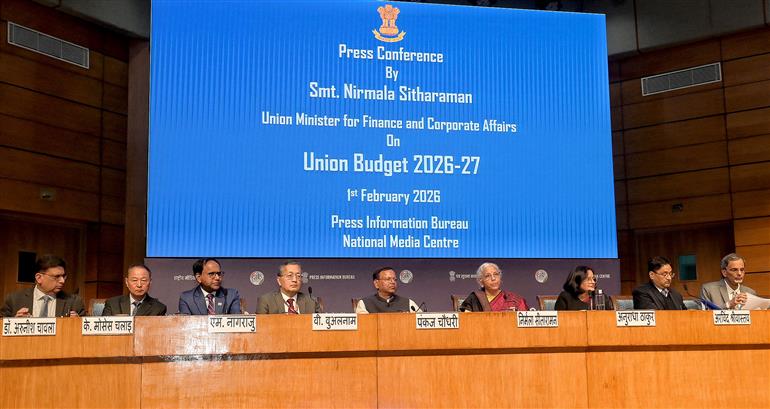
India’s Union Budget for 2026–27 presents itself as a forward-looking policy document, anchored in long-term national capability building rather than short-term political optics. The government has framed the Budget around a clear strategic narrative—industrial transformation, human-capital renewal and inclusive growth—while projecting fiscal discipline and continuity of public investment.
At the macro level, the message is stability with ambition. The continued push on capital expenditure and a calibrated fiscal consolidation path underline the government’s confidence that public investment must remain the primary growth engine in a world of slowing global demand and geopolitical uncertainty. The emphasis is unmistakably on building productive capacity rather than stimulating consumption through temporary reliefs.
Rewriting growth — from expenditure to capability
A defining feature of this Budget is its attempt to reposition economic growth as a function of strategic industrial capability. The proposed expansion of manufacturing ecosystems, specialised industrial clusters, chemicals and materials parks, advanced tool rooms, biotechnology and semiconductor-linked value chains signals a decisive move away from fragmented industrial support toward a more mission-oriented industrial policy framework.
Equally significant is the renewed focus on MSMEs and supply-chain integration. Instead of relying solely on credit-based interventions, the Budget seeks to nurture scale, productivity and technology absorption. This is a welcome shift, particularly for a country where small and medium enterprises continue to suffer from structural disadvantages in market access, compliance burdens and technology adoption.
Yet, industrial ambition on paper does not automatically translate into industrial outcomes on the ground.
The real fault line: execution and governance
Here lies the most uncomfortable but unavoidable question: can India’s bureaucracy keep pace with purpose? Scaling industrial clusters, chemicals parks and advanced tool-room networks does not merely depend on policy design—it hinges on execution within a delivery architecture that is today visibly strained. Rampant corruption, rent-seeking practices and deep procedural opacity across large sections of the administrative machinery have created an adverse spiral in the entire babudom—from state headquarters down to districts, tehsils and even panchayats.
More disturbingly, successive political dispensations—irrespective of ideology—have increasingly converted the administrative arm into a money-spinning ecosystem to finance electoral politics. When in power, political parties routinely deploy postings, transfers, approvals, contracts and regulatory discretion as revenue-generating instruments. A dense web of middlemen, fixers, political touts and crony business intermediaries now operates as the lubricating layer between policy and execution, ensuring that public administration serves partisan survival as much as public purpose.
This entrenched political–bureaucratic–commercial nexus has steadily transformed political parties into electoral juggernauts sustained by administrative patronage and corporate proximity, riding roughshod over fair political competition. The consequence is deeply corrosive: the practical elimination of a level playing field for new political entrants, independent voices and reform-oriented movements—despite the constitutional façade of equal political rights.
In such an environment, the persistent absence of personal accountability, weak outcome monitoring and an entrenched culture of file-driven governance have hollowed out the state’s capacity to serve the citizen. Unless this rickety delivery system—largely divorced from urgency, empathy and the lived realities of the common man—is decisively reformed, even the most well-intentioned industrial and infrastructure ambitions will be reduced to routine paperwork, delayed clearances and compromised implementation—India’s perennial Achilles’ heel.
Social and human-capital ambitions
Beyond industry, the Budget attempts to link economic growth with social aspiration. Education-to-employment pathways, regional medical hubs, allied health skilling, creative and digital learning ecosystems, and tourism-linked cultural infrastructure together reflect an effort to broaden the idea of development beyond factories and highways.
The emphasis on healthcare capacity, mental health infrastructure, heritage and destination-based tourism and digital public knowledge platforms indicates a growing recognition that economic productivity cannot be separated from social resilience and cultural confidence.
However, a large part of this agenda remains policy-heavy and financing-light. The absence of clearly articulated implementation structures, delivery partnerships and outcome benchmarks raises questions about how rapidly these initiatives can translate into measurable improvements in employability, healthcare access and regional development.
Rural and inclusion signals
The Budget also carries important signals for rural India—particularly through water infrastructure, reservoir development, AI-enabled agricultural services and productivity-oriented farm technology interventions. There are parallel attempts to strengthen social protection frameworks for vulnerable groups, including persons with disabilities and mental health beneficiaries.
These initiatives, while directionally sound, appear modest in scale when measured against the depth of rural distress, declining real farm incomes and widening access gaps in public health and education.
Tax and regulatory reforms
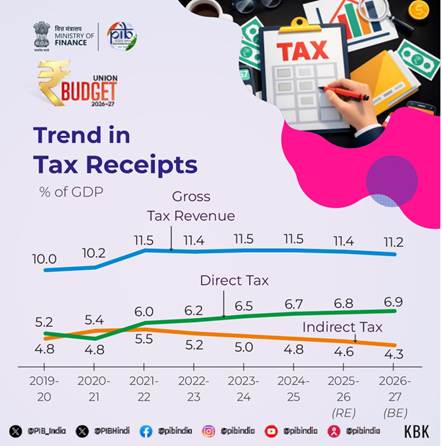
On the tax and compliance front, the proposed new income tax framework, simplified procedures, reduced penalties and expanded automation represent a conscious attempt to soften the state’s interface with citizens and small businesses. Measures designed to attract foreign capital, data infrastructure providers and global technology firms indicate that India continues to position itself as a long-term investment destination.
Yet, the broader perception challenge remains. When enforcement discretion, regulatory approvals and compliance processes remain embedded in opaque administrative hierarchies, formal simplification does not always translate into practical relief for smaller enterprises and individual taxpayers.
However, any discussion on tax simplification and softer compliance must confront a far more uncomfortable ground reality — the deeply oppressive character of the income-tax enforcement machinery itself. For vast sections of India’s business community, the problem is not merely complexity of law, but the culture of intimidation embedded in its implementation. The tragic case of CJ Roy, a widely respected and popular entrepreneur who shot himself dead after an Income Tax raid on his office, stands as a haunting reminder of how coercive and dehumanising the system has become. Reacting to his death, a renowned social thinker, scholar and historian wrote that governance in India is structurally designed to terrorise citizens—first through rules and their arbitrary implementation, and then through the pervasive layer of corruption that accompanies enforcement. As he noted, nearly everyone who runs any business in India routinely lives under official intimidation, silently enduring fear, uncertainty and pressure. Roy, admired for running no-debt projects and for building thousands of homes and civil structures without a single complaint from beneficiaries, represented precisely the kind of ethical entrepreneurship that public policy claims to encourage. His death exposes a disturbing contradiction: while the Budget promises simplified tax laws and automated systems, the real crisis lies in the unchecked coercive power of the tax administration, which continues to operate with minimal accountability and enormous discretionary authority. Unless the culture of fear, harassment and extraction within the tax machinery is confronted head-on, regulatory reform will remain cosmetic—and trust between the citizen and the state will continue to erode.
Fiscal balance and political economy
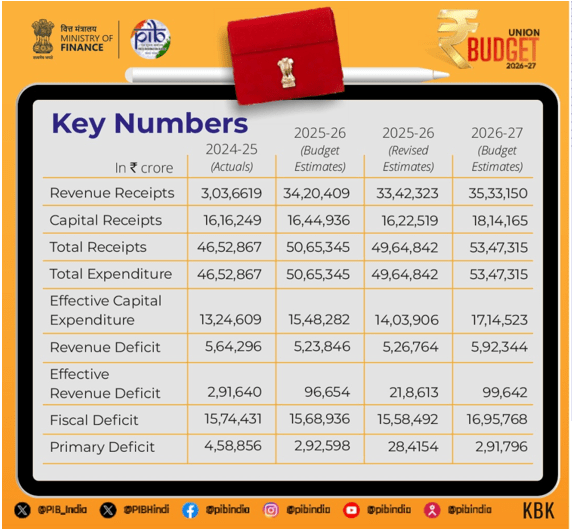
The government has clearly attempted to balance fiscal prudence with growth imperatives. The steady consolidation path and sustained capital expenditure push reflect a belief that public investment can crowd in private investment without destabilising macroeconomic fundamentals.
But the deeper risk confronting the Budget is not fiscal—it is institutional.
The bottom line
In essence, this Budget carries strategic vision and policy coherence, but its fate rests not on fiscal arithmetic, sectoral announcements or reform rhetoric—it rests on whether India can break the deeply entrenched nexus of political funding compulsions, bureaucratic rent extraction and intermediary-driven governance. Without confronting systemic corruption, politicised administration, weak accountability and a delivery architecture captured by electoral and commercial interests, the promises of industrial renewal, human-capital reform and inclusive growth will remain aspirational rather than experiential.
The real test of this Budget, therefore, is not economic design but democratic governance itself—because in today’s India, policies do not collapse for lack of ideas; they collapse under the weight of politicised execution.
