

By Lalit Shastri
(For This is News Network)
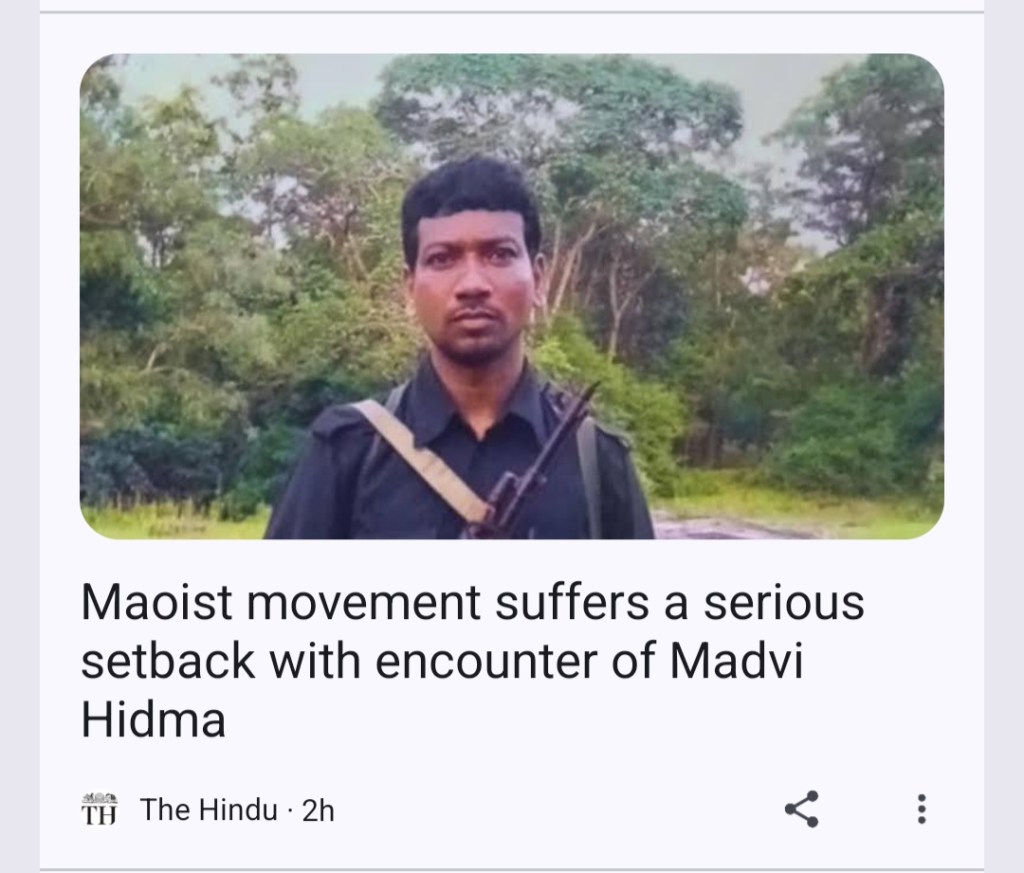
A Headline That Distorts Reality
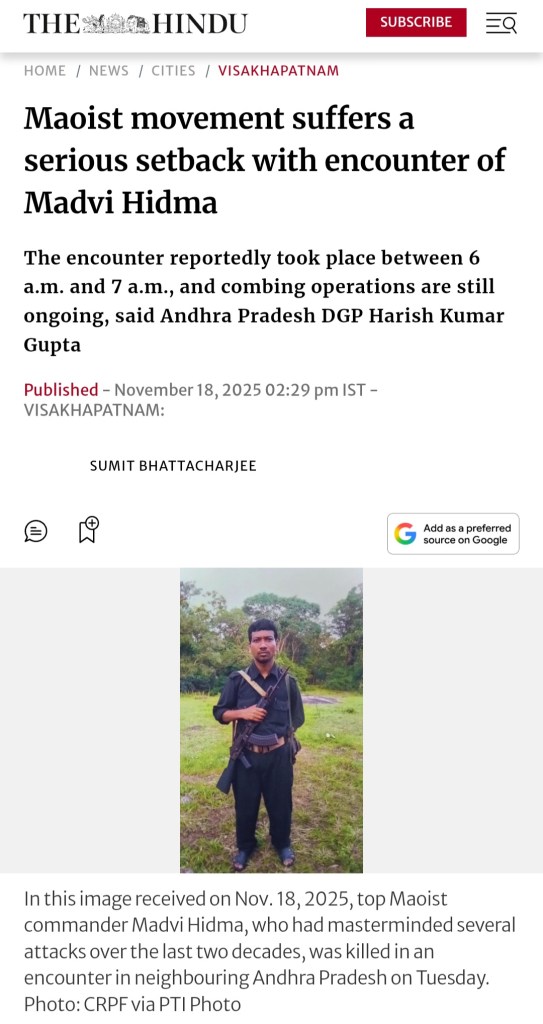
A headline on 18 November 2025 announcing that the “Maoist movement suffers a serious setback with encounter of Madvi Hidma” may appear routine to some. But the wording reveals a dangerous flaw in how sections of the media continue to frame this long, brutal chapter of insurgency.
Calling this extremist network a movement suggests legitimacy. Calling the encounter a setback implies a noble struggle interrupted. This language sanitises one of India’s deadliest terror organisations — an outfit that has murdered villagers, blown up buses, ambushed police camps, kidnapped schoolchildren, held entire communities hostage, and unleashed a trail of brutality from Bastar to Gadchiroli.
Maoists do not deserve the dignity of the word ‘movement.’ They deserve to be identified for what they are — armed insurgents waging war against the Indian Republic.
A Legacy Written in Blood
From Dantewada and Sukma to Gadchiroli and Bijapur, the poorest and most vulnerable citizens have borne the weight of Maoist terror.
Security forces — often young men from modest homes — have paid the highest price on the frontlines. Yet their stories rarely receive the sustained national attention they deserve.
As I had written earlier:
“Where were the letters of outrage when Maoists planted IEDs and turned security convoys into funeral processions?“
That question still stands.
Hidma’s Trail of Blood Across the Red Corridor
Madvi Hidma’s signature of terror runs through some of the darkest chapters in India’s internal security history. It was under his command that the 2010 Dantewada massacre unfolded — an operation in which 76 CRPF personnel were slaughtered in a single ambush, marking one of the gravest blows to India’s security forces.
Three years later, he engineered the 2013 Jhiram Ghati ambush — a political assassination mission of chilling precision. Senior Congress leaders including Mahendra Karma, state party chief Nand Kumar Patel, and veteran Congress strongman Vidya Charan Shukla were eliminated in a coordinated attack meant to decapitate the political leadership of Chhattisgarh.
These were not isolated or accidental acts — they were deliberate exhibitions of Maoist brutality. Hidma crafted terror designed to dominate the region, undermine governance, and crush democratic institutions under the weight of fear.
His death in an encounter is therefore not just a tactical success.
It is the elimination of a terrorist who instilled fear across an entire region.
Hidma did not lead a movement — he engineered massacres. His elimination dismantles a symbol of unrestrained brutality that scarred the region for decades.
The Myth of a Revolutionary Cause
For years, Maoist propaganda has tried to project the insurgency as a “people’s struggle.”
But the lived experience of tribal families tells a very different story — coercion, extortion, forced recruitment, kangaroo courts, and executions carried out to consolidate control.
This is not revolution.
It is organised terror.
In earlier field reports, I documented how Maoists:
- executed villagers who refused to cooperate,
- abducted youth for indoctrination,
- used children as shields,
- destroyed schools and health centres,
- ran parallel courts that governed entire hamlets through fear.
The Maoist enterprise has no ideology beyond violence and no commitment beyond the destruction of institutions that uphold the Republic.
Victory for the Constitution, Not a ‘Setback’ for Maoism
The latest encounter is not a mere operational milestone.
For thousands living in remote districts — families caught between Maoist coercion and state suspicion — this is a step toward reclaiming normalcy.
It reassures tribal India that the long shadow of gun-wielding authoritarianism is finally shrinking.
It reaffirms the state’s determination to protect every citizen, especially those whose voices are seldom heard.
Calling this a “setback to the movement” does violence to the truth.
It is a victory for the Constitution, for democracy, for every jawan who fell, and for every villager who lived in fear.
Why Language Matters
Media narratives shape public consciousness. Using terms like “movement,” “setback,” or “rebel activities” normalises what is, in reality, a reign of terror.
Across India, this linguistic dilution is not limited to Maoist violence.
We see the same pattern in the reportage on Kashmir, where Pakistan-trained infiltrators, Lashkar and Jaish operatives, and Hizb commanders are frequently described as militants, ultras, gunmen, or even local boys. These euphemisms obscure the truth about cross-border terror networks that kill civilians, migrant workers, Kashmiri Pandits, political representatives, police personnel, and soldiers.
When a terrorist trained in Pakistan infiltrates Indian soil with the explicit intent to kill innocents, there is nothing “militant” about him.
He is a terrorist, and must be identified as such.
Soft vocabulary does not merely distort public understanding — it erodes moral clarity.
The terminology we choose determines whether we confront terror with honesty or camouflage it under editorial hesitation.
Just as Maoists are not a “movement,” Pakistan-sponsored operatives are not “militants.”
A terrorist must be called a terrorist — every single time.
From the Red Corridor to Kashmir, soft labels like ‘militants’ and ‘ultras’ blur the truth. A terrorist must be called a terrorist — anything less distorts reality.
The Red Curtain Has Fallen — Stop Holding It Up
The encounter that neutralised Madvi Hidma is not a setback for Maoism.
It is a decisive blow to an empire of terror built on blood, intimidation, political assassinations, and relentless violence against India’s most vulnerable citizens.
Let us stop romanticising extremism with soft language.
Let us honour the victims with truth — not euphemism.
And let us recognise this moment for what it is: a victory for India’s democracy and a reaffirmation of the state’s duty to protect its people.
 This is News