
Lalit Shastri
India’s technological rise is not a borrowed dream — it is a homegrown revolution that needs no foreign validation.
— Lalit Shastri
India’s Tech Story: Truth Over Narrative
A recent video doing the rounds on social media presents a gloomy, almost patronising view of India’s scientific and technological rise — suggesting that our achievements are overstated and built on borrowed strength.

It is a familiar tone: the scepticism that often greets an emerging power challenging global hierarchies. But this time, the old narrative doesn’t hold. India’s transformation in information technology, space science, and digital infrastructure is not a matter of propaganda; it is a matter of record.
The country is already building its own yardsticks — in open source, in silicon, in data, and in destiny.
India’s Digital Infrastructure Is No Mirage
The video insinuates that India’s claims of technological advancement are inflated. Facts prove otherwise.
India today operates the world’s largest biometric identification system (Aadhaar), the most sophisticated real-time digital payment interface (UPI), and a globally recognised digital public infrastructure that has become a model for other developing economies.
These are not Western imports. They are homegrown systems built by Indian engineers, tested on Indian scale, and governed by Indian institutions.
The government’s policy on the adoption of open-source software (OSS) has fundamentally shifted India’s technological framework. Ministries and public sector enterprises are increasingly using open-source Linux-based systems for e-governance, cybersecurity, and cloud operations.
To declare that “India runs all sensitive programmes on open-source Linux” may be an overstatement — but the underlying truth is undeniable: India has placed its trust in open, transparent, and indigenous digital architecture over proprietary dependence.
From Space to Silicon — The Hard Numbers Tell the Story
The video’s narrative tries to undermine India’s ambition in semiconductors and advanced manufacturing. Yet, a quiet revolution is unfolding.
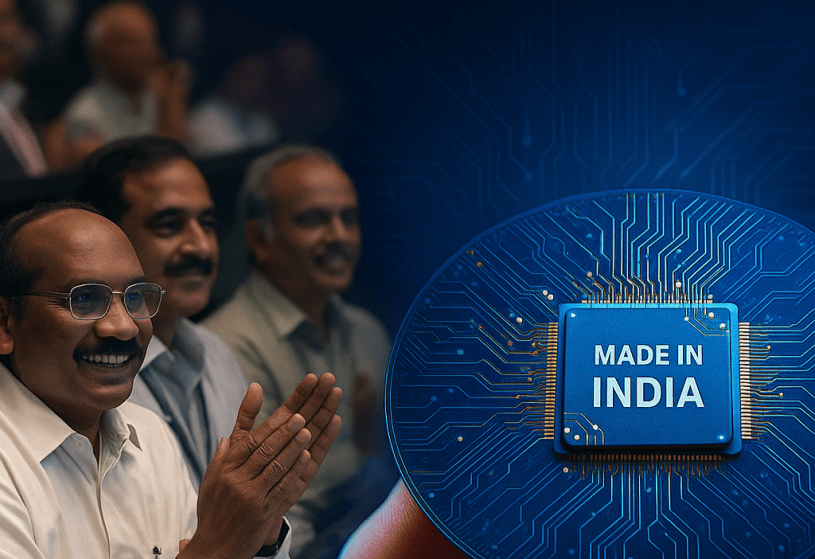
Four new semiconductor plants were approved in Odisha, Punjab, and Andhra Pradesh in August 2025. With these four more approvals, total approved projects under ISM (India Semiconductor Mission) have gone up to 10 with cumulative investments of around Rs.1.60 lakh crore in 6 states. Hence, India’s semiconductor mission is no slogan. It is a structured, well-funded national endeavour.
India already accounts for nearly one-fifth of the world’s chip design engineers — the intellectual front end of the global semiconductor chain.
True, we do not yet have large-scale fabrication capacity, and “self-sufficiency in a decade” remains aspirational. But nations are not built on instant gratification. The groundwork being laid now — in policy, infrastructure, and design capability — will yield dividends that last generations.
In contrast, the video’s tone betrays a dated worldview — one that refuses to accept that India, through its own effort, is closing the technological gap once monopolised by a few Western economies.
Guardians of Digital Sovereignty
Another claim dismissed in the video — that India is asserting control over its data — deserves to be clarified.
The government’s insistence on storing sensitive data within Indian territory is not paranoia; it is prudence. The new Data Protection Act mandates that critical and personal data be stored in India, while cross-border transfers are allowed only under regulated conditions. This ensures both national security and economic independence.
Major global and Indian corporations are responding by establishing large-scale data centres across Mumbai, Hyderabad, and Chennai. India is emerging as one of the fastest-growing data-centre hubs in the Asia-Pacific region.
In this context, to mock India’s push for data localisation is to ignore the realities of the 21st century — where data is the new oil, and sovereignty depends on who controls it.
The Power of Indigenous Enterprise
If there is one story that shatters the condescending tone of the viral video, it is the rise of Indian technology entrepreneurs like Sridhar Vembu of Zoho. Operating from a rural base in Tamil Nadu, Vembu has built a global software company that competes head-to-head with Silicon Valley giants — and does so with entirely Indian engineering talent and intellectual property.
He represents a new breed of innovators who are proving that “Make in India” is not a slogan but a working reality.
Then we have the success story of SISIR Radar, an Indian spacetech company launched by Tapan Misra, who is recognised globally as father of Indian SAR (Synthetic Aperture Radar). He is a distinguished scientist and former Director Space Applications Centre. His company specialises in building high resolution SAR satellites with extremely high imaging coverage. Tapan’s valuable contriburion in terms of radar technology and particularly SAR, during his long innings with ISRO, has led to the materialising of the NASA-ISRO Synthetic Aperture Radar mission, a joint project between NASA and ISRO.
SISIR Radar designs and develops world-class Synthetic Aperture Radar (SAR) payloads, Ground Penetrating Radar (GPR), Drone-borne Hyperspectral Imaging systems as well as conventional Radars. These technologies are designed to serve diverse industries, including defence, agriculture, mining, urban planning and environmental monitoring, by providing timely actionable insights to users.
With the world’s highest resolution L band SAR, they have won 2 IDEX challenges from the Indian Ministry of Defence and have partnered with multiple organisations to address critical challenges.
This quiet confidence — self-made, self-assured, and self-reliant — is the true face of India’s digital transformation. It needs no validation from foreign commentators who still view India through the lens of dependency.
A Global Realignment in the Making
Even on the geopolitical front, the attempt to trivialise India’s alignment with BRICS and its participation in efforts to develop alternative payment and data systems is misplaced.
While BRICS may still be evolving its financial architecture, the intent is clear — to build a more balanced world order, less beholden to Western control. India is asserting its rightful place within that emerging multipolar framework — as both a technology creator and a rule-shaper.
Between Propaganda and Pride
The real story, then, is this: India no longer needs to boast, nor does it need to defend its progress against dismissive voices. The numbers speak, the missions deliver, and the results are visible from Chandrayaan’s triumph on the Moon’s south pole to the success of the Digital India stack.
Those who accuse India of overstating its capabilities miss the essence of this moment. This is a nation that has learned to build quietly, innovate relentlessly, and stand on its own technological feet.
Let the sceptics continue to measure India with outdated yardsticks. The country is already building its own — in open source, in silicon, in data, and in destiny.
