

INSIGHT | ANALYSIS
By Lalit Shastri

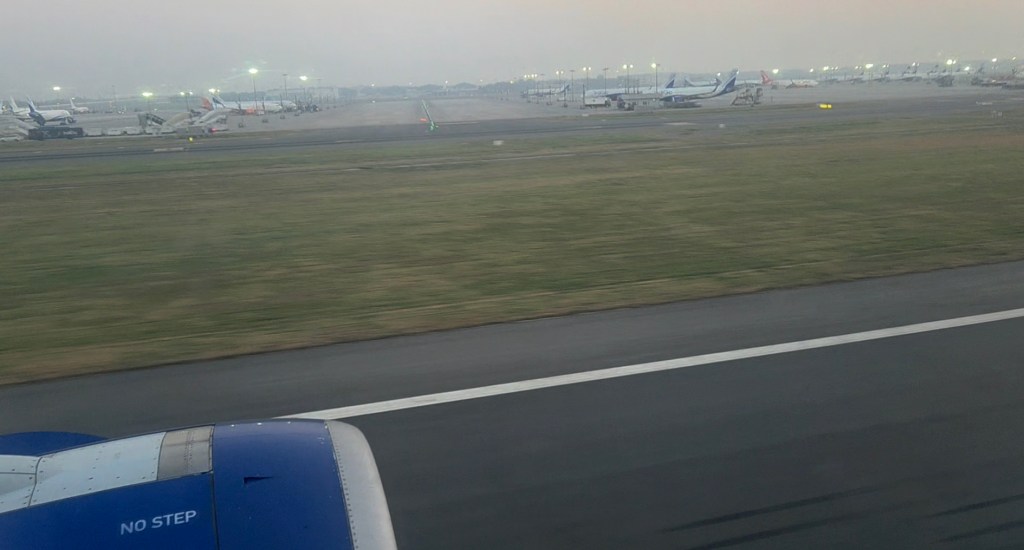
The real turbulence lies not in the sky, but in the media’s understanding of aviation technology.
Panic Over Technology Misread
In recent days, The Times of India, Times Now TV and some other outlets have sounded alarm bells over so-called “GPS spoofing” near Delhi’s Indira Gandhi International Airport (IGIA), claiming that this prompted the Directorate General of Civil Aviation (DGCA) to rush through an Instrument Landing System (ILS) implementation on Runway 10/28.
The story, while eye-catching, is deeply misleading. It betrays a fundamental lack of understanding of how modern aviation navigation actually works.
Air Traffic Does Not Depend on GPS
Contrary to what has been implied, commercial air traffic is not built on GPS dependence.
Every modern aircraft carries multiple redundant navigation systems to ensure that no single failure — including GPS interference — can affect flight safety.
At the heart of it all lies the Inertial Navigation System (INS) — a self-contained guidance mechanism that calculates the aircraft’s position using internal sensors, without needing satellite input. Even if GPS signals were lost or corrupted, INS would continue to function with remarkable accuracy.
Further, ground-based navigation aids like VORs (Very High Frequency Omni-Directional Range) and NDBs (Non-Directional Beacons) provide reliable, GPS-independent signals for en route and approach guidance. These have formed the backbone of air traffic navigation for decades.
If GPS spoofing were truly affecting Delhi airspace, neighboring airports would have gone dark too — they didn’t.
The Real Role of ILS
The Instrument Landing System (ILS) mentioned in the Times report is a ground-based precision approach aid, not a satellite-linked system. It transmits radio beams from the runway to guide an aircraft’s approach during low visibility.
The DGCA’s decision to expedite ILS Category I operations on Runway 10/28 was an operational decision, not a crisis response. The ILS had been temporarily withdrawn to upgrade to CAT III standards. With easterly winds requiring landings from the Dwarka end, reactivating a CAT I ILS simply optimized runway usage — nothing more dramatic than that.
Spoofing: The Buzzword That Doesn’t Fit
Yes, GPS spoofing is real — but mostly in military or conflict zones, wherever GPS is used. Reports of spoofing 60 nautical miles from IGIA stretch credulity.
Had such interference truly occurred, it would have impacted multiple North Indian airports, triggered international alerts, and led to mass diversions and airspace closures. None of this happened.
Airlines and regulators do monitor for spoofing, but commercial aircraft are equipped to detect, isolate, and disregard corrupted GPS data. Pilots are trained to instantly switch to alternate navigation systems if required.
This is not speculation; it is standard operating procedure.
A few errant satellite signals cannot bring down one of the world’s most complex and monitored airspaces.
The Real Issue: Misreporting
Aviation safety depends as much on public trust as on technical systems. When major newspapers exaggerate technical matters without grasping the fundamentals, they distort public understanding and create needless anxiety.
The DGCA’s move to operationalize ILS Category I earlier than planned was a sound administrative step, ensuring preparedness for winter fog and easterly wind conditions. It was routine aviation management, not a firefight against invisible cyber threats.
To suggest otherwise is to replace technical accuracy with techno-sensationalism.
How Aircraft Navigate Without GPS
- INS (Inertial Navigation System): Uses internal motion sensors; independent of satellites.
- VOR (Very High Frequency Omni-Directional Range): Ground transmitters guide bearing and distance.
- NDB (Non-Directional Beacon): Simple radio beacon providing direction.
- ILS (Instrument Landing System): Ground-based radio guidance for approach and landing.
- Redundancy: Cross-verification between systems ensures zero dependency on GPS alone.
The DGCA’s decision reflects good governance — not crisis management.
The DGCA’s expedited ILS activation is a story of operational prudence — not panic.
The real turbulence, it turns out, lies not in Delhi’s skies, but in the media’s understanding of aviation technology.
EDITOR’S VIEW

By Lalit Shastri
My IndiGo flight from Bhopal to Delhi on Friday, 7 November, was delayed by several hours. Later, I came across a news report attributing flight disruptions near Delhi to “GPS spoofing” — a claim that immediately raised red flags. TIMES NOW even went to the extent of telling the viewers that fake GPS signals were overriding genuine GPS signals.
As someone who has long observed aviation policy and reporting standards, I found the explanation both technically implausible and journalistically careless. India has a network of air route surveillance radars that constantly track aircraft movements across the country, ensuring seamless coordination and safety.
Aviation operations are not built on GPS dependency; they rest on layered redundancies — inertial navigation systems, ground-based radio beacons, radar, and human skill. In fact, Delhi operates four runways and handles a departure or landing every four minutes, guided by an automatic sequencing system at ATC that may occasionally malfunction but is swiftly rectified.
When viewed against this reality, to suggest that “GPS spoofing” alone could cause major disruptions is to misunderstand the layered, resilient design of air traffic management in India.
Yet, the urge to dramatize technology has led to an unfortunate erosion of accuracy in mainstream media. Terms like “spoofing” and “signal manipulation” are thrown around as if they define aviation safety, when in truth, they often mislead the public.
Sensationalism is not a substitute for substance. Journalism must match aviation’s own discipline — calm, evidence-based, and accountable.
 This is News