
Lalit Shastri
Bharat with Narendra Modi as Prime Minister won’t bow. Aatmanirbhar Bharat is the new order
Published August 8, 2025, exclusive editorial
America’s playbook hasn’t changed in a century. From the ashes of Hiroshima and Nagasaki to the dismemberment of the Soviet Union, from the destruction of Iraq to the sanctions on Iran, Washington has consistently crushed any nation—or individual—that dared to threaten its economic and geopolitical supremacy. Today, China is their biggest challenger. But as India rises in strategic importance, the crosshairs are shifting firmly onto us.
The latest salvo—Donald Trump’s doubling of tariffs on Indian goods, triggering an immediate freeze on orders from American retail giants Amazon, Walmart, and Target—is not an isolated act. It is part of a long and deliberate strategy to slow India’s momentum. But here’s the truth: this is not the time to panic. It is the time to pivot.
The Billionaire Narrative Is a Distraction
Much of the chatter focuses on billionaires—Adani, Ambani, Tata, Mahindra—and whether the U.S. will target them next, just as it clipped Jack Ma’s wings in China. But billionaires alone do not define a nation’s destiny. What will truly give the so-called superpower a run for its money is a combination of India’s ancient spiritual resilience, its Swadeshi spirit, its disciplined and tough labour force, and the unmatched courage of its armed forces.
India’s true edge lies not in imitating the Western model but in building an economic and social order rooted in our civilisational values—where production is for need, not greed; where strength is measured in self-reliance, not dependence on global approval.
Trump’s Miscalculation
By doubling tariffs and inviting Pakistan’s Army Chief Asim Munir—a jihadi patron in uniform—for the second time in as many months, the US President Donald Trump has revealed his cards. This is the same America that created and funded the Taliban to counter Russia in Afghanistan, and now bankrolls Pakistan’s terror outfits like Jaish-e-Mohammed to destabilise India.
Trump imagines tariffs will bring India to its knees. What he fails to grasp is that the U.S. economy itself is a hollow shell—consumer and debt-driven, dependent on global supply chains it cannot control. Every previous misadventure—from the jungles of Vietnam to the mountains of Afghanistan—has ended in humiliation. This tariff war will be no different.
The West’s Fear: An Aatmanirbhar Bharat
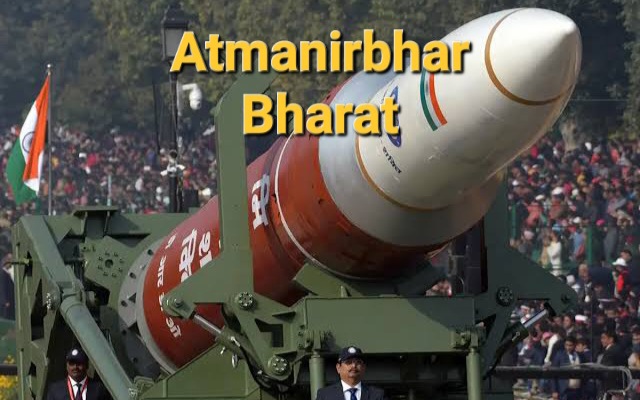
For ten years, India has had a stable, strong government. That stability, combined with policies like Aatmanirbhar Bharat and Make in India, threatens to upend the global order. If India becomes self-reliant in manufacturing, technology, and—most crucially—energy, the U.S., Europe, China, and the Arab oil bloc will suffer massive economic losses.
Adani’s low-cost green hydrogen ambitions directly threaten oil’s stranglehold on global energy. The attacks on his empire—whether through Hindenburg-style reports or orchestrated media narratives—are part of a larger effort to stop India from controlling its own energy future.
The Real Weakness—and the Real Answer
Yes, India’s vulnerability has always been its energy dependence. In 1991, it almost brought us to bankruptcy. The answer is not to play the victim in a U.S.-led tariff war but to double down on indigenous innovation, renewable energy, and non-Western trade partnerships.
The U.S. wants a fragmented India, perpetually dependent, governed by a weak coalition they can manipulate. The answer is a decisive, long-term economic and strategic vision that rejects the Western consumerist trap and replaces it with a civilisational model of growth.
Modinomics Must Evolve
Prime Minister Modi’s government has talked the talk on Swadeshi, but now it must walk the walk—fearlessly. Bilateral and multilateral trade deals that bypass tariff threats must be prioritised. South-South cooperation, BRICS+ mechanisms, and deeper Indo-Pacific partnerships (minus U.S. dominance) must become the backbone of our strategy.
The world is our stage and our market. In this new order, Washington will no longer dictate the script.
Quad at a Crossroads
Trump’s tariff aggression is not without collateral damage. The Quadrilateral Security Dialogue (Quad)—positioned as a bulwark against China in the Indo-Pacific—now finds itself in uncertain waters. Trust is the currency of such alliances, and Washington’s decision to economically target a key member sends the opposite signal. Quad summit scheduled later this year is something that will have to be closely watched.
If the U.S. treats India as a trade adversary while expecting military cooperation, the Quad risks becoming hollow rhetoric. For India, the choice is stark—either remain tethered to an unreliable partner or pivot towards a multi-aligned strategy through SCO, BRICS+, and regional South-South frameworks. The current developments make it clear: a self-reliant India cannot base its strategic security solely on a bloc where its own rise is seen as a threat by one of its principal members.
From Tariffs to Ties: Modi’s Moscow Move Sends a Message to Washington
Modi Strengthens the Moscow Axis
India’s strategic compass is multi-directional — and Moscow remains firmly on the map.
While Trump was busy indulging in India-bashing and tariff theatrics, Prime Minister Modi was on a different wavelength—engaged in a substantive, forward-looking conversation with Russian President Vladimir Putin, a leader he calls a trusted friend. The dialogue went beyond routine diplomacy, touching on the latest developments in Ukraine and evaluating the momentum of the India–Russia partnership.
While Washington turns up the tariffs, New Delhi deepens its ‘Special and Privileged Strategic Partnership’ with Russia.
Both leaders reaffirmed their commitment to strengthen what is officially termed the Special and Privileged Strategic Partnership—an alliance that has withstood decades of global turbulence. Modi’s message was clear: India’s foreign policy will not be boxed in by any one power bloc, and he is ready to roll out the red carpet for Putin’s visit to India later this year.
Trump’s tariff miscalculation only pushes India to diversify — not retreat.
Significantly, Prime Minister Modi shortly will also be attending the SCO Summit.This is clear indication of India’s intent to deepen engagement with non-Western power blocs. This underscores New Delhi’s readiness to recalibrate its diplomatic posture in response to Washington’s tariff provocation. This would be more than symbolic. The world should treat this as strategic marker of a new, self-assured India.
A Final Word
In the coming months, the propaganda machine—social media platforms owned by American giants, Western-funded think tanks, and paid domestic voices—will go into overdrive. Their goal will be to pit Indian against Indian, to demonise our industrial champions, and to weaken our resolve.
This is the time for vigilance, unity, and a return to our roots. Protecting India’s industrial and strategic interests is not cronyism—it is national security. The U.S. may have missed the bus already, but if we lose focus now, we risk missing our own historic moment.
Bharat’s rise is inevitable—if we choose courage over compromise.
What do you think India’s next move should be? Leave your thoughts below.
