
Tapan Misra
Kudos to Dr. S Somnath, Chairman ISRO and Team ISRO for successful launch of SSLV D3. It helalded operationalisation of SSLV programme.
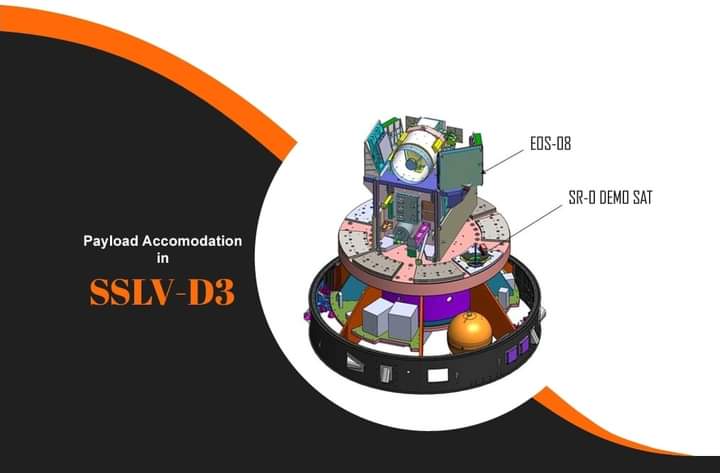
SSLV D3 carried a small satellite EOS-8, equipped with three interesting payloads. One is an infrared payload for detecting thermal emissions day and night. We have launched similar payload on micro satellites, but sensor could not perform optimally for 3 axis stabilisation issues of micro satellites.
Second was Silicon Carbide based sensor to map UV radiation in the free space. It will help in designing proper window for our Gaganyaan satellite.
The third payload, is GNSS Reflectometry payload to measure GNSS signal reflection from ocean and land in L band. GNSS satellites like GPS, NAVIC , Beidou, GLONASS and Gallileo send circularly polarised signal and received by two antennas, pointed at opposite side of the track, giving high accuracy position of the satellite and the GNSS platform. Third antenna is pointed downwards to receive oppositely polarised first reflection signals. Because of forward scattering, the signal is high in strength and there are perturbations in the signal because of rougness of sea and land. An elementary trigonometry will solve exact point of reflection. A great sensor for measuring ocean wind vector, soil moisture, vegetation and forestry.
I distinctly remember a boy from IIST, with a master degree in Physics, visiting my office very dejected, as he did not like his posting in meteorology department. I convinced him that he will do wonder in payload development, knowing fully well that engineers and scientists are not always in the same wavelength with each other. Posting him in any running payload activity will surely stall his career as the team have preponderence of engineering talents. So I gave him the GNSS R payload development as Technology Development Programme, which was a nascent subject in 2016-2017 time frame. He had a free run as the bosses were not much convinced of the viability, that too being developed by a physics gaduate! I still remember the days I used to visit the skeletal team on the rooftop of MRSA building to encourage them in their struggle to capture reflected GNSS signal. Today the payload is launched and sure will herald a revolution in passive microwave sensing, primarily led by the boy. A great tribute to ISRO for spotting and nurturing talents.
The author, Tapan Misra is Founder of the tralblazing and successful startup SISIR Radar. He is a distinguished scientist and a former Director Space Applications Centre, National Physical Laboratory and Advisor in the Department of Space
