

Lalit Shastri
The argument began with a friend on social media. A familiar list had been forwarded — alleged missed territorial opportunities, rejected strategic offers, diplomatic decisions attributed to India’s first Prime Minister, Jawaharlal Nehru. The tone was not archival. It was accusatory. The conclusion was stark: India had paid an immeasurable civilisational price.
The response that followed was thoughtful, almost clinical. It is human nature, my friend observed, to ask what could have been done differently. But the more demanding question is how it could have been done in that historical moment — and what the consequences might have been. Change a decision in 1948, and the entire chain of events that followed would also change. Without examining cause and effect, hindsight becomes opinion rather than analysis.
That private exchange mirrors a broader national mood. India is revisiting its founding decades with renewed intensity. In that reassessment, Nehru has become less a historical figure and more a symbolic fault line. For some, he represents idealism that underestimated hard power realities. For others, he embodies institutional imagination at a time when the Republic was still being assembled from trauma and fragmentation. Both readings flatten a far more complex landscape.
The Weight of the Founding Moment
When India became independent in 1947, it did not inherit a settled nation-state. It inherited Partition — one of the largest forced migrations in modern history, accompanied by communal violence that left deep psychological and political scars. Hundreds of princely states had to be integrated. Borders were fluid. Administrative capacity was stretched thin. The armed forces were in transition. Democratic institutions were being built even as refugees streamed across new frontiers.
To evaluate early decisions solely through the prism of present-day strategic anxiety risks misreading proportion. The India of the late 1940s did not possess the military reach, economic leverage or diplomatic influence it commands today. Statecraft was being improvised in real time, under extraordinary strain.
This does not place those decisions beyond scrutiny. Democracies require scrutiny. But scrutiny divorced from context becomes indictment without analysis.
Civilisational Anxiety in the Present
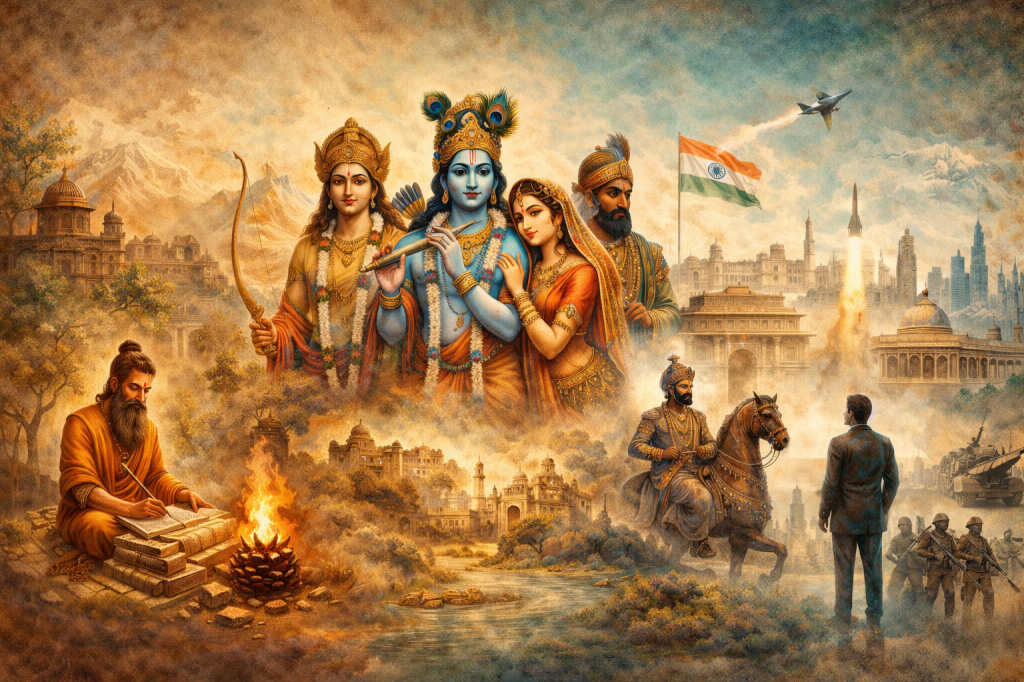
Yet the intensity of today’s debate cannot be dismissed as partisan revisionism. Beneath it lies a deeper civilisational anxiety. For many Indians, especially those who identify strongly with the continuity of Sanatan traditions, history is not merely archival memory. It is a lived inheritance marked by centuries of invasions, cultural disruption and the trauma of Partition. The fear is not confined to territorial questions of the mid-20th century. It is about whether the modern Indian state has sufficiently internalised the vulnerabilities of its past.
In contemporary geopolitical realities — marked by terrorism, ideological extremism and assertive neighbours — that anxiety sharpens. The conversation shifts from individual policy choices to a broader question: How does India protect the best of its civilisational inheritance — its knowledge systems, philosophical traditions, arts, sciences and plural ethos — without compromising democratic character?
It is here that the debate becomes more consequential than any single historical episode.
Beyond Retrospective Blame
The temptation, however, is to convert civilisational concern into partisan accusation. When history is reduced to a morality play of foresight versus failure, clarity suffers. Nations do not evolve through counterfactual rage. They evolve through institutional strengthening.
India’s civilisational continuity did not endure millennia because of one leader, nor was it undone by one prime ministerial decision. It survived through decentralised traditions, intellectual elasticity and a remarkable capacity to absorb shocks without losing its core identity. The choice to begin the Republic as a democracy — rather than as a military regime or ideological state — was itself a civilisational wager on pluralism and constitutionalism.
Whether every early decision was strategically optimal remains open to debate. But retroactive certainty is a luxury history rarely affords.
The Conversation That Matters Now
The more urgent question is not whether different choices in 1950 would have produced a different map in 2026. Counterfactuals may sharpen perspective, but they do not build institutions. The pressing challenge is whether India today is equipping itself — intellectually, culturally and strategically — to secure what it values.
Civilisation is not preserved by grievance alone. It is preserved by competence, confidence and clarity. If past leaders underestimated threats, the corrective lies not in perpetual recrimination but in strengthening present capacities — educational systems that deepen historical literacy without weaponising it, strategic doctrines that balance realism with restraint, and public discourse that distinguishes between vigilance and paranoia.
In the end, the most constructive moment in that social media exchange was not the listing of historical allegations. It was the agreement that followed: that strengthening India’s value system is the conversation worth having.
History deserves examination. Civilisation deserves protection. But the future will not be secured by endlessly litigating the anxieties of 1948. It will be secured by how seriously India takes the responsibility of 2026 — with maturity equal to its memory and confidence equal to its inheritance.
 This is News