

Lalit Shastri
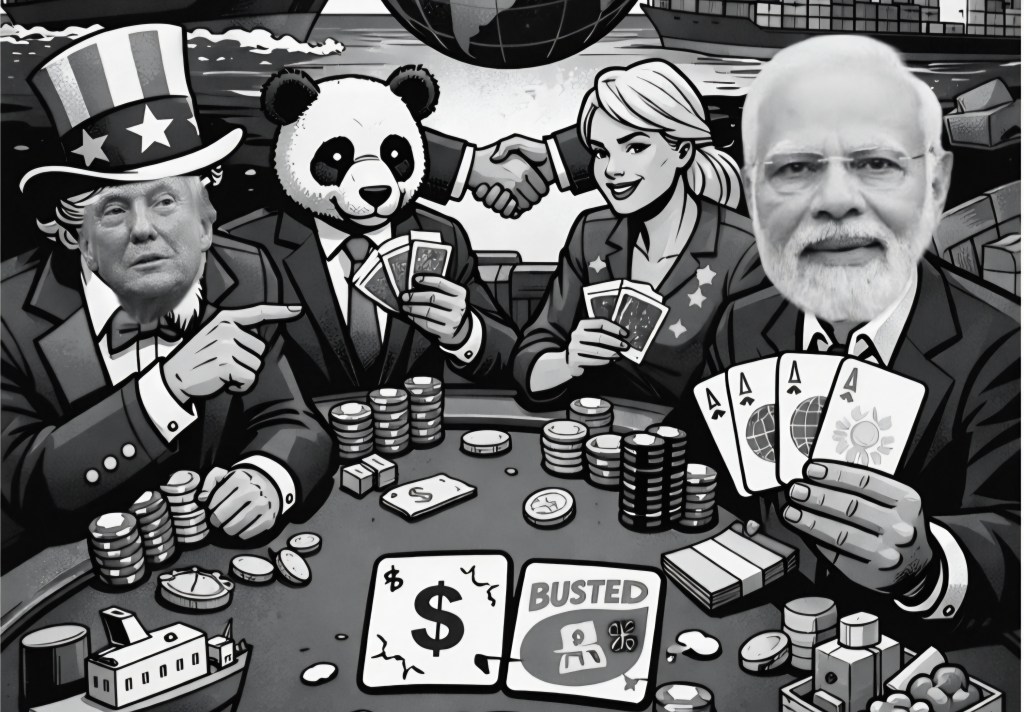
In the great casino of global trade, the Indo-American deal was played not across negotiating tables, but across a green baize that smelled faintly of television studios and campaign slogans.
Donald Trump strode in like a high-roller from a loud Las Vegas poster—chips stacked high, grin stacked higher—announcing a tariff squeeze so tight that even geography would start paying customs duty. The problem was not his bravado. The problem was his hand.
He had no winning cards.
Still, he kept dealing—blind. Bluff after bluff. Threat after threat. A poker player who confused volume with value, spectacle with strategy. “Fold, or else,” he declared to the room, mistaking intimidation for leverage, and leverage for leadership.
Across the table, Narendra Modi did something far more dangerous than counter-threats.
He simply waited.
Because, unlike the noise coming from the other end of the table, Modi was not playing on borrowed bravado.
He was quietly sitting on three aces.
And those three aces were nothing less than the mother of all trade cushions — a deepening, long-horizon, strategic commercial embrace with Europe, waiting patiently in his hand while Washington was busy rattling the chips.
Trump kept pushing stakes that weren’t really his—market access here, sanctions there, a dash of geopolitical pressure thrown in like free peanuts at the bar. But when the cards were finally laid bare, it turned out the famous tariff squeeze had more noise than muscle, more headlines than hard options.
The moment Modi called, the room saw what the table had quietly known all along.
The bluff had been priced in.
And neutralised.
Europe was already on the other side of the hedge.
That is when the satire slid into farce.
The man who claimed he could “win any deal” had wagered reputation, alliances and diplomatic goodwill on a hand made entirely of television bravado. Modi, without raising either his voice or his stake, merely placed his cards on the table.
Three aces.
Silence followed.
Trump did not merely lose the pot.
He lost the narrative.
He lost the illusion.
He lost the costume of being the smartest man in the room.
In the final reckoning of the Indo-American trade poker night, the emperor of tariffs discovered what every seasoned negotiator knows — and every showman forgets:
You can bully a table for a while.
You can blind-bet for a round or two.
But when the bluff is finally called, even the loudest player can walk away lighter —
sometimes lighter than the very pants he wore while pretending to own the casino.
