
Lalit Shastri
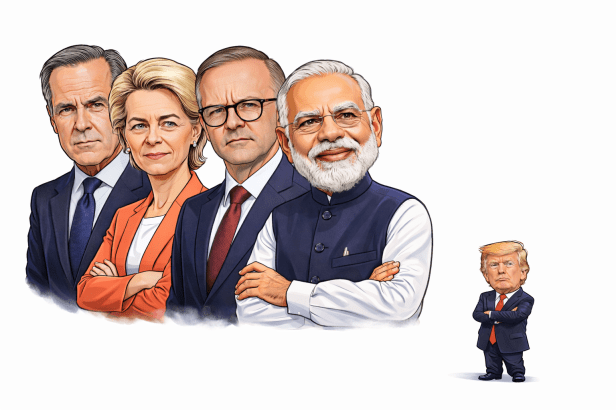
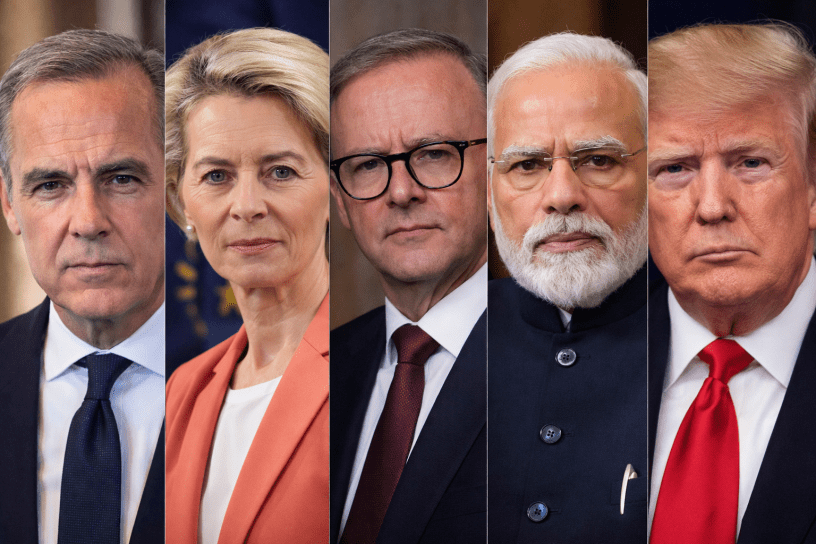
As Canada, Australia, and the European Union recalibrate their global strategies amid intensifying great-power rivalry, a striking truth is emerging: India articulated this moment years ago. What is now being framed as a new middle-power doctrine is, in fact, the delayed recognition of a strategic pathway India has long pursued—anchored in realism, resilience, and sovereign choice.
What is unfolding in global geopolitics today is not a transition disguised as continuity; it is a rupture finally acknowledged. The reassuring language of a neutral, rules-based international order has collapsed under the weight of selective enforcement, economic coercion, and the unembarrassed return of power politics. Middle powers—long the system’s most disciplined believers—are discovering that faith without force is not virtue, but vulnerability.
India understood this before it became fashionable to say so.
For over a decade, New Delhi has refused to romanticise global governance structures that applied rules asymmetrically and protected strength more reliably than justice. Under Prime Minister **Narendra Modi**, India steadily dismantled the illusion that alignment alone guaranteed security or prosperity. Instead, it chose a harder, lonelier path: strategic autonomy grounded in capacity, not posturing.
That choice was often misunderstood—sometimes wilfully so. India was accused of hedging, of fence-sitting, of insufficient moral clarity. In reality, it was among the first major powers to accept a blunt truth others are only now willing to articulate: the global order had ceased to constrain the strong, and pretending otherwise was an act of self-deception.
External Affairs Minister S. Jaishankar gave this realism its most unsparing expression. In speeches, interviews, and diplomatic exchanges, he argued that international politics had returned to an era of open competition, where power spoke more loudly than principle and economic interdependence could be weaponised. His message was simple and unsettling: values unsupported by capacity are not values—they are liabilities.
India’s response was not withdrawal from the world, but preparation for it.
Autonomy Without Illusion
Long before supply chains fractured and trade became coercive, India invested in food security, energy diversification, digital public infrastructure, defence production, and manufacturing scale. The Atmanirbhar Bharat framework was never about isolationism; it was about insurance. It recognised that when integration becomes leverage in someone else’s hands, sovereignty demands resilience at home.
This approach quietly rewrote the meaning of strategic autonomy. It was no longer a slogan of non-alignment, but an operational doctrine: reduce vulnerability, widen choices, and preserve decision-making space. India did not seek to escape globalisation; it sought to survive it intact.
At the same time, India expanded its diplomatic footprint rather than narrowing it. Long before Western capitals began speaking of “variable geometry,” India was practising it—engaging simultaneously with the Quad, BRICS, G20, SCO, I2U2, and a dense web of bilateral and regional partnerships. This was not confusion or opportunism. It was strategic clarity in a fractured world.
India’s presidency of the G20, amid deep geopolitical polarisation, demonstrated how a middle power could convene without pretending that consensus was automatic or values universally shared. The focus on development, debt relief, climate finance, and digital public goods reflected a different kind of influence—one rooted in legitimacy and relevance rather than coercion.
Showing the Way—Before the Rupture Became Explicit
Well before the global order was openly strained by the weaponisation of tariffs—used not merely for negotiation but for arm-twisting and outright blackmail—India had already begun building alternatives. Long before trade became an instrument of coercion rather than commerce, New Delhi grasped a critical reality: connectivity itself would become geopolitical.
That understanding took concrete form at the 2023 G20 Summit in New Delhi with the launch of the India–Middle East–Europe Economic Corridor (IMEC). IMEC was not conceived as a reaction to any single leader or episode. It was strategic anticipation—a recognition that chokepoints would be exploited, supply chains disrupted, and tariffs deployed as leverage.
IMEC proposes a multimodal network combining sea lanes, rail connectivity, energy grids, and digital infrastructure to link India with Europe via the United Arab Emirates, Saudi Arabia, Jordan, and Israel—bypassing the increasingly vulnerable Suez Canal to deliver faster, cheaper, and more resilient trade.
To view IMEC merely as a logistics corridor is to miss its deeper significance. It integrates transport, energy, and digital links into a single strategic framework—redundancy-rich by design. At a time when tariffs are wielded as political instruments and market access as pressure points, IMEC represents pre-emptive resilience.
Crucially, it also offers a credible alternative to the Belt and Road Initiative. Unlike debt-heavy, leverage-concentrating models, IMEC is modular, transparent, and partnership-driven—connectivity without dependency. It reflects India’s consistent preference for architecture that distributes value rather than concentrates control.
Canada Finds Its Voice
It is against this backdrop that Canadian Prime Minister Mark Carney’s speech at Davos assumes real significance. The address was striking not for its novelty, but for its honesty. By publicly acknowledging that the old bargain no longer works—that the rules-based order has thinned into ritual rather than restraint—Canada crossed a psychological threshold.
For a Western middle power to say openly what India has argued for years is not a rhetorical shift; it is an admission of delay. Carney’s insistence that middle powers must stop “living within a lie,” build strength at home, and cooperate issue by issue echoes a doctrine India has already operationalised.
Canada’s Davos moment, therefore, was less about innovation and more about arrival.
Australia: From Assumption to Adaptation
Australia’s recalibration reinforces this pattern of belated recognition. For decades, Canberra operated on the assumption that geography, alliances, and open markets would automatically deliver security and prosperity. Strategic pressure in the Indo-Pacific and the experience of economic coercion shattered that comfort.
Under Prime Minister Anthony Albanese, Australia has reassessed dependence, diversified trade, secured critical minerals, and rebuilt domestic capacity—moving closer to the Indian template: resilience first, engagement wide, alliances without illusion.
The deepening India–Australia Comprehensive Strategic Partnership across defence, maritime security, supply chains, education, and technology is not merely bilateral cooperation; it is a statement of shared middle-power logic. Their collaboration within the **Quadrilateral Security Dialogue** reflects coordination without subordination—precisely the balance India has long advocated.
Europe’s Strategic Turn Towards India
The European Union’s pivot towards India completes this emerging geometry. When European Commission President Ursula von der Leyen described the forthcoming EU–India trade agreement as the “mother of all deals,” she was signalling strategic necessity, not just commercial ambition.
Europe has learned—painfully—that overdependence is a liability in a weaponised global economy. Diversification is now a security imperative. India, by virtue of scale, demographic depth, political stability, and strategic autonomy, offers Europe growth without subordination and partnership without coercion. Together, they represent nearly two billion people—geopolitical ballast in a world of binary pressure.
IMEC, in this context, is not peripheral; it is foundational. It gives Europe options before pressure arrives—exactly the logic middle powers are now rediscovering.
The Clarifying Effect of Unmasked Power
What has accelerated this global awakening is not ideology, but exposure. The renewed assertiveness of American power—including its openly expressed strategic interest in Greenland—articulated most bluntly, one might even say brutally, by President Donald Trump, has stripped away the last vestiges of diplomatic illusion. When leadership speaks openly in the language of dominance, transactional alliances, and strategic entitlement, it performs an unintended service: it clarifies the world as it is, not as it is marketed.
This rhetoric is not an anomaly; it is a signal. It confirms what India had already internalised—that restraint cannot be assumed, multilateralism cannot substitute for capacity, and sovereignty that depends on goodwill is sovereignty on loan. For middle powers, the lesson is unforgiving: this is not a phase to be waited out, but a condition to be prepared for.
IMEC anticipated precisely this moment. By creating parallel routes and shared stakes across regions, India reduced the effectiveness of pressure before it was applied. **The best response to economic coercion is not complaint, but choice.**
The End of Strategic Innocence
What emerges from this convergence—India, Canada, Australia, and the European Union—is not a bloc, but a pathway. It rejects fortress nationalism as much as submissive multilateralism. It insists on strength at home, diversification abroad, and cooperation among sovereign actors who understand power without worshipping it.
This is not anti-anyone. It is anti-illusion.
India’s role is not that of a leader demanding followers, but of an early mover whose choices now look prescient. It demonstrates that autonomy and engagement are not contradictions, that realism need not be cynical, and that middle powers can shape outcomes if they act together rather than compete for favour.
History may remember this as the moment middle powers stopped pretending that inherited rules would protect them. It should also remember that India did not wait for crises to force clarity. It named reality early, invested patiently, and built alternatives—IMEC foremost among them—before denial became untenable.
The age of polite illusions is over. Power no longer bothers to mask itself, and protection is no longer automatic. Middle powers that fail to grasp this now will soon discover that sovereignty is not lost in dramatic moments, but surrendered quietly—through dependence, hesitation, and self-deception. India understood this before it became fashionable, prepared before it became urgent, and acted before it became unavoidable. Others are only now catching up. In the coming order, the choice will be stark: shape reality collectively, or be shaped by it individually. There will be no third option.
India chose early.
The rest of the world is finally catching up.
