

Lalit Shastri
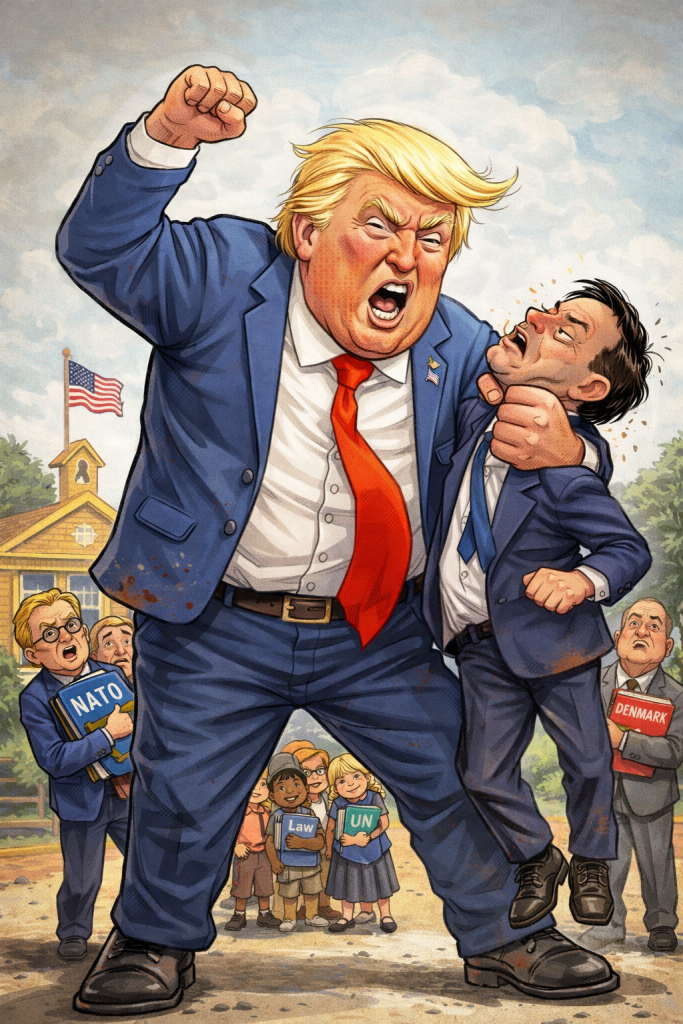
The letter to Norway’s Prime Minister Jonas Gahr Støre attributed to the US President Donald J. Trump reads less like a statesman’s communication and more like the outburst of a familiar character from school days—the class dunce who was also the bully. Not the brightest student, but loud enough, aggressive enough, and backed by a gang of delinquents and spineless followers who mistook intimidation for leadership. When challenged, he didn’t argue; he shoved. When contradicted, he didn’t reason; he picked a fight.
This, unfortunately, is not just a personality flaw. In international relations, personality—when fused with power—can become doctrine.
Trump’s worldview, as reflected in this missive, is rooted in a crude, pre-modern understanding of power: might makes right, ownership flows from force or convenience, and moral restraint is optional when one believes oneself indispensable. This is not realism as taught in textbooks; it is realism as practised by street bullies.
Let us begin with the absurd proposition at the heart of the argument: that Denmark has no legitimate claim over Greenland because it cannot “protect” it sufficiently, and that historical ownership is questionable because it rests on who landed there first with boats.
This logic would embarrass even first-year students of international relations.
When Power Replaces Law
Modern international order rests on Westphalian sovereignty, reinforced after 1945 by the UN Charter. Territory is not a casual prize awarded to the loudest claimant. Sovereignty is recognised through law, treaties, continuity of administration, and international recognition, not by who can deploy more aircraft carriers.
If inability to militarily defend territory invalidates ownership, then dozens of small states cease to exist overnight. By that logic, Iceland, Bhutan, or even Luxembourg would be fair game for any power with superior force. The world abandoned this logic precisely because it led to catastrophe—twice—in the 20th century.
Trump’s thinking is not realism; it is pre-1945 imperial entitlement, dressed up in the language of security.
The Historical Amnesia
Now to the boat argument.
Yes, boats landed in Greenland centuries ago. Boats also landed on the eastern shores of North America—first by Norse explorers, then by waves of Europeans from Britain, Spain, France, and the Netherlands. If landing boats is the benchmark for rightful ownership, then the logical conclusion is devastating for Trump’s thesis.
Because by that standard, the United States itself is illegitimate.
Following Trump’s own logic, America does not belong to Europeans or their descendants. It belongs to the Native American nations who lived there for millennia before Columbus was even a footnote in history. They did not merely land boats; they built civilizations, governance systems, cultures, and spiritual relationships with the land.
European settlers arrived not with moral authority, but with guns, disease, and displacement. If history is to be reduced to crude arrival narratives, then the only consistent conclusion is that modern America is a historical accident sustained by power, not legitimacy.
That is precisely why international law evolved—to prevent endless retroactive claims and perpetual wars based on selective memory.
Trump’s argument inadvertently exposes the fragility of his own nation’s moral foundations.
NATO as a Protection Racket?
Equally juvenile is the claim that Trump has “done more for NATO than anyone since its founding” and that NATO now “owes” the United States.
This is not alliance politics; it is transactional blackmail.
NATO was not formed as a favour to Europe. It was a strategic instrument serving American interests—containing Soviet influence, stabilising Western Europe, and preventing another continental war that would inevitably drag the US back into conflict. The alliance benefited Washington as much as, if not more than, its partners.
To frame NATO as a debt collector’s ledger is to misunderstand alliances entirely. Alliances endure not because of invoices, but because of shared threat perception, trust, and institutional continuity. Once reduced to extortion, alliances collapse—and history shows that great powers rarely survive long after alienating their allies.
The Greenland Obsession and Imperial Nostalgia
The insistence that the world is unsafe without “complete and total control” of Greenland reveals a deeper pathology: imperial nostalgia. The belief that global order requires territorial domination rather than cooperation.
Greenland is strategically important, yes. The Arctic is geopolitically sensitive, undeniably. But strategic access is not the same as ownership. The US already maintains military presence and cooperation agreements there—without violating sovereignty.
Trump’s demand is not about security; it is about possession. The language of “complete and total control” belongs not to modern diplomacy, but to colonial charters and conquest-era proclamations.
The Real Danger
The real danger is not Trump’s ignorance. Ignorance can be corrected. The danger is confidence without comprehension, power without reflection, and a worldview that mistakes bullying for leadership.
In school, the bully eventually grows up—or is contained by rules. In global politics, when the bully sits at the head of the class with nuclear codes, the stakes are infinitely higher.
Trump’s worldview collapses under the weight of its own contradictions. His historical logic delegitimises his own country. His alliance logic undermines American power. His security logic destabilises the very order that enabled US dominance.
In the end, this is not about Greenland, NATO, or Denmark. It is about whether the world is governed by law, memory, and mutual restraint, or by the loudest boy in the room throwing his weight around and calling it destiny.
History, fortunately, has a habit of disciplining bullies—if not immediately, then inevitably.
And when it does, it never asks how loudly they shouted, but how wisely they led.
 This is News