

Lalit Shastri
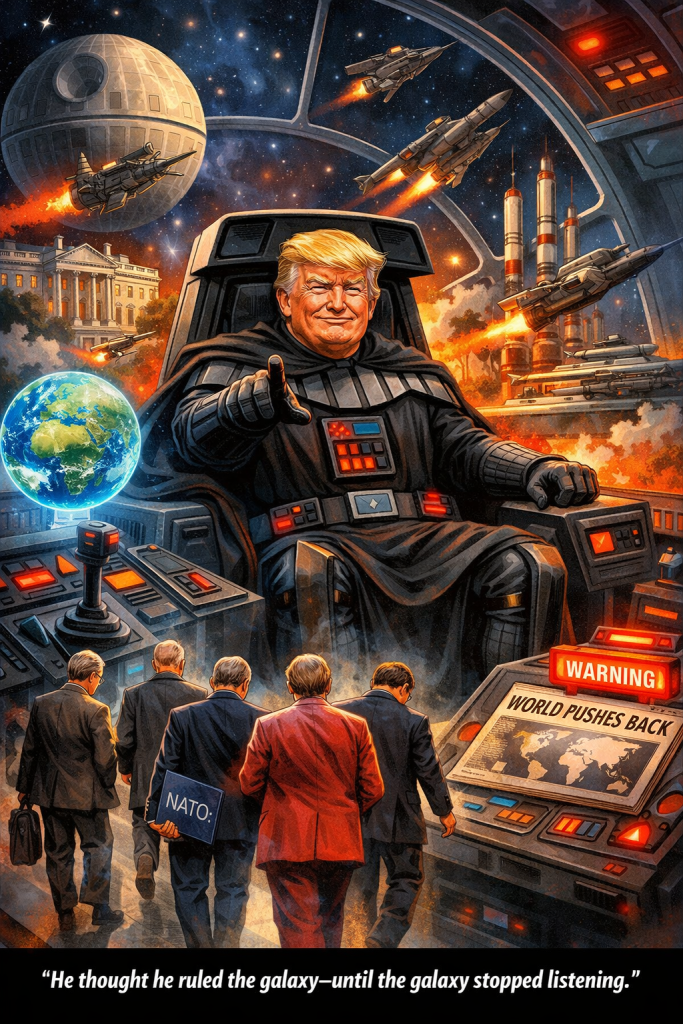
Sometimes it feels as though Donald J. Trump is not a product of American politics at all, but a character who wandered in from a Hollywood sci-fi franchise—a Star Wars–style villain who crash-landed from a distant planet, promptly occupied the White House, and seized control of the world’s most sophisticated machinery of mass destruction.
Not weapons alone—though those too—but the far more lethal arsenal of fear, spectacle, and intimidation.
In this cinematic universe, Trump plays the self-declared Emperor who believes the galaxy exists only to obey. Diplomacy is weakness. Allies are expendable. Treaties are scraps of paper. And any planet—read country—that refuses to fall in line is threatened with tariffs, sanctions, humiliation, or total abandonment. It is less foreign policy and more intergalactic decree: You are either with me, or you are irrelevant.
Like all such movie villains, Trump appears convinced that power flows from noise. The louder the threat, the greater the authority. The bigger the spectacle, the deeper the fear. Subtlety has no place in his cosmos. Nuance is for lesser beings. Complexity is treason.
This is not how real leadership works.
But it is exactly how bad cinema writes its antagonists.
The trouble begins when fiction mistakes itself for reality.
Trump’s worldview resembles that of a conqueror who has mistaken a multiplex for a map of the world. He talks as though nations are franchises to be acquired, governments are hostile takeovers, and global order is a subscription service that can be cancelled if the dues feel too high. NATO becomes a protection racket. Trade becomes extortion. Sovereignty becomes a privilege granted at Washington’s pleasure.
In such films, the Emperor always believes the superweapon will guarantee obedience. Control the Death Star, and the galaxy will kneel. Control sanctions, markets, currencies, and threats—and the world will comply.
History, however, is a poor scriptwriter for tyrants.
The world does not end when an Emperor shouts. It reorganises.
Quietly at first. Then steadily.
Alliances deepen without him. Supply chains shift. Strategic autonomy grows. Countries learn, painfully but decisively, that dependence on one volatile centre of power is a strategic error. What begins as fear eventually turns into fatigue—and fatigue into resolve.
The most telling flaw in Trump’s cinematic fantasy is that he imagines the rest of the world as extras. In reality, they are co-authors. Europe recalibrates. Asia hedges. The Global South refuses to audition for the role of obedient background character. Even America’s own institutions—judiciary, press, civil society—begin acting like the resistance movements every sci-fi saga eventually produces.
No blasters required. Just time, law, and memory.
Every nightmare villain believes himself eternal. Yet the pattern is always the same. The costume frays. The monologues grow repetitive. The threats lose their shock value. What once looked like omnipotence begins to resemble isolation.
And then comes the quiet ending no tyrant anticipates.
Not explosion.
Not annihilation.
But irrelevance.
The nightmare does not end with the galaxy in flames. It ends with the Emperor shouting into a void that no longer listens. The control panels still blink, but fewer hands respond. The decrees still come, but they echo less. The illusion of absolute power collapses under the weight of global coordination and institutional resilience.
The world does not need to “blow him into smithereens.”
It only needs to outgrow him.
That, in the end, is the great irony of Trump’s cinematic presidency. He imagined himself the centre of the universe. He may instead be remembered as a cautionary character—a reminder that even in the age of spectacle, reality has a longer attention span than any bully from another planet.
The credits will roll.
The lights will come on.
And the world, bruised but wiser, will walk out of the theatre—ready to write a better sequel.
 This is News