

Lalit Shastri
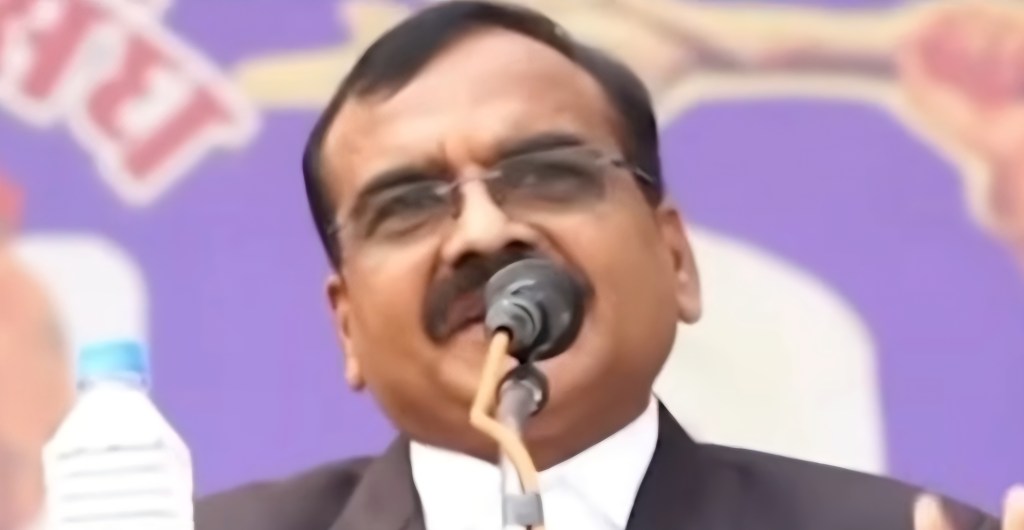
A shocking and deeply disturbing video is in the public domain from the 23 November AJJAKS (Madhya Pradesh SC ST Officers and Employees Association) convention in Madhya Pradesh, where senior IAS officer and newly elected AJJAKS president Santosh Verma publicly declared that reservation on caste basis should continue until a Brahmin “gives his daughter” to his son or “forms a sambandh” (relationship) with him. This was not a stray comment muttered in haste. It was spoken from a public stage by a serving officer of the Indian Administrative Service — the very cadre entrusted with protecting constitutional values and social harmony. When a senior bureaucrat uses the language of sexual barter to discuss caste policy, the nation must ask whether we are witnessing activism, arrogance, or the vulgarisation of public discourse beyond redemption.
“This was not a slip of tongue. It was a deliberate sexualisation of caste identity from a public stage.”
This single statement, uttered from a public platform by a serving IAS officer, is shocking enough in itself. A remark that sexualises women of a particular community and links their dignity to the continuation of a constitutional policy does not require repetition to reveal intent. One such utterance is sufficient to expose a mindset that is demeaning, objectifying and deeply problematic.
A Sacred Ritual Dragged into Vulgarity
It must also be emphasised that the word “दान” in this context traditionally refers to कन्यादान, a sacred component of Hindu marriage ceremonies symbolising blessings, responsibility and familial union, not the crude notion of “donating” a daughter as an object. To reduce कन्यादान to a transactional “giving away” is itself a distortion of cultural meaning. Yet Verma went further: instead of using respectful and culturally accurate terms such as “शादी,” “विवाह,” or even कन्यादान in its solemn sense, he paired the ritual word with the sexually loaded phrase “संबंध बनाना,” thereby dragging a sacred matrimonial tradition into vulgarity and humiliation. His phrasing effectively transformed कन्यादान—a symbolic act of parental blessing—into a bargaining chip in caste politics, stripping it of dignity and turning it into a vulgar punchline. The insult, therefore, does not arise from the Hindu ritual, but from his deliberate choice to trivialise and sexualise it.
Some may now attempt to sanitise Verma’s words by arguing that he merely referred to marriage. However, this defence collapses both linguistically and culturally. In common Hindi usage, the phrase “संबंध बनाना” is not used to describe marriage; it denotes the establishment of a sexual relationship. An educated IAS officer, trained in communication, fully understands this distinction. A person who genuinely wanted to speak about marriage would have used the clear and culturally appropriate terms “शादी,” “विवाह,” or “रिश्ता.” His deliberate choice of a double-meaning expression allowed him to inject vulgarity into the discourse while retaining a superficial layer of plausible deniability.
By couching his remark in this ambiguous yet sexually loaded language, he sought to ridicule a community, commodify its women, and reduce a sacred ritual to a vulgar punchline—all while leaving room to later claim that he was merely referring to marriage.
“When a senior IAS officer speaks the language of sexual barter, the Constitution itself is insulted.”
यह भी महत्वपूर्ण है कि यदि वर्मा वास्तव में सामाजिक समरसता या पारस्परिक स्वीकृति की बात करना चाहते, तो उनके पास एक कहीं अधिक सम्मानजनक और सकारात्मक अभिव्यक्ति उपलब्ध थी। वह आसानी से कह सकते थे, “जब तक किसी ब्राह्मण परिवार में मेरी बेटी को बहू के रूप में स्वीकार नहीं किया जाता,” या इसके विपरीत, “जब तक हमारे परिवार में किसी ब्राह्मण बेटी को बहू के रूप में स्वीकार नहीं किया जाता,” जो विवाह और पारिवारिक संबंधों के माध्यम से परस्पर सम्मान और सामाजिक एकीकरण का संकेत देता। ऐसी भाषा न केवल सांस्कृतिक रूप से उपयुक्त होती, बल्कि महिलाओं को समान और स्वायत्त व्यक्ति के रूप में स्वीकार करने वाली होती।
लेकिन वर्मा ने इस सम्मानजनक और समतामूलक विकल्प को पूरी तरह नज़रअंदाज़ किया और इसके बजाय केवल इस पर ज़ोर दिया कि एक ब्राह्मण बेटी को उनके बेटे को “दान” किया जाए या उससे “संबंध” बनाया जाए। यह एकतरफ़ा, लैंगिक भेदभावपूर्ण, स्त्री-विरोधी और अपमानजनक दृष्टिकोण को उजागर करता है जिसमें महिला की भूमिका केवल प्राप्त की जाने वाली वस्तु या यौन उपलब्धता तक सीमित कर दी जाती है, न कि एक समान, अधिकार सम्पन्न और स्वायत्त व्यक्ति के रूप में।
English rendering of the above:
It is equally important to note that if Verma truly wished to speak about social harmony or mutual acceptance, he had a far more respectful and positive expression available to him. He could easily have said, “until a Brahmin family accepts my daughter as their daughter-in-law,” or conversely, “until our family accepts a Brahmin daughter as our daughter-in-law,” which would have reflected mutual respect and social integration through marriage and familial relationships. Such phrasing would not only have been culturally appropriate, but would also have acknowledged women as equal and autonomous individuals.
Instead, Verma completely ignored this respectful and egalitarian alternative and chose to emphasise only that a Brahmin daughter should be “given” to his son or that a “relationship” should be formed with her. This reveals a one-sided, gender-discriminatory, anti-women and degrading mindset, in which a woman’s role is reduced to that of an object to be acquired or sexually accessed, rather than an equal, empowered and autonomous individual.
Verma’s Defence Makes It Worse
Verma’s subsequent defence only deepens the concern. In his clarification, he claims that his remark must be understood in the broader context of a 27-minute speech about “सामाजिक समरसता” and “रोटी-बेटी का व्यवहार,” suggesting that he was advocating inter-caste harmony. Yet his own explanation exposes the problem: even when speaking about social integration, he framed the idea exclusively as a Brahmin daughter entering his family, never as mutual acceptance or reciprocity. The traditional expression “रोटी-बेटी का व्यवहार” culturally implies two-way familial ties, but Verma reduced it to a one-directional acquisition of a woman from another community. His defence therefore does not neutralise the misogyny—it confirms it. It reveals that even in his supposedly positive context, a woman remains an object to be transferred, not an autonomous participant in relationships.
Even more troubling is that Verma’s own explanation reveals that he believes caste-based reservation should continue until such a personal and socially demeaning condition is fulfilled, and only thereafter should the system shift to an economic basis. In other words, the transition from caste-based to economic reservation, in his view, is contingent not upon social indicators, constitutional principles or measurable upliftment, but upon a symbolic act involving the movement of a woman between families. This framing reduces the dignity and autonomy of women to a trigger point for constitutional reform, making their bodies and relationships the deciding factor for national policy. When a senior IAS officer links the future of reservation policy to the acquisition of a woman from another community, the issue is no longer ideological—it becomes deeply personal, patriarchal and dangerous.
A Direct Assault on Constitutional Morality
The implications of this remark are grave. It objectifies women as sexual commodities, degrades Hindu cultural traditions, incites caste hostility and legitimises humiliation as political discourse.
Legal and Administrative Consequences Must Follow
Prima facie, Verma’s public statement appears to attract criminal liability under the Bharatiya Nyaya Sanhita, including provisions dealing with acts prejudicial to national integration, promoting enmity between distinct social groups, and insulting the dignity of women through sexually loaded and derogatory remarks. The statement may render him liable for prosecution under Section 197 (acts prejudicial to national integration), Section 353 (promoting enmity between distinct social groups), Section 326 (outraging the dignity of women through obscene or degrading expression), and other relevant provisions of the BNS. Whether prosecution is ultimately initiated will depend on due legal process, but the law clearly provides for action in cases where public statements jeopardise social harmony and demean the dignity of women. Beyond criminal liability, the remark constitutes a serious violation of the All India Services (Conduct) Rules, which require officers to maintain dignity, decency, impartiality and communal harmony in both speech and behaviour.
Silence Now Would Be Complicity
“Silence now would legitimise a dangerous new vocabulary of caste humiliation and misogynistic aggression.”
India cannot afford to trivialise this moment. A senior IAS officer did not merely hurt sentiments; he dragged a sacred ritual into obscenity, sexualised caste identity, demeaned women, and publicly advocated humiliation that strikes at the core of national integration. If such speech attracts no consequences, it will legitimise a new, dangerous vocabulary in public life. silence in the face of such behaviour would amount to complicity. The system must respond with firmness and legal clarity.
 This is News