

Lalit Shastri
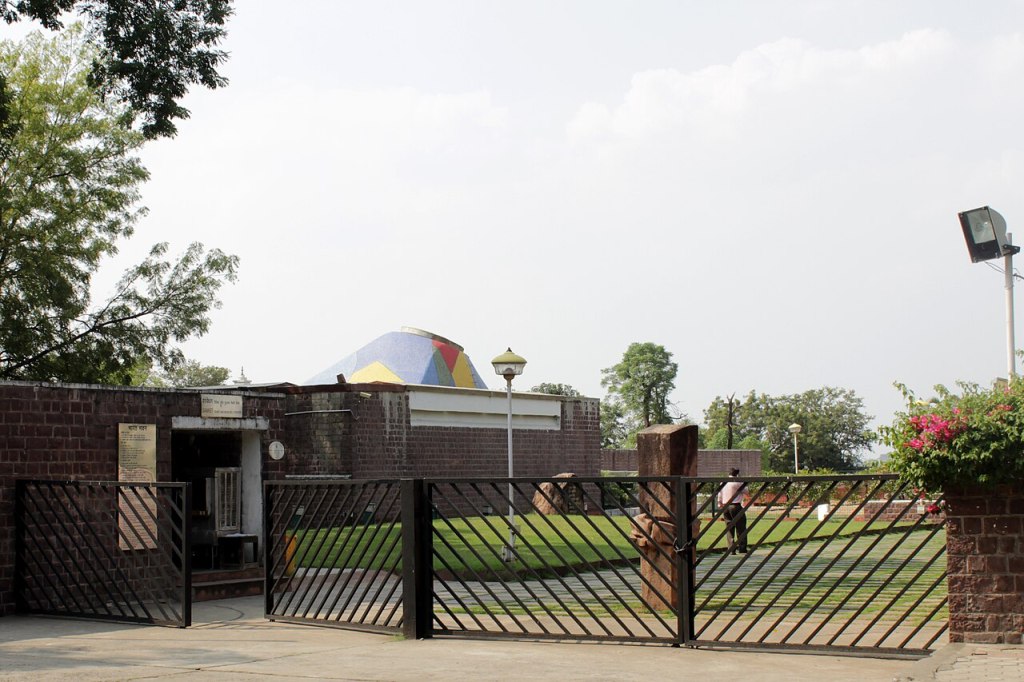
Bharat Bhawan, inaugurated by Indira Gandhi in 1982, was hailed as a bold cultural milestone. In reality, it recycled concepts Correa had already tested in Mumbai. Add to that the design flaws of the Madhya Pradesh Assembly, and the untouchable aura around him begins to crumble.
Charles Correa is often celebrated as India’s greatest modern architect—a visionary who gave us Bharat Bhawan in Bhopal, the new Madhya Pradesh Assembly building, and countless other landmarks. But beneath the halo of accolades and national awards lies a story that is far less flattering. His work, when examined closely, exposes repetition, conceptual shortcuts, and glaring design failures.
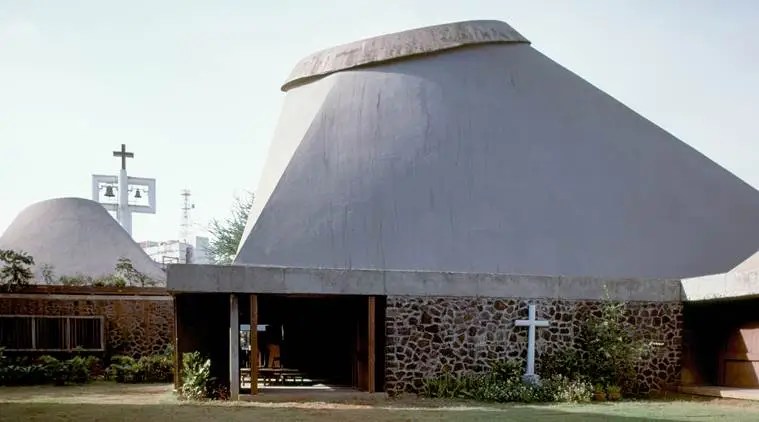
Take the Our Lady of Salvation Church in Dadar, Mumbai. Renovated by Correa in 1977, it was praised as groundbreaking: the steeples and Gothic arches were stripped away, replaced by stark conical domes, interconnected walkways, and a courtyard meant to serve as much for congregation as the interiors. Correa himself dressed this up in lofty language, writing about the axis mundi—the universal column linking heaven and earth—expressed through the “open-to-sky” conical flues.
Far from being an act of radical imagination, Bharat Bhawan is nothing but a repackaged rerun.
Now, turn to Bharat Bhawan, inaugurated in 1982 by the then Prime Minister Indira Gandhi and hailed as Correa’s masterpiece. But look closely, and you’ll see the same recycled vocabulary: pyramidal and conical roofs, inward-facing courtyards, the same “open-to-sky” symbolism. What was praised as spiritual innovation in a Mumbai church became a cultural breakthrough in Bhopal. Different client, different city, same cut-and-paste formula.
This was not a one-off lapse. The “modern” Madhya Pradesh Assembly, also designed by Correa, managed what the old Assembly never did—it blocked one-third of the House from the press gallery. From where journalists sat, nearly a third of the proceedings were invisible.
The ‘modern’ Madhya Pradesh Assembly blocked one-third of the House from view — a failure the old building never had.
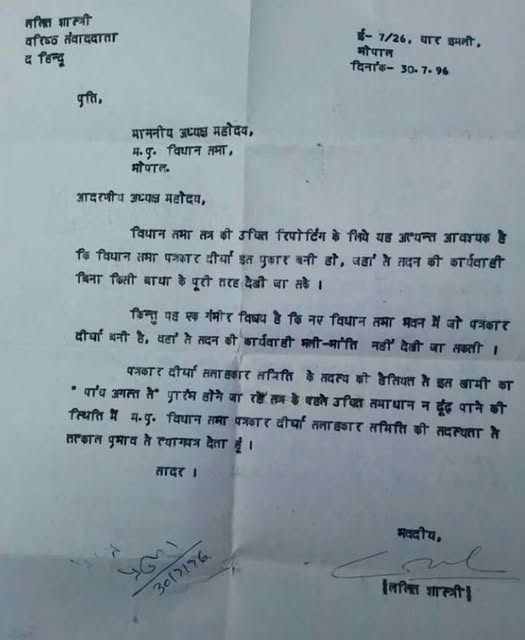
Respected Speaker,
For proper reporting of the Assembly proceedings, it is very important that the press gallery in the Vidhan Sabha is built in such a way that the proceedings of the House can be seen completely without any obstruction.
But it is a serious matter that the proceedings of the House cannot be seen properly from the press gallery built in the new Vidhan Sabha building.
As a member of the Press Gallery Advisory Committee, in the event of not being able to find a proper solution to this shortcoming before the session starting from August 5 (1996), I resign from the membership of the MP Vidhan Sabha Press Gallery Advisory Committee with immediate effect.
Regards.
Yours sincerely,
Lalit Shastri
30 July 1996
(The Assembly building was inaugurated by the then President Dr Shankar Dayal Sharma on 3 August 1996)
When I raised this issue, those in charge had no answers. Instead, the attitude was one of arrogance: take it or leave it. I left. In 1996, I resigned from the Press Advisory Committee in protest. Ironically, the old Assembly building had provided a clear, complete view of the House—something the “modern” marvel failed to deliver.
Here lies the uncomfortable truth: Correa, shielded by his larger-than-life reputation and establishment reverence, was never held accountable.
Correa, shielded by his larger-than-life reputation, was never held accountable for recycling ideas or flawed designs.
Instead of being questioned for recycling motifs or delivering flawed designs, he was lionized. The press, the architectural community, and the political class all contributed to building an untouchable myth around him.
Bharat Bhawan is not the triumph of originality it is made out to be; it is a hand-me-down from a church design in Mumbai. The Assembly building is not a democratic monument but a space that quite literally obstructs democratic transparency.
Indira Gandhi may have inaugurated Bharat Bhawan as a symbol of cultural renaissance. In truth, Bhopal received only architectural déjà vu.
For all the talk of genius, Correa’s legacy is riddled with borrowed ideas and uncorrected mistakes. Indira Gandhi may have inaugurated Bharat Bhawan as a symbol of India’s cultural renaissance. In truth, what Bhopal received was not a burst of originality but an act of architectural déjà vu—proof that even icons can fall back on the comfort of repetition, and still be applauded as visionaries.
