
Lalit Shastri
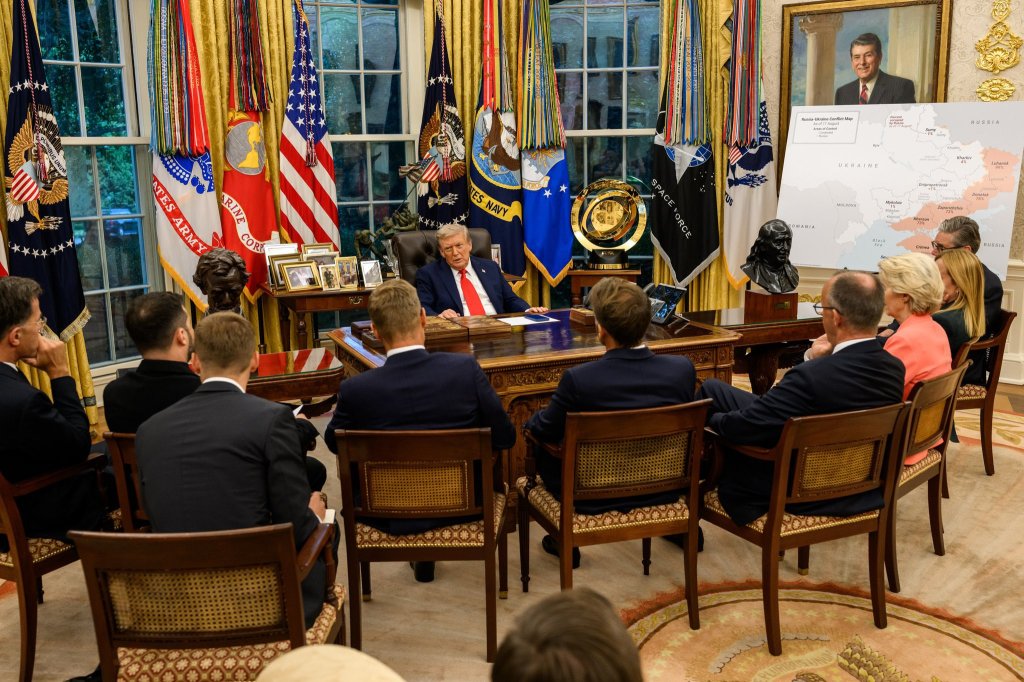
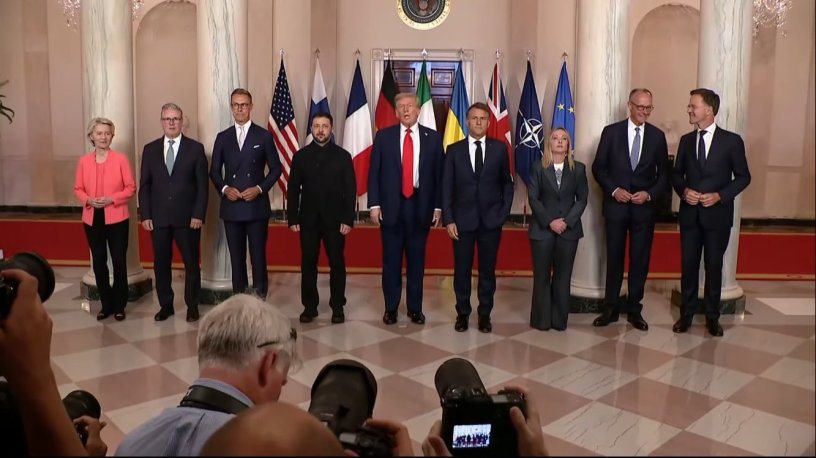
On 18-19 August, the carefully curated photograph of President Donald Trump surrounded by the leaders of Britain, France, Germany, Italy, Finland, the European Union, NATO and Ukraine inside the Oval Office was presented as evidence of an alliance united in purpose and action. In reality, it reflects the unsettling emergence of two parallel realities in the global order. One is the increasingly desperate attempt by the transatlantic establishment to preserve its role as arbiter and authority. The other is the unmistakable signaling by the rest of the world that this authority has already eroded, and that no amount of choreography, symbolism or diplomatic posturing can restore it.
Volodymyr Zelensky arrived at the White House this week not as a wartime leader seeking peace but as an actor playing to a script where the endgame is neither peace nor decisive victory. With his mandate practically exhausted and his legitimacy frayed, his primary function at this juncture is to buy time — for himself and, more importantly, for those powers that see in the Ukraine conflict not a tragedy but an opportunity. His posture before Trump — accommodating, deferential, supportive of humanitarian gestures and open to new formats of talks — is neither surprising nor commendable. It is part of a broader strategy of deflection: the difficult questions about a real ceasefire, the heavy dependence on Western armaments, and the possibility of freezing the conflict rather than resolving it, are being outsourced to the European leaders flanking him in the Oval Office. Those leaders, in turn, are silently aligned on one point: the war should not end so long as it continues to serve the geopolitical and military-industrial objectives of those underwriting it.
In Washington, there is little appetite to stop the war. The American public has been fed a narrative of heroic rescue and democratic salvation. The strategic community, meanwhile, views the conflict as a low-cost tool for degrading Russian capacity without deploying U.S. troops. As costs escalate, financial responsibility is now being transferred to the Europeans, who are willingly expanding their war chest. The simple question — in whose interest is it to stop the war — hangs in the air unanswered. The peace talks that Trump keeps referring to may go through the expected motions, but behind closed doors nobody is preparing for an actual settlement. What is being prepared instead is the next stage of stalemate: a phase in which both Russia and Ukraine will be compelled to escalate in their own ways, simply to avoid being seen as yielding.
Against this backdrop, what is particularly striking is the gradual pivot of this entire axis towards India. There is a growing conviction in Washington’s strategic circles that if Russia is to be pressured, it must be done indirectly — by constraining its strongest civilisational and economic partner, India. Trump appears to have accepted this logic, perhaps without grasping the larger implication. By turning its guns on India, the United States is effectively declaring to the wider world who, in its perception, is now the principal challenger to the Western-led order. It is not China, the world’s second-largest economy and a country that has already weathered and bypassed U.S. sanctions and containment efforts. It is India — the country that has consistently refused to fall in line, has deepened its strategic autonomy in energy and defence, and has signalled to its diaspora that the time has come to root its future in the Indian civilisational space, not in the temporary comforts of the West.
This is not a sudden development. It is the culmination of a long game that began well before Trump returned to the White House. The fact that New Delhi did not wade blindly into the post-Sheikh Hasina transition in Bangladesh, or the way it has calibrated its response to Afghanistan and the broader Indo-Pacific, suggests that India is not unaware of the gears that have been set in motion. In fact, it is quietly preparing for precisely this scenario: a moment when the United States would begin to leverage its full range of coercive instruments – diplomatic, economic and informational – to bring India to heel, something they will never be able to do. The Oval Office image, therefore, is less a show of unity and more a reminder to the rest of the world of how limited that unity actually is. When the so-called leaders of the “free world” gather on cue to discuss peace, yet fail to utter a single word about stopping the war, the only logical conclusion is that peace is not the objective.
And that raises the larger point: the world is not defined by a room of formally dressed transatlantic figures repeating old mantras. It is defined by those countries that no longer seek permission to pursue their interests. Increasingly, large parts of Asia, Africa and Latin America recognise that the era of Western arbitration is ending. The sooner Washington accepts that reality, the less disruptive the transition will be. If it continues to believe that summoning its European partners into a gilded room will change the course of history, it will soon discover that history has already moved on.
