
ThisisNews Network
As the dust settles over Iran’s scorched nuclear terrain, the temporary ceasefire announced by the United States appears to hold—for now. Yet beneath this momentary calm lies a web of unfinished business, strategic signaling, and veiled intentions. The barrage of strikes launched by Israel with direct American support last week targeted key Iranian nuclear facilities, including Fordo and Natanz, creating massive surface craters captured in satellite imagery. But as ThisisNews Network reported on June 23—well before global media caught on—the reality beneath the rubble tells a far more nuanced story.
Contrary to public claims by Israeli and American officials about having “crippled” Iran’s nuclear infrastructure, there is a growing body of evidence suggesting the assault fell short of obliterating the Islamic Republic’s deep underground complexes. ThisisNews Network was among the first to highlight the absence of crater depth, noting that there were no visible signs of the kind of bunker-busting sequences required to destroy Iran’s fortified subterranean chambers. While President Donald Trump declared total success within hours of the U.S. B-2 bomber strikes, our analysis revealed no indicators of penetration beyond surface-level installations.
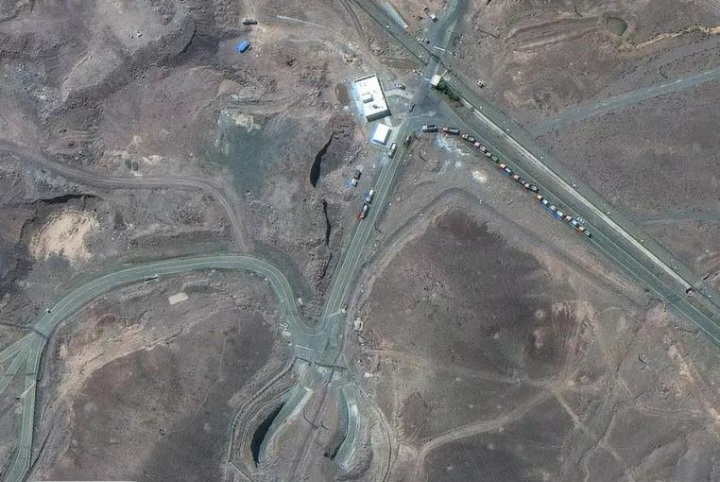
Further supporting this assessment were satellite images from Fordo captured just two days before the bombing campaign. These images showed at least 16 cargo trucks parked near the facility, strongly suggesting that Iran had forewarning and had likely moved vital nuclear assets, including enriched uranium and advanced centrifuge components, out of the strike zone in advance. This strategic withdrawal, now corroborated by subsequent intelligence assessments, blunted the effectiveness of the much-publicized aerial assault.
Even within the U.S. intelligence community, as has now been reported, a more tempered evaluation is emerging. Officials concede that Iran’s nuclear delay may be a matter of months—not years—and that Tehran retains sufficient material and scientific capacity to rebound quickly. While key scientists were reportedly killed in the strikes, Iran’s decentralized and redundant structure means technical expertise remains intact.
Meanwhile, Iran’s retaliatory missile attacks on Israel—some of which struck close to the Soroka Medical Center in Beersheba—have tested the resolve of the Israeli defense establishment. Though no mass casualties have been reported from that specific strike, the psychological impact was significant. Israel’s Iron Dome intercepted a majority of incoming projectiles, but scattered damage and casualties across the southern region kept military units on alert.
Civilian casualties on both sides continue to mount. Israeli authorities have confirmed at least 28 deaths, while Iranian sources report over 600 killed—including civilians, nuclear personnel, and members of the Islamic Revolutionary Guard Corps. The attacks also caused infrastructural damage, raising concerns of hazardous leaks from sensitive sites, though official confirmation remains absent.
Diplomatic backchannels, spearheaded by the United States, Qatar, and the European Union, are now attempting to revive dialogue. Talks surrounding a possible reentry into the 2015 Joint Comprehensive Plan of Action (JCPOA) have resurfaced, though trust between parties remains fragile. European negotiators have warned that failure to build on the ceasefire could lead to renewed sanctions and instability across the Gulf.
Yet Tehran’s posture remains one of calculated defiance. Iran’s supreme leader Ayatollah Ali Khamenei has refrained from public comment but is believed to have authorized the dispersal of remaining nuclear assets to secure, undisclosed locations. Current estimates suggest Iran still possesses over 400 kilograms of enriched uranium—enough to construct multiple nuclear devices if it chooses to cross the weapons threshold.
For Israel, the stakes are existential. Prime Minister Benjamin Netanyahu has pledged continued vigilance and warned of further strikes should Iran resume enrichment activities. Military analysts expect preemptive operations if any sign of nuclear reassembly is detected.
In Washington, the US President Trump is attempting to strike a balance between projecting dominance and avoiding entanglement. Having declared the mission a success, his administration must now contend with the possibility that the operation may have been more performative than permanent in its impact. With an eye on the 2026 elections, Trump is eager to portray himself as a leader who neutralized two adversaries—Iran and its nuclear program—with precision and restraint. But facts on the ground remain in flux.
ThisisNews Network stands by its early and continuing assessment: Iran’s nuclear ambitions have been dented, but not destroyed. The United States and Israel may have succeeded in delivering a powerful message—but whether that message has deterred or merely delayed remains to be seen. As both sides regroup and recalibrate, the fragile ceasefire may offer the last opportunity for diplomacy before another phase of this shadow war erupts.
