
Lalit Shastri
BrahMos Devastation and Pakistan’s Desperate Bet on IRIS-T SLM
In the aftermath of India’s devastating use of BrahMos cruise missiles during Operation Sindoor, Pakistan finds itself scrambling for answers—military, political, and psychological. One such response appears to be the hurried pursuit of the German-made IRIS-T SLM air defense system. But will this imported shield be enough to counter India’s offensive dominance?
India Redraws the Battlefield with BrahMos
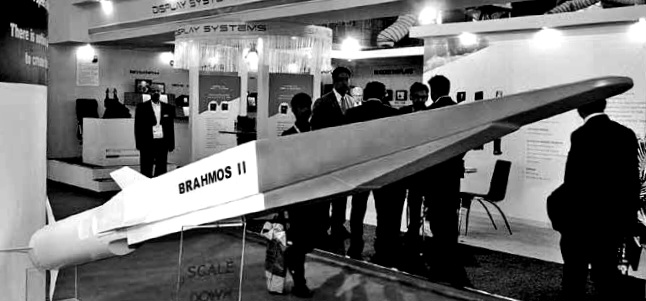
India’s precision strikes during Operation Sindoor, which penetrated deep into hostile territory and neutralized key Pakistani air assets, have marked a decisive shift in the regional military balance. The BrahMos missile, known for its Mach 3 speed, low-altitude trajectory, and pin-point accuracy, demonstrated the futility of legacy surface-to-air missile (SAM) systems when pitted against modern cruise missile warfare.
Pakistan’s Chinese-origin air defense systems failed to react in time or intercept any incoming threat. The result was a trail of destruction at critical airbases—highlighting both technological lag and tactical vulnerabilities.
IRIS-T SLM: The Imported Firewall
In response, Pakistan is now reportedly pursuing the IRIS-T SLM—a medium-range mobile air defense system developed by Germany’s Diehl Defence. It is designed to intercept aircraft, drones, and subsonic cruise missiles, and has been tested in European conflict theatres.
However, the choice raises serious strategic questions. Will this foreign air defense system provide any credible deterrent against a modern missile force like India’s? Can it match the speed, range, and operational versatility of the BrahMos or the upcoming BrahMos II?
Side-by-Side Strategic Comparison
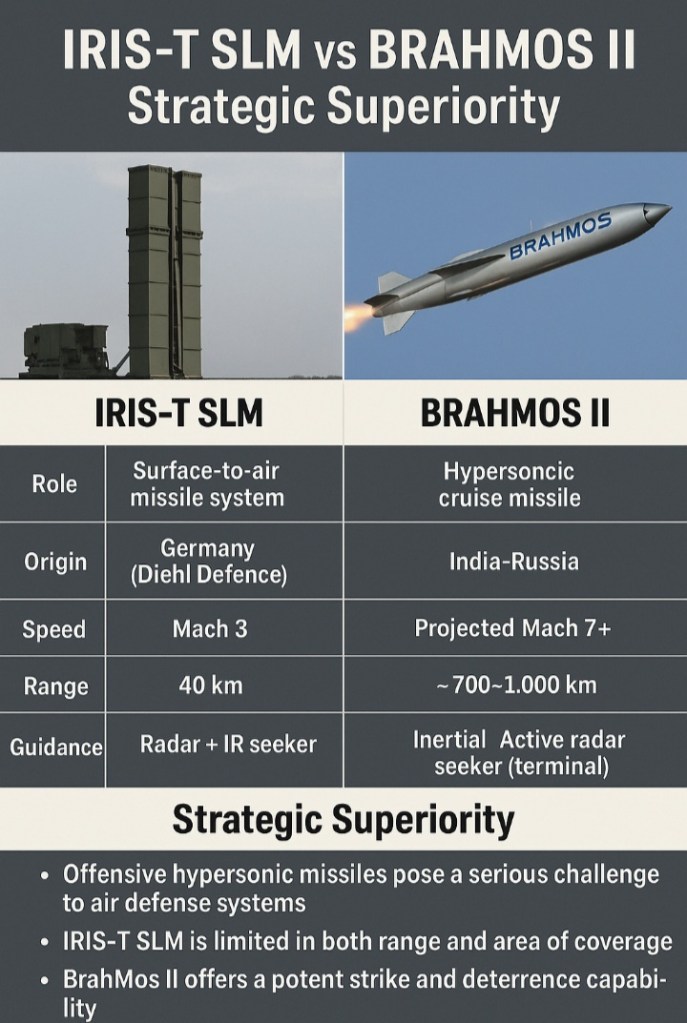
| System | IRIS-T SLM | BrahMos II |
|---|---|---|
| Role | Surface-to-Air (Defensive) | Hypersonic Cruise Missile (Offensive) |
| Origin | Germany | India-Russia |
| Range | ~40 km (interception) | ~700–1,000 km (strike) |
| Speed | Up to Mach 3 | Projected Mach 7+ |
| Purpose | Intercept aircraft, drones, cruise missiles | Pre-emptive or retaliatory strikes on strategic targets |
| Deployment | Mobile launchers for localized protection | Land, air, sea, and sub launched for wide strategic reach |
| Guidance | Radar + IR seeker | Inertial + Active radar seeker |
Strategic Realities: A Shield with Cracks
Pakistan’s motivation to acquire the IRIS-T system appears to stem from its recent exposure to BrahMos precision strikes and the failure of its Chinese-supplied air defense systems to respond effectively. But tactically and strategically, IRIS-T SLM falls short:
- Limited Coverage: It is a point-defense system — effective only within a small radius. With India’s missiles striking from hundreds of kilometers away, its utility is geographically constrained.
- Outdated Against Hypersonics: With BrahMos II advancing toward hypersonic speeds (Mach 7+), Pakistan’s system—designed for supersonic threats—is already at the edge of its effectiveness window.
- Dependence on Foreign Subsidies: The potential external financing of this acquisition exposes Pakistan’s fragile economic posture and dependency on foreign defense sponsors, rather than self-sustained strategic planning.
India’s Advantage: Strike First, Strike Deep
While Pakistan is resorting to imported patches for air defense, India has evolved a comprehensive offensive ecosystem:
- Multi-platform missile deployment: land, sea, air, and undersea.
- Integrated real-time surveillance and targeting
- A roadmap toward hypersonic and AI-assisted missile systems
- Indigenous production and Make in India military doctrine
The BrahMos program is not just about missiles — it’s about building a strike doctrine that is fast, flexible, precise, and deeply indigenous.
Deterrence vs Superiority
Let’s distill the real difference in strategic effect:
| Parameter | IRIS-T SLM | BrahMos II |
|---|---|---|
| Strategic Value | Point-defense asset | Theater-level deterrent and first-strike weapon |
| Cost Effectiveness | High cost per limited coverage | Force multiplier across platforms |
| Technology Trajectory | Static, focused on current threats | Rapidly evolving into hypersonic, AI-enhanced capability |
| Geopolitical Autonomy | Dependent on suppliers | Indigenous capability with export potential |
Firepower Trumps Firewall
Pakistan’s move to acquire IRIS-T SLM is reactionary, not visionary. It may offer tactical protection to a few select targets, but it does not shift the strategic balance. India’s integrated and self-reliant missile doctrine, centered on BrahMos and its successors, has redefined deterrence in South Asia.
In warfighting calculus, dominance belongs to the side that strikes on its terms.
A few imported shields cannot compensate for a doctrine that lacks coherence, depth, or autonomy.
 This is News