

Lalit Shastri
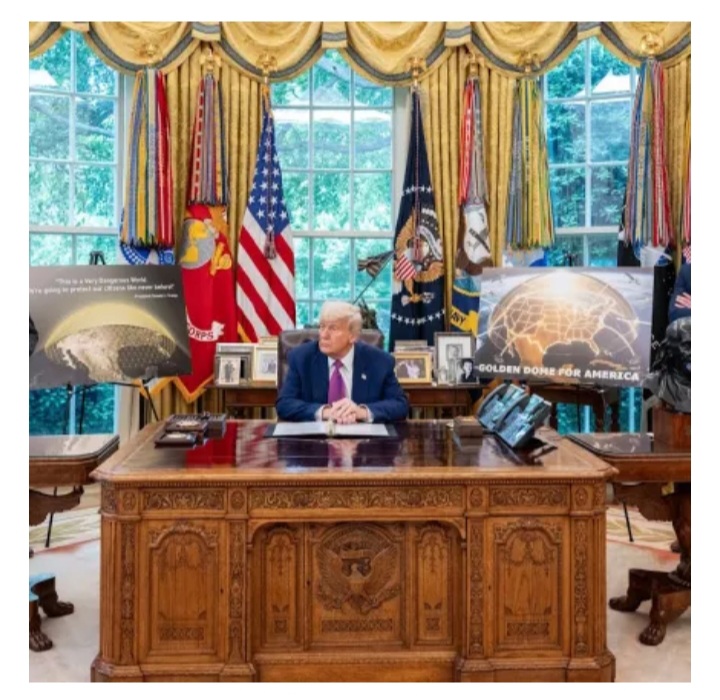
U.S. President Donald Trump’s announcement on 20 May of a $175 billion “Golden Dome” missile defense initiative is far more than a domestic defense policy move. It is the ignition key to a new phase of the global space race—a 21st-century Star Wars where dominance is measured not in nuclear stockpiles alone, but in satellite constellations, hypersonic interceptors, orbital kill vehicles, and space-based lasers. The Golden Dome is being projected as a shield, but it is in reality a signal flare—an open declaration that the United States seeks to own the high ground of warfare: space.
Visual Explainer: The Orbital Arms Race
What is the Golden Dome?
- $175 billion initiative
- Layered missile defense integrating land, air, and space
- Space-based sensors, AI-controlled interceptors, Starlink-backed communication
The Golden Goose: Defense Beneficiaries
| Company | Role in Golden Dome | Strategic Edge |
|---|---|---|
| Lockheed Martin | AI-enabled missile systems, THAAD, Aegis | Defense backbone |
| SpaceX | Launch & communication grid (Starlink) | Orbital communication dominance |
| Raytheon | Radar, interceptors, kinetic defense tech | Integrated battle networks |
| Boeing | Satellite integration, command systems | Long-range strategic command |
Major Global Competitors in the Space Race
| Country | Key Capabilities | Strategic Goals |
|---|---|---|
| China | ASATs, proximity satellites, dual-use platforms | Space dominance via “informatized warfare” |
| Russia | Jammers, orbital maneuverers, Soviet-era tech | Asymmetric disruption of U.S. systems |
| India | ASAT test (Mission Shakti), secure comms | Regional deterrence, democratic space order |
Risks of Militarized Space
- Weaponization of Orbits: Civilian satellites become war targets
- Asymmetric Threats: Cyberwarfare and GPS spoofing by rogue actors
- Legal Vacuum: No binding rules on orbital weapons or ASAT
- Permanent Militarization: No room for retreat or diplomacy in space warfare
The Defense Industry’s Golden Goose
For companies like Lockheed Martin, Raytheon, Boeing, and SpaceX, the Golden Dome initiative is a once-in-a-generation bonanza. It guarantees decades of R&D contracts, technological leadership, and embedded roles in national and global security frameworks. Lockheed Martin, which leads U.S. missile defense systems like THAAD and Aegis, will likely spearhead next-gen integration of AI-enabled interceptors and space-based sensors. SpaceX, with its Starlink megaconstellation and Pentagon contracts, is poised to anchor the orbital communications and detection infrastructure of the Golden Dome, giving the private sector a central role in the military-industrial complex of the skies.
The Global Competitors
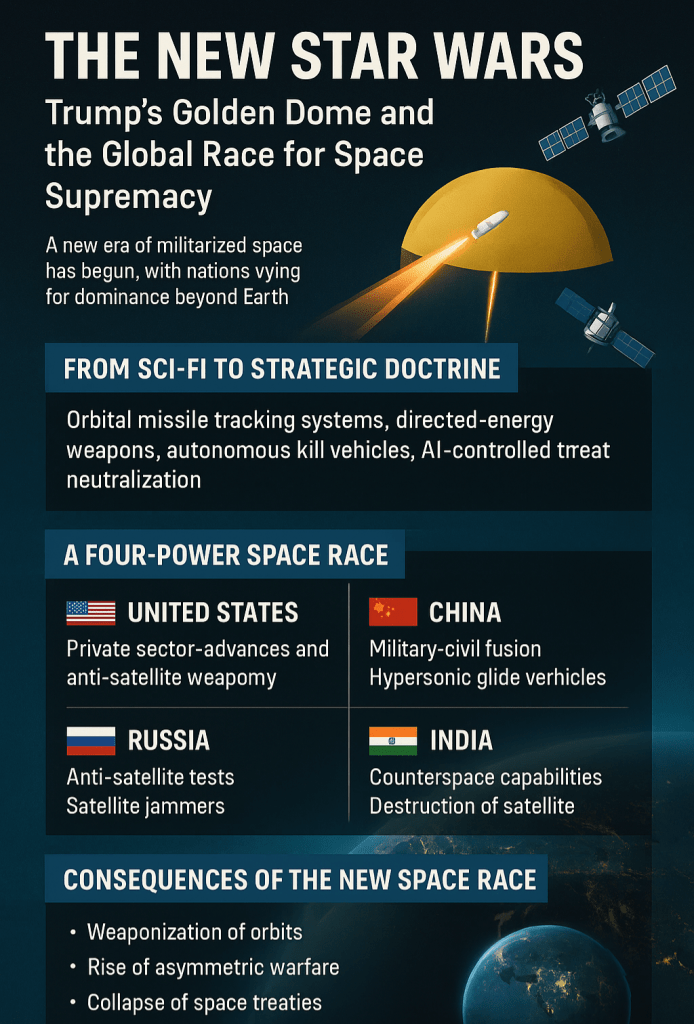
The U.S. may be first off the mark, but it is not alone. China, Russia, and India are racing to stake their claims in the militarization of space.
China
China views space as a key theater in its strategy of “informatized warfare.” The People’s Liberation Army has invested heavily in anti-satellite (ASAT) weapons, electronic warfare satellites, and orbital platforms capable of proximity sabotage. China’s dual-use space infrastructure enables rapid civilian-to-military transition, making it a formidable adversary in both offensive and defensive space capabilities.
Russia
Russia, despite economic setbacks, retains deep technological know-how from the Soviet era. Its continued testing of ASAT weapons, jamming satellites, and satellite maneuvering tactics indicates an intent to challenge U.S. orbital dominance. Moscow’s approach is asymmetric, focused on neutralizing American superiority with targeted disruption rather than a parallel buildup.
India
India’s emergence as a serious space power was cemented with its 2019 Mission Shakti ASAT test. With ISRO collaborating closely with DRDO and military agencies, India is developing secure communications, early-warning systems, and counter-space capabilities. Positioned as a strong nation in a volatile region, especially after demonstrating its striking power during Operation Sindoor against Pakistan sponsored terror, India is likely to play a major role in a rules-based orbital framework.
Consequences: Beyond the Stratosphere
Weaponization of Orbits
As defense systems expand into space, so do the risks. Satellites essential to global positioning systems, communications, finance, and weather forecasting are now potential targets. A war in space could have catastrophic consequences for civilian life on Earth.
Asymmetric Threats
Smaller states or rogue actors may exploit the vulnerabilities of space infrastructure with low-cost tools like cyberattacks, GPS spoofing, or microwave weapons. This makes space a frontier where non-traditional threats can have outsized impact.
Legal and Ethical Void
The 1967 Outer Space Treaty is ill-equipped for this era. There are no binding rules on ASAT weapons, satellite armament, or orbital combat protocols. Without a new legal regime, the space race risks spinning into an uncontrolled arms race above the Earth.
Permanent Militarization
With the U.S. Space Force operational, and adversaries responding in kind, we are entering an era where space is a permanent military domain. Unlike terrestrial warzones, space allows no retreat, and errors have instantaneous, global consequences.
Between Profit, Power, and Peril
Trump’s Golden Dome is a golden goose for the US defense industry and a geopolitical gambit with global implications. It marks the dawn of an orbital age of deterrence, where the old doctrines of mutually assured destruction give way to layered, AI-driven, space-based shields.
But it also drags the world closer to a future where Earth’s conflicts are mirrored, amplified, and fought in the vacuum of space. Without robust international dialogue, updated treaties, and ethical constraints, the Golden Dome might just become a gilded cage—protecting some, but imprisoning the entire planet in a cycle of permanent escalation.
Infographic and editorial layout courtesy: This is News Network. For syndication or reproduction rights, contact editor@thisisnews.org
 This is News