

By Tapan Misra
Former Director, Space Applications Centre | Founder, SISIR Radar
India’s Homegrown Air Defence System Proved Its Mettle in 2025 War Against Pakistan
How “Steel Dome” redefined the future of warfare with integrated indigenous systems
As I delivered a pre-symposium tutorial on Synthetic Aperture Radar (SAR) technology at the inaugural Symposium on Microwaves, Antennas and Radar Technologies (SMART 25), something extraordinary was simultaneously unfolding across the western frontier. That very day marked a turning point in the India-Pakistan war of 2025, where India’s military dominance was decisively established in the face of aggression.

It was clear—India’s strategic brilliance lay in flipping the war dynamics using a revolutionary approach: the deployment of the Akash Teer Integrated Air Defence System, spanning over 2,000 km of border.
If Israel’s Iron Dome covers 200 km, India’s ‘Steel Dome’ defended 2,000 km with unmatched precision.
Steel Dome: A Name Earned in Fire
The Israeli Iron Dome is hailed as a global benchmark, but what India achieved was a scale and effectiveness never seen before in real-world battle conditions. The Steel Dome—India’s indigenous, AI-driven, multilayered air defence network—not only neutralised aerial threats with clinical precision but enabled deep and decisive IAF strikes into hostile territory while keeping Indian soil virtually untouched.
IAF struck deep, but not a scratch was allowed on Indian soil.
At the core of this triumph was homegrown excellence—not a single foreign shield. It was an ecosystem built painstakingly by DRDO and ISRO, using:
- AKASH and Rajendra Radars
- AI-driven, human-intervention-less defence software
- Anti-drone and precision missile systems
- Sub-meter 3D mapping from RISAT and Cartosat satellites
- Stand-alone 1m accuracy navigation via NAVIC
- SATCOM-powered battlefield coordination
The Unsung Architects of Victory
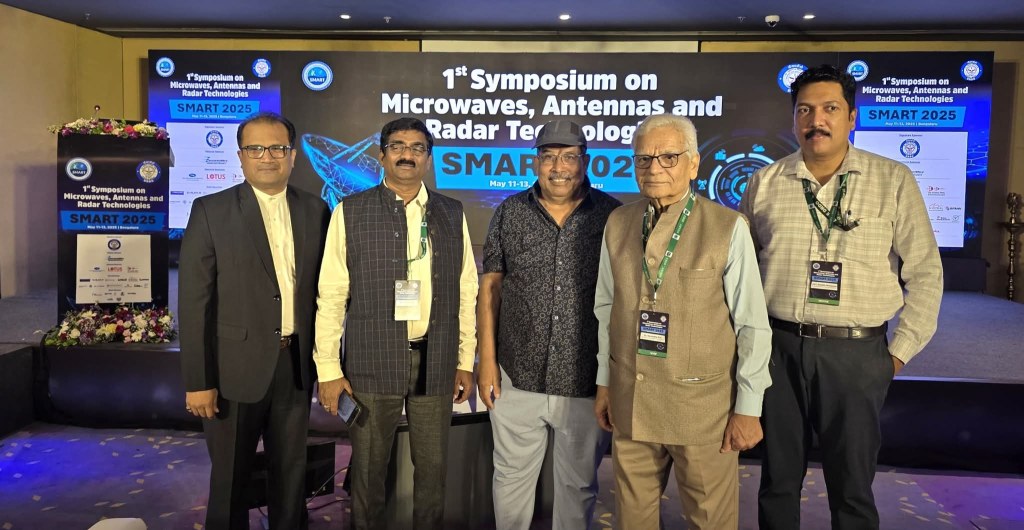
What made this day more special for me was the company I was in. Gathered under one roof at SMART 25 were several unsung heroes—key minds behind India’s breakthrough systems. Yet, these stalwarts remain invisible to the nation.
Not a single Bhatnagar, Infosys, or high-society award bears their names.
They were government scientists—quiet, unglamorous, often ridiculed by the very system they served. Their innovations emerged not only through technical brilliance but also by resisting systemic apathy, facing global tech denials, and overcoming an inferiority complex within parts of India’s policy, academia, and media elite.
The colonisers left, but their shadows stayed in our minds.
Despite this, they persisted, proved, and prevailed. Today, their work has redefined Indian military strategy—a milestone that will find place in global defence studies. But they remain in the shadows, beneath the glowing lamp of national pride they helped light.
A Final Word
India’s victory in 2025 was not just military—it was technological, strategic, and deeply emotional. It was a vindication of indigenous capability and the triumph of belief over bias. As a scientist privileged to witness this evolution, I salute my colleagues—the invisible warriors whose names may not be known, but whose contributions have now become immortal.
