

Lalit Shastri
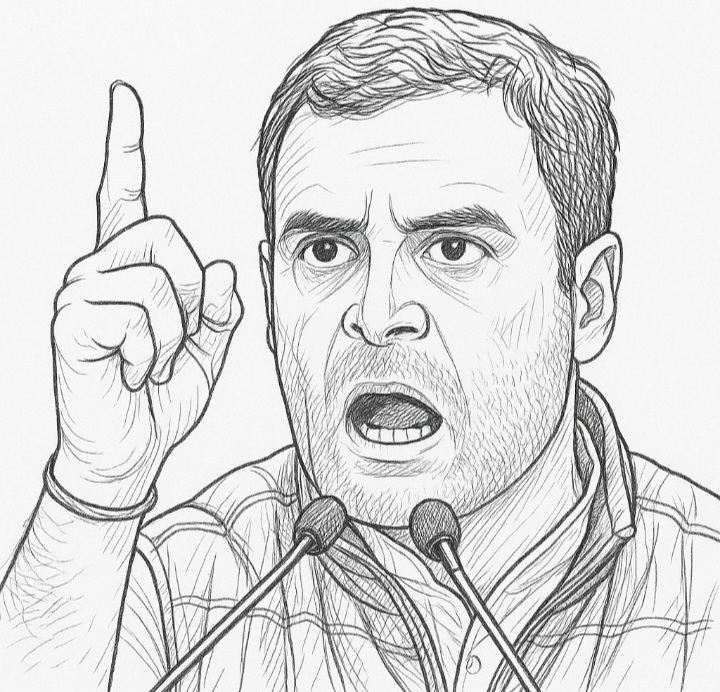
In a shocking display of ignorance and irresponsibility, Rahul Gandhi has accused India’s External Affairs Minister of “treason” in the wake of Operation Sindoor—India’s decisive and precise military retaliation against Pakistan-sponsored terror. His baseless rhetoric, amplified by the Congress party’s top leadership, amounts to a direct attack on India’s national security doctrine and the integrity of its armed forces.
At a time when the nation should stand united in the face of grave external threats, the principal opposition party has instead chosen to play politics—peddling disinformation, downplaying a successful military operation, and parroting the enemy’s narrative.
The Pahalgam massacre, which claimed 26 innocent Indian lives, triggered Operation Sindoor—a limited but devastatingly effective military strike executed between 1:00 pm and 1:30 pm on May 7, 2025. India’s armed forces hit specific terror camps in Muridke and Bahawalpur, home to Lashkar-e-Taiba and Jaish-e-Mohammed. Within moments of the successful operation, the Indian Army communicated via the Director General of Military Operations (DGMO) hotline—an army-to-army channel—notifying Pakistan that only terror facilities were targeted, not military assets. Pakistan was advised not to escalate.
This message was not merely a formality—it was a calculated de-escalatory gesture, underscoring India’s commitment to restraint even while defending its sovereignty.
Rahul Gandhi’s insinuation that terrorists had been tipped off is both absurd and false. Had there been any warning, the targets would have fled with their families and aides. But they didn’t. Among those neutralised were high-value terrorists, including Abdul Rauf Asghar, the notorious architect of the IC-814 hijacking and the Pulwama and Pathankot attacks. Crucially, the presence of uniformed Pakistani army personnel at the funerals of the slain confirms both the efficacy of the strike and the long-suspected nexus between Pakistan’s military and terror outfits.
Pakistan Escalated—India Responded With Precision: Despite India’s intent to avoid further conflict, Pakistan escalated by launching drone and missile attacks on Indian positions. India with its highly advanced air defence system completely neutralised the enemy assault and also exercised its right to proportional retaliation—launching precision strikes using BrahMos and other missiles to disable Pakistan’s air force command centres and key air bases. These actions were swift, targeted, and calibrated to avoid civilian damage—hallmarks of a responsible military power.
India not only hit back, it redefined the rules of engagement.
Congress Leadership Echoes Enemy Lines: Instead of rallying behind the country, Congress has chosen to undercut the national narrative. Rahul Gandhi’s treason charge against the Foreign Minister is not just disgraceful—it provides political ammunition to India’s adversaries. Worse still, Congress President Mallikarjun Kharge, in a public rally, referred to the war against terror as a mere “Chhutput Yudh” (small skirmish)—belittling the civilian lives lost, the military risks undertaken, and the larger strategic objectives achieved.
This is not dissent. This is disruption.
India Today Is Not the India of 2008 or 2016: India today is not the India of 2008, when the Mumbai terror attacks left 166 dead and the government of the day chose restraint over retaliation—relying solely on diplomatic channels and dossiers that failed to deter future attacks. Nor is it the India of 2016, when the Uri army camp attack killed 19 Indian soldiers, triggering the first cross-border surgical strikes—an unprecedented move at the time, but one kept under tight official wraps.
Since then, India’s strategic posture has undergone a transformation. Operations like Balakot (2019) and now Sindoor (2025) reflect a new doctrine—one that is preemptive, proportionate, and unapologetically public. India today doesn’t merely defend—it deters. It doesn’t plead—it pre-empts. It doesn’t absorb attacks—it responds with precision and principle.
This shift is military, diplomatic, and psychological. And those who choose to ignore or undermine it are choosing irrelevance—or worse.
Who Benefits From This Political Recklessness?
At a time when India’s adversaries in Beijing, Islamabad, Ankara, and beyond are looking for ways to weaken and destabilise the nation, the Congress party’s internal sabotage raises a chilling concern: Is the principal Opposition, wittingly or unwittingly, playing into the hands of hostile foreign interests?
Such rhetoric may serve narrow political ambitions, but it corrodes national unity and emboldens enemies abroad. It gives cover to those who seek to isolate India diplomatically and destabilise it strategically.
The Nation Deserves Better: India’s armed forces and foreign policy establishment have acted with maturity, decisiveness, and resolve. In return, they deserve national solidarity—not slander from within.
This is not the time for slogan-mongering or manufactured outrage. This is a time for statesmanship. For unity. For nation-first thinking.
History will not be kind to those who, in the face of terror, chose to stand on the side of the enemy and chaos.
 This is News