

Pakistan’s Dirty Secret Blown Up

Lalit Shastri
In a dramatic shift in the balance of strategic power in South Asia, India has reportedly preempted and neutralised Pakistan’s nuclear launch capabilities in a swift, surgical strike that left the Pakistani establishment reeling and global observers stunned.
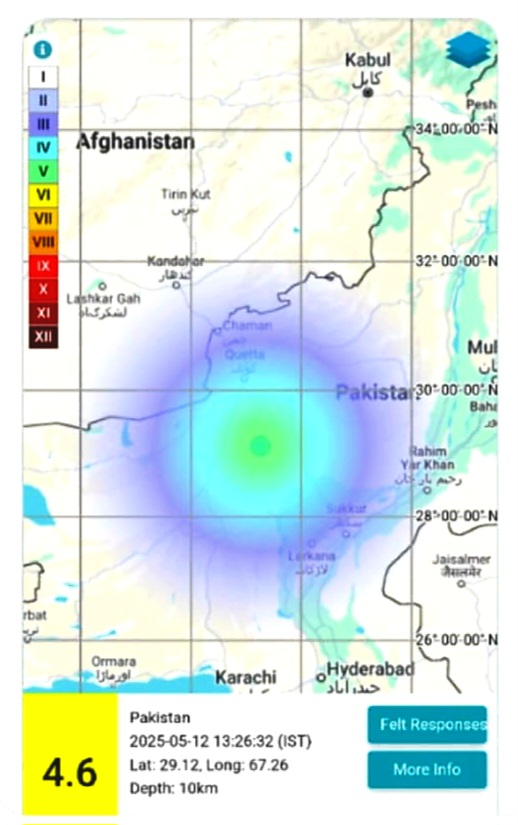
Recent seismic disturbances in Pakistan’s Chagai hills and Kirana hills nuclear arsenal storage locations are being described in knowledgeable circles as explosions, not tectonic movements. Both sites are long known as nuclear launch and warhead preparation zones.
The Chagai Hills region of Balochistan, Pakistan, experienced increased seismic activity, including an earthquake of magnitude 4.6 on May 12, 2025. This was after two other earthquakes in the region on May 10, including a 5.7 magnitude quake.
India has sent a clear message: If you dare move your nukes, we’ll strike first and strike true.
Explosions Confirmed: The Granite Shield Was Breached
Pakistan’s nuclear materials are typically stored deep underground in dismantled form — under layers of granite, thought to be impervious to conventional strikes.
This means only one thing, i e., Pakistan assembled its warheads and moved them above ground for imminent launch and in that precise moment, they were intercepted and destroyed by Indian BrahMos missiles.
The only way a BrahMos could hit those sites is if the bombs were ready for launch. And there are indications they were.
Pakistan relies on two primary platforms for launching nuclear payloads:
- Missile launches from the Chagai hills and Kirana hills nuclear arsenal storage facility
- Noor khan Airbase in Chakala, Rawalpindi and surrounding hills
India’s denial notwithstanding, there are ample indications that both platforms were struck. Both reported seismic activity.
The intelligence required to hit these sites at the right moment indicates real-time monitoring, made possible only by superior Indian Intelligence, Surveillance, and Reconnaissance (ISR) capabilities — a combination of satellite tracking, human assets, signal interception, and AI-enhanced surveillance.
India mapped Pakistan’s nuclear infrastructure to the last dot.
The Dirty Truth of Pakistan’s Nuclear Bluff
The scale and nature of the explosions provide another startling insight.
There was no mushroom cloud, no classic thermonuclear chain reaction. Instead, radiation hazards were detected — the hallmark of dirty bombs. These are made with low-grade enriched uranium, incapable of sustained detonation.
What Pakistan tried to unleash was not a strategic deterrent — it was a radiological panic weapon.
From available information, there is ample reason to conclude Pakistan has no real nuclear bomb. Only a dirty, unstable terror device.
This exposes the myth of Pakistani nuclear parity with India. It is a façade propped up by decades of military bluffing and foreign backing. The reality is far grimmer — and far weaker.
India’s Technological Edge: Better than the Best
The success of this operation underscores the Modi government’s transformation of India’s defense posture.
BrahMos cruise missiles, flying at Mach 3 and skimming just above the ground, evaded all Pakistani radar.
India’s integrated air defense system incorporating the L70 guns, the most widely used air defense gun in India’s armed forces, and the ZU 23 towed 23×152mm anti-aircraft twin-barreled auto cannons, enhanced with radar, electro-optical sensors, including auto-tracking systems, capable of firing 100s of rounds per minute with a range of up to 4 km, blasted the swarms of Pakistani drones. These were the mainstay of our defense against Pakistan backed with S-400s, Akash missiles, and a deep radar net. With all this, India could rival or exceed even Israel’s famed Iron Dome. What India could achieve within a couple of days is enough to wake up the USA and send warning signals to China.
Real-time tracking and strike execution demonstrated unmatched military synchronization.
India didn’t just strike — it predicted, prepared, and preempted.
The Modi Doctrine: Preempt, Pinpoint, Pulverize
This strategic action signals the crystallization of a new military doctrine —it can be referred to as The Modi Doctrine of Decisive Deterrence.
It is built on three uncompromising principles:
- Preempt any existential threat
- Pinpoint enemy vulnerabilities
- Pulverize targets without delay
No longer will India wait to be attacked. It will act — with intelligence, speed, and total precision.
The Illusion Lies in Ruins
Pakistan’s hollow nuclear bluff has been exposed. Their infrastructure lies compromised. Their ability to strike first — or retaliate — stands degraded.
This was not just a military strike. This was a geopolitical earthquake. One that has shaken the myth of Pakistani strategic parity down to its radioactive rubble.
India rewrote the rules of nuclear engagement — without firing a full-scale warhead.
