
Dr. Sudesh Waghmare

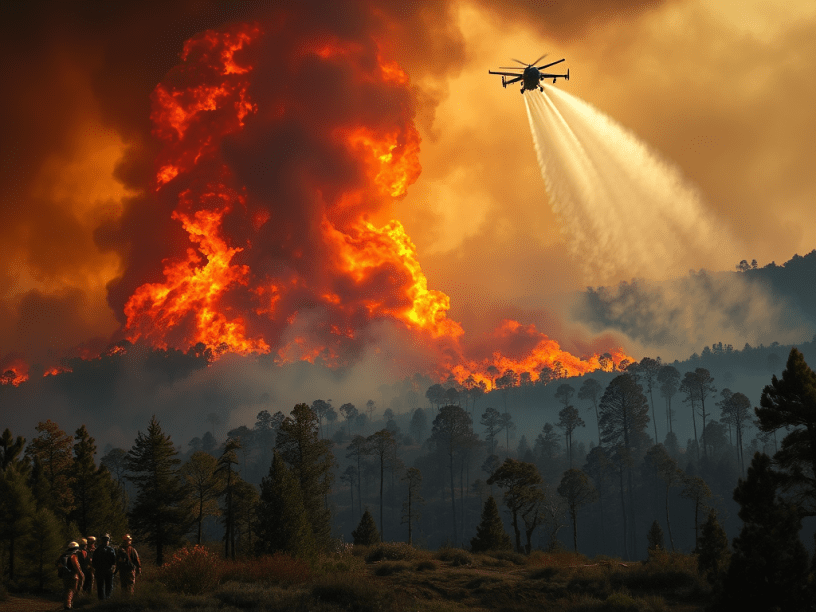
The United States is the wealthiest nation globally, and California stands as its richest state. Yet, even with all its resources, the January 2025 forest fire in Los Angeles has inflicted a staggering loss of approximately $150 billion (₹1,24,65,75,00,00,000). To put this into perspective, this figure surpasses the annual budgets of several Indian states. An arsenal of manpower, advanced technology, water-spraying aircraft, and anti-fire chemicals are being deployed to combat the fire, which has engulfed 117 square kilometers.
In India, too, forest fires are a recurring issue, particularly during the summer, with an average of 10,000 incidents annually. Many of these fires are attributed to human negligence. In regions such as North, Central, and South India, rural communities often set forests ablaze in pursuit of Mahua and Tendu leaves. In the North-East, however, pine fires occur for different reasons. Unfortunately, the act of setting forests on fire seems ingrained in our history and practices. Clearing forests for agriculture has long been done by simply setting fire, saving laborious effort. Even today, encroachers resort to burning forests to clear land. Historically, when the soil turned infertile, they moved on, burning another patch of forest—a practice known as shifting cultivation. In some tribal traditions, forests are burned as an offering to celebrate fulfilled wishes, such as winning a legal case or the birth of a child. “I will burn 50 acres of forest,” one might vow.
However, the absence of large-scale catastrophic fires in India is largely due to the efforts of the Forest Department’s trained staff. Every year, a fire safety plan is implemented from March to June, comprising fire lines, protection of sensitive areas, training programs, and watchtowers. Decades ago, temporary fire watchers were hired during the summer months to assist forest guards. I recall during patrols, fire watchers presenting muster rolls stored in bamboo baskets for verification. The shared experience of signing those rolls under the shade of a jamun tree in the scorching heat forged a sense of unity between the workers and officers. In case of fire, no officer—from the district level to the forest guard—would rest until the blaze was extinguished.
Over millions of years, Indian trees have evolved adaptations to survive fires. For instance, the outer bark of the Bhirra tree (Chloroxylon swietenia) is cork-like, protecting the crown from flames. Some species even thrive because of fire. For example, the teak tree’s hard seed coat benefits from burning, which enhances germination. Managing forest fires is both a science and an art. To extinguish a fire, you sometimes have to set a controlled counter fire. Once, while executing this technique, I found myself encircled by flames. Trapped in a fiery pit, my eyebrows and arm hair were scorched, and my survival depended on quick thinking and a bit of luck.
For the past two decades, India has adopted satellite-based fire alert systems, inspired by western nations. These systems notify forest officials, regardless of rank, about fires in real time. However, fighting fires requires more than mobile alerts—it demands human labor and resources, which come at a cost. The combined annual budget for India’s entire Forest and Environment Ministry is a mere ₹3250 crore. As the saying goes, “What can a naked person bathe with, and what can he extract?” While the Forest Act expects forest dwellers to extinguish fires and includes provisions for six months’ imprisonment for noncompliance, enforcing unpaid labor is like extracting water from sand.
Fortunately, some environmental organizations recognize the importance of preventing forest fires and actively work to raise awareness. For instance, Narmada Samagra has published a concise, affordable booklet on forest fire prevention and public awareness. Its simplicity and accessibility make it an invaluable resource.
“Your face shines so beautifully,
The moon pales in comparison.
The audience listens for hours,
For my story feels like everyone’s story.
Fires ignite in mere moments,
But it takes an eternity to extinguish them.”
The author Dr. Sudesh Waghmare is ex-Dy. Director Van Vihar National Park, Bhopal.
