

Lalit Shastri
On the advocacy for a 90-hour work week without an off on Sunday by L&T’s Chairman SN Subrahmanyan and before him, the batting for long hours by Infosys founder Narayana Murthy, I must strongly disagree. This ‘woke duo’ seems to have completely missed the point, despite their evident admiration for hard work.
To those supporting this idea, I ask:
- What about the distinction between long hours and quality work?
- What about quality of life—striking a balance between work, home, and social life?
- What about nurturing a healthy balance between work, leisure, time in nature, adventure, and entertainment?
Are we striving to cultivate well-rounded, fulfilled individuals, or are we reducing human beings to mere robots or slaves, trading their vitality and creativity for a paycheck? Let us remember: a life well-lived is not measured by hours at a desk but by the harmony between professional dedication and personal fulfillment.
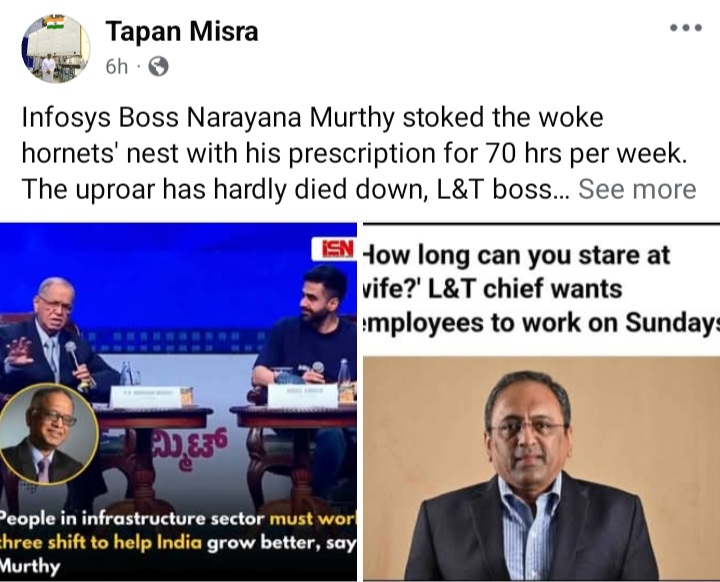
Critique on Tapan Misra’s Facebook Post
The social media post by distinguished scientist Tapan Misra provides a personal narrative of hard work and dedication, culminating in professional success. It emphasizes a singular perspective on work ethics, particularly the idea that success demands relentless effort and long hours. While the post is a valuable insight into the work culture at organizations like ISRO and the personal experience of a globally acclaimed scientist, it overlooks the complexity of life, human diversity, and the challenges associated with prescribing a one-size-fits-all approach to professional success.
1. Not Everyone Aspires to Be a Team Leader
The Misra’s post conveys the message that all individuals should aspire to be team leaders, capable of filling gaps and inspiring team members to achieve collective goals. However, people have diverse ambitions, skill sets, and values. Leadership roles often require specific traits, including high levels of interpersonal skills, vision, and resilience, which may not align with everyone’s strengths or career aspirations (Northouse, 2021).
Instead, organizations thrive on a diversity of roles and contributions. Many individuals excel in technical or supportive roles, which are equally crucial for achieving organizational goals. The rigid expectation that everyone should aspire to leadership is counterproductive and fails to appreciate the varied dimensions of human potential (Goleman, 2000).
2. Work-Life Balance and Well-Being
The narrative glorifies sacrificing personal life, health, and family time for professional success. While hard work is important, research has consistently shown that long working hours can lead to burnout, reduced productivity, and health issues (Maslach & Leiter, 2016). The World Health Organization (WHO) identifies long working hours as a significant occupational health risk, linked to increased cardiovascular disease and stress-related disorders (WHO, 2021).
Moreover, a sustainable work-life balance is essential for individual well-being and long-term career success. Encouraging individuals to work excessively risks normalizing unhealthy work practices that can have negative consequences for both individuals and organizations.
3. Diverse Approaches to Success
The post suggests that the “secret of success” is universally tied to hard and smart work, as exemplified in the author’s personal experience. However, success can be defined and achieved in various ways depending on individual interests, talents, and contexts. For example, creative professionals, caregivers, and educators may prioritize impact over relentless pursuit of efficiency. Theories of intrinsic motivation, such as Deci and Ryan’s Self-Determination Theory, highlight that autonomy, competence, and relatedness are critical to satisfaction and success, beyond just effort (Deci & Ryan, 2000).
4. Life is Complex and Multi-Dimensional
Life is not solely about professional achievements. The post fails to account for the complex interplay of personal, professional, and societal factors that shape individual lives. People value different aspects of life, including relationships, hobbies, and self-fulfillment, and these are not necessarily secondary to professional success. The idea that one’s profession should “transcend to a hobby” risks invalidating these other dimensions.
Modern organizational studies also emphasize the importance of psychological safety, inclusivity, and valuing diverse contributions within teams (Edmondson, 2018). The notion that everyone should “run at equal pace” underestimates the varying capacities, challenges, and contributions of team members.
5. Cultural and Systemic Considerations
Prescriptions such as 70–90 hours of work per week, as mentioned in the context of Infosys and L&T leaders, also ignore systemic issues like inequality, privilege, and resource access. The author’s experience reflects a specific context—ISRO and a highly motivated individual with access to certain opportunities. However, not everyone operates in environments that support such an intense work ethic, nor should they be expected to do so. Promoting such norms risks alienating those who may lack similar privileges or have different priorities.
Conclusion
Tapan Misra’s post is an inspiring testament to individual dedication, but its prescriptive tone and narrow focus on hard work and leadership miss the broader picture of human diversity, well-being, and systemic complexity. Life and success are not linear or uniform. Organizations and societies must acknowledge and value diverse contributions, encourage sustainable practices, and support individual aspirations and well-being.
References
- Deci, E. L., & Ryan, R. M. (2000). Self-determination theory: The dynamics of motivation. Psychological Inquiry, 11(4), 227-268.
- Edmondson, A. C. (2018). The Fearless Organization: Creating Psychological Safety in the Workplace for Learning, Innovation, and Growth. Wiley.
- Goleman, D. (2000). Leadership that gets results. Harvard Business Review, 78(2), 78-90.
- Maslach, C., & Leiter, M. P. (2016). Burnout. In G. Fink (Ed.), Stress: Concepts, Cognition, Emotion, and Behavior (pp. 351-357). Elsevier.
- Northouse, P. G. (2021). Leadership: Theory and Practice (9th ed.). Sage Publications.
- World Health Organization (WHO). (2021). Long working hours and risk of cardiovascular disease and stroke: A systematic review and meta-analysis.
 This is News