
This is News Network
Never before has such a comprehensive Handbook been compiled.
The handbook is divided into three parts.
Part One has seven essays; Part Two has five; Part Three has eight.
Lavanya Vemsani contributes an essay in each part. In addition she has authored an insightful Introduction and a very balanced Conclusion.
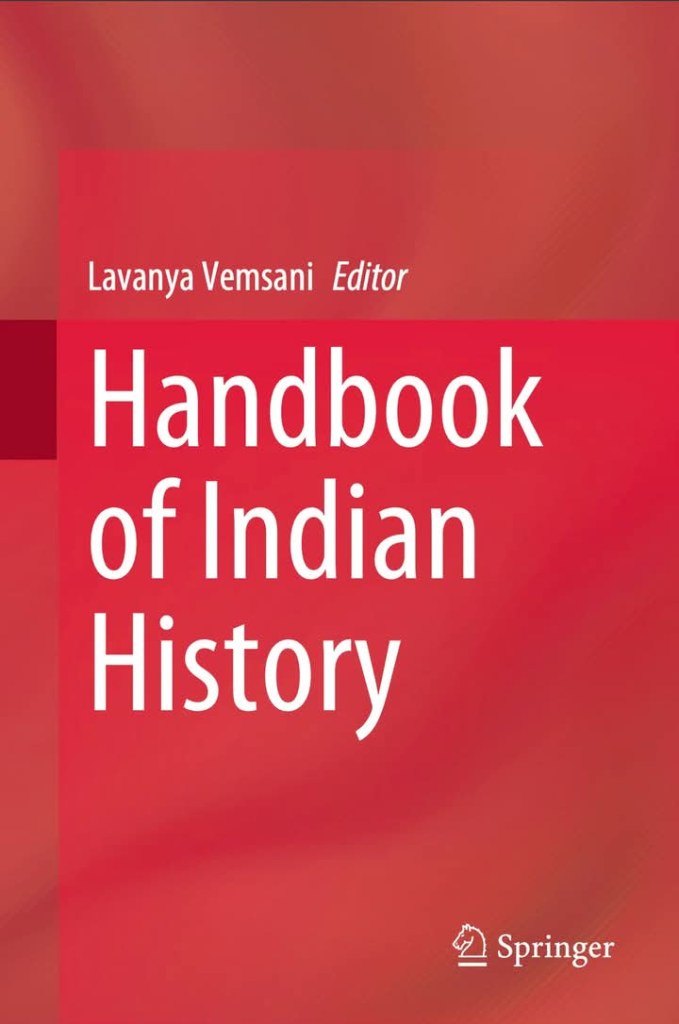
Interesting book. Avoids the usual ideological claptrap associated with history writing on India. Manages to give a comprehensive overview of major strands that make India’s past and connect it with the present – Rajiv Lochan, eminent historian, author & columnist
Given below are titles of the chapters and their authors
Part I
The Beginnings of Indian Civilization
1 Introduction to Handbook of Indian History by Lavanya Vemsani
2 The Beginnings of India’s History: Archeological and Genetic
History by Lavanya Vemsani
3 Palaeolithic Culture of Deccan in the Upper Krishna Basin
of India with Special Reference to Recent Studies by Jayendra Joglekar
4 Southern Neolithic Culture of India: People, Plants,
and Animals by R. Arjun
5 The Indus River Valley and Other Bronze Age Cultures by Marie N. Pareja
6 The Historical Reception of Panini’s Sanskrit Grammar by Rishi Rajpopat
7 Classical Understanding of Gender in Indian Texts by Lavanya Vemsani
Part II
India Beyond the Borders
8 Sailing Ships and Seafaring Networks: The Indian Ocean
and the Maritime Silk Road by Himanshu Prabha Ray
9 Relations Between India and East Asia in Light of Buddhism by Bradley S. Clough
10 Shaiva Traditions of Southern India: Tamil Shaivism
and Shaiva Siddhanta by Michael A. Gollner
11 The Reconstruction of the Early History of Tamil-Speaking
Southern India by Herman Tieken
12 Jainism in Indian History and Culture by Patrick Felix Krüger
Part III
India Through Colonization and Modernity
13 Literary Exchange Between India and Sri Lanka by Justin W. Henry
14 Devotionalism in the Cultural and Social Spheres of India:
Popular and Monastic Aspects of Hinduism in History by Nalini Rao
15 Hinduism in the New Millennium: History, Tradition,
and Practice in the Goddess Festival by Lavanya Vemsani
16 Legacies of Colonial Rule in India: How Race and Caste
Continue to Divide Modern India by Jyoti Mohan
17 Indian Indepentism: Networks Abroad by Mathieu Gotteland
18 Independent India: Hawkish Neighbors and Few Friends by Marc Reyes
19 A Living Legacy: The Continuing Influence of Swami
Vivekananda in the Western World by Jeffery D. Long
20 How Becoming a Myth Leads to History: A Modern
Embodiment of the Goddess Durga as the Female
Shankaracarya in Hindu Society by Antoinette DeNapoli
21 Conclusion by Lavanya Vemsani
The Introduction provides the necessary contextual springboard for the Handbook of Indian History.
The following chapters quickly take there reader through information about India spanning history from the earliest known times to the present. The most refreshing aspect of this book is its focus on the long term strands that mark the processes of history. There is no place in this book for transient dynasties and their transient achievements.
The focus is on social and ideological processes that marked society in India as it transformed into its present shape. These included ideas that came to India from abroad and left a lasting mark– at times beneficial, at times adverse– on society.
The most important aspect of this book is that unlike previously written textbooks, the Handbook introduces us to the web that connected India to the world.
Unlike earlier textbooks, this Handbook does not shy of mentioning the lootings, pillagings and extreme violence indulged in by Islamic invaders which destroyed many strands of the people’s connection with the past, created lasting bad memories and put a block on the emergence of new, scientific knowledge.
At the same time, it links many long strands in the history of India to India’s deep contact with Arabia, Africa and Europe and the idea of Dharma, Right Conduct, which underlay India’s society. B S Clough’s essay in the Handbook puts things in perspective when it says:
“in comparison with other major missionary-oriented religions that have spread widely around the world, namely Christianity and Islam, Buddhism has been decidedly less exclusivist and more tolerant with respect to indigenous traditions it encounters when introducing itself to new cultures. In such situations, Buddhism has tended not to forbid the worship of native deities, accepting them rather as newly converted protectors of the Dharma. Furthermore, it has been more flexible and accommodating with respect to more worldly matters. While Buddhism has seen itself as religiously superior in terms of spiritual truth and efficacy, in other areas of human societal life particularly economic, social, and political ones—it has usually been content not to interfere, leaving them to be addressed by native traditions.”
