
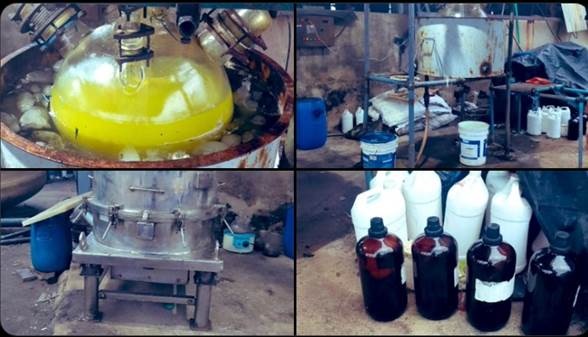
New Delhi: Acting on specific intelligence, officers of the Directorate of Revenue Intelligence (DRI) busted a factory that was engaged in the illegal manufacture of Mephedrone (a psychotropic substance under NDPS Act, 1985) located in the Industrial Area of Meghnagar in Jhabua district of Madhya Pradesh in the early hours of Saturday 12 October 2024.
The operation resulted in the seizure of 36 kg of Mephedrone in powder form and 76 kg of liquid Mephedrone, worth Rs. 168 crore, and other raw materials and equipment. The factory, which was being illegally used for the manufacture of drugs, was also sealed.
Four individuals, including the director of the factory, have been arrested for illegal manufacturing and storing of Mephedrone.
Representative samples drawn out of manufactured drugs were sent to the Forensics Science Laboratory for preliminary testing. The lab confirmed the presence of Mephedrone in the samples.
Mephedrone, also known as 4-methyl methcathinone, 4-MMC, and 4-methylephedrone, is a synthetic stimulant drug belonging to the amphetamine and cathinone classes. It is commonly referred to by slang names such as drone, M-CAT, White Magic, meow meow, and bubble.
In India, the manufacture, sale, and distribution of Mephedrone (also known as “Meow Meow” or “MD”) is illegal under the Narcotic Drugs and Psychotropic Substances (NDPS) Act, 1985. This law governs the control and regulation of operations relating to narcotic drugs and psychotropic substances in India. Mephedrone was added to the list of controlled substances in the NDPS Act in 2015 due to its rising abuse.
Legal Provisions and Penalties
Possession and Manufacture:
Under the NDPS Act, it is illegal to manufacture, possess, transport, or sell Mephedrone without a valid license.
The act imposes stringent penalties depending on the quantity of the drug involved, categorized as small, commercial, or intermediate.
Punishments Under NDPS Act:
For Small Quantity (less than 5 grams of Mephedrone):
Punishment: Imprisonment up to 1 year, or a fine up to ₹10,000, or both.
For Commercial Quantity (more than 250 grams):
Punishment: Rigorous imprisonment for a term not less than 10 years, which may extend to 20 years, along with a fine of not less than ₹1,00,000, which may extend to ₹2,00,000.
For Intermediate Quantity (between 5 grams and 250 grams):
Punishment: Imprisonment up to 10 years and a fine, which may vary based on the case.
Repeat Offenders:
In cases of repeat offenses, the punishment can be harsher, including a potential death penalty in specific cases involving large quantities of narcotics.
Abetment and Criminal Conspiracy:
Those involved in aiding, abetting, or conspiring to commit such offenses (including financiers or distributors) are also subject to the same punishments as those directly involved in the manufacture or distribution.
Bail:
Bail provisions under the NDPS Act are very stringent, especially for commercial quantities. Courts often deny bail due to the serious nature of drug-related offenses.
Seizure and Confiscation:
The Act provides for the seizure and forfeiture of all property derived from drug trafficking. This includes the confiscation of any property used in the commission of the offense.
Enforcement
The law is enforced by various agencies like:
Narcotics Control Bureau (NCB): India’s apex drug enforcement agency.
State police departments: Involved in local drug-related investigations.
Customs and Central Excise: To monitor smuggling and cross-border trafficking of drugs.
Rehabilitation and Treatment
The NDPS Act also emphasizes the rehabilitation of drug users and addicts by prescribing that they be sent to rehabilitation centers rather than prison, depending on the nature and extent of their involvement.
