
Uday Kumar Varma
In heaven, Lord Ganesha will establish the predominance of gods, on earth, that of people, in the nether world, that of serpents and anti-gods.
A Hymn from Sri Bhagavat-Tathva
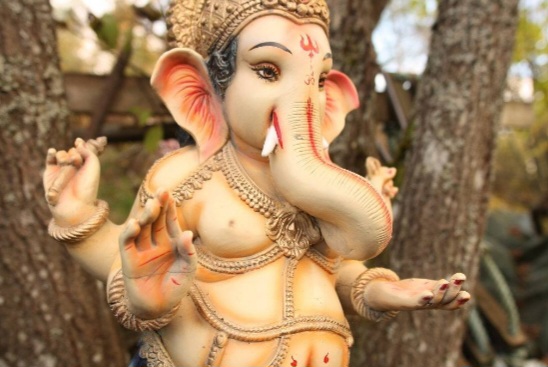
In the illustrious pantheon of Hindu deities, Lord Ganesh occupies a truly extraordinary place. He defies conventional expectations, sporting an elephant’s head, a less-than-shapely physique, and an unassuming mount in the form of a mouse. He doesn’t fit the mould of a mighty warrior; instead, his triumphs are marked by his intelligence, wit, and profound thinking. His sweet tooth leans towards Modak, a treat not typically held in high regard. In essence, he is the antithesis of our conventional image of a god. And yet, he remains the deity to whom we turn first, the one whose mere invocation assures the success of our endeavours. What sets him apart, and why?
In the intricate tapestry of Hindu mythology, He stands out, with lessons and wisdom that reverberate profoundly in the face of today’s moral and societal challenges. Lord Ganesh, the elephant-headed god, emerges from these mythological annals with a tale that carries deep significance. His birth, form, and conduct offer us a guiding beacon to navigate the labyrinthine dilemmas of our modern world and lead lives steeped in righteousness, thereby fostering the betterment of our societies, communities, and nations.
The story of Ganesh’s birth unfolds as a testament to loyalty and devotion. It begins with Goddess Parvati’s yearning for solitude during her bath on the majestic Mt. Kailash. Instructing her steadfast guardian, Nandi, to bar entry to anyone, she unknowingly sets the stage for the creation of Ganesh. Nandi’s unwavering allegiance to Lord Shiva compels him to allow Shiva’s passage, an act that deeply vexes Parvati. In her frustration, she sculpts a being from turmeric paste, breathing life into it, thus giving birth to Ganesh as her own loyal son.
Ganesh’s ensuing duty is to protect Parvati’s sanctity during her ablutions. However, when Lord Shiva returns home and encounters the determined young guardian, divine fury takes hold. Shiva, typically serene, commands his celestial army to confront the boy, but they all falter in the face of Ganesh’s extraordinary power. Only then does Shiva decide to engage in a battle with this seemingly ordinary boy, culminating in the tragic severance of Ganesh’s head.
Upon learning of her son’s untimely demise, Parvati is consumed by righteous fury, vowing to obliterate the entire cosmos. In her wrath, she sets forth two conditions for reconciliation: the resurrection of Ganesh and his elevation as the foremost deity, to be worshipped above all others. Shiva, reflecting on his error, consents to these terms. Thus, he bestows upon Ganesh an elephant’s head and declares him the leader of all beings, conferring upon him the title of Ganapati.
This enchanting tale, upon closer scrutiny, reveals layers of profound spiritual wisdom. Parvati symbolizes the Supreme Energy, with her bath signifying the purity required for spiritual realization. Nandi, the guardian, embodies the attitude of the spiritual aspirant, ever directed toward the divine. Ganesh’s creation from turmeric paste, associated with the Muladhara chakra, signifies the need for an earthly awareness that guards the secrets of spiritual awakening. Ganesh, representing ego-bound consciousness, exemplifies humanity’s failure to recognize the divine presence amidst the clouds of ego.
Shiva, as the Supreme Teacher, symbolically severs Ganesh’s ego-bound head, emphasizing the necessity for ego dissolution on the spiritual journey. The Guru, often resorting to a more rigorous approach, guides the aspirant toward enlightenment. Parvati’s threat to destroy creation underscores the liberation of the soul from attachment to the impermanent world as the ego diminishes. To grasp the world’s secrets, represented by Devi, one must first receive Ganesh’s blessings.
Shiva’s act of restoring life to Ganesh and replacing his head with an elephant’s represents the transformation from a limited individual self to a universal self, fostering a life that benefits all of creation. Ganesh’s dominion over the Ganas, encompassing all classes of beings, reflects the interconnectedness of creation. By honouring Ganesh, we seek the grace of all beings, remove potential obstacles, and ensure our endeavours bear fruit.
In today’s tumultuous world, Lord Ganesh, with his wisdom and benevolence, serves as a beacon of hope. His story encourages us to cultivate unwavering loyalty to the divine, to recognize the futility of ego, and to acknowledge the interconnectedness of all life forms. These profound lessons can be applied to address the ongoing crisis of distrust, deceit, violence, and virulence in our social and political discourse. By following the path illuminated by Ganesh, we can collectively work toward righteousness, fostering a spirit of trust, truth, non-violence, and compassion in our societies, communities, and nations.
To worship Ganesha, we must become Ganesha, which is to let go of our outer minds and embrace the unknown higher knowledge, becoming the entire universe and beyond, Shiva and Shakti, both within and around us. To do that we must become humble and let Shiva and Parvati enter and reside within us. Seeking Him is seeking eudemonia.
Jai Ganesha!

Uday Kumar Varma, a 1976 batch IAS officer of Madhya Pradesh cadre, was Secretary Information & Broadcasting, member of the Central Administrative Tribunal (CAT) and member of the Broadcasting Content Complaints Council, a self-regulatory body for general entertainment channels. As Secretary I&B, he spearheaded the nationwide digitisation programme.
