

Tapan Misra
I encountered the formidable DD ( Deputy Director) of SATCOM activities, on the campus alley. I was a small fry, a division head only, the lowest rank of leadership chain. My full concentration then was facing daily challenges of building RISAT payload. Everyday we thought we solved a major problem and rest will be a cakewalk. But instead, a ghost of another major problem used to appeare from nowhere.
Normally the DD would have ignored me with a fleeting exchange of smiles. But he himself approached with a stern face. “Tapan, you have just put a nail on your career. You were unnecessarily arguing with the Director and whole SAC council yesterday for a futile proposal.”
That day I was defending an R&D proposal, totalling Rs. 50 Cr. for a scaled model of an active L band SAR, a programme of mmWave (millimeter wave) radiometer and LTCC (Low Temperature Confired Ceramic) fabrication facility to build exactly reproducible TR module electronics at a very cheap cost, indigenously. Normally R&D proposals used to be nominal of a few lakhs of rupees to maximum 1-2 cr. from promising scientists to spurt innovation. In the SAC council review, Director and other senior DDs were taken aback with the audacity of the proposal. I argued about the merit of the proposal to build our future and trigger innovations on a large scale. Instead the council was annoyed that such audacious proposal is a sure case for Chairman, ISRO to dump into dustbin unceremoniously. I was ridiculed, albeit with sophistication, for being immature to gauge reality. Firmly controlling tears from rolling down, I insisted on sending the proposal to Chairman, Dr. Madhavan Nair. The council reluctantly approved.
I along with Director, SAC and Associate Director, SAC got a call for review by Chairman, ISRO, probably on 8th October 2008 at 530 pm. That day was ninth (Navami) Day of Durgapuja, a day too sacrosanct for Bengalis to devote for anything else. I faced a grumpy face of my wife when I broached my travel plan.
We left for Bengaluru by a flight in the morning hours. We got a call to meet Chairman, at 4 pm. Navami is very auspicious day in South India. The day is marked for Sastra Puja, worship of tools and weapons. Whole of ISRO HQ was decorated with flowers, banana plants and coconuts on earthen pots.
At sharp 4 pm, Dr. Madhavan Nair took us to downstairs to offer Puja together. At sharp 530 pm he met us. Looked like he had thoroughly read the proposal. After a bit of cursory discussion, he approved the whole proposal in toto, without even a scratch by his pen.
We built one tile of active array antenna of L band SAR with all back end electronics. But it could not be elevated to full scale L band SAR because of inking of NISAR deal. We could have built one almost a decade back. We could have had both. But the reason for jettisoning of L band SAR by subsequent HQ mandarins still baffles me.
We built an impressive LTCC facility. It was a roaring success. Two RISAT follow on payloads and scores of GSAT satcom payloads were built with indigenous LTCC facility.
We built very sophisticated mmwave laboratory with all top notch test and calibration equipments, along with augmentation of electronic and mechanical fabrication facility. We built a developmental model of multichannel scanning mmwave radiometer and a humidity sounder. 183 GHz humidity sounder was flown in a small satellite aboard successful launch of our second SSLV in the early part of current year.
Sometimes doggedness and a passionate approach that even puts a prospective career in the line of fire, pave the course of future. And you also need a visionary leader like Dr. Madhavan Nair at the helm of affairs, to offer the very crucial helping hand and give a small nudge. An unforgettable lesson on how future is created.
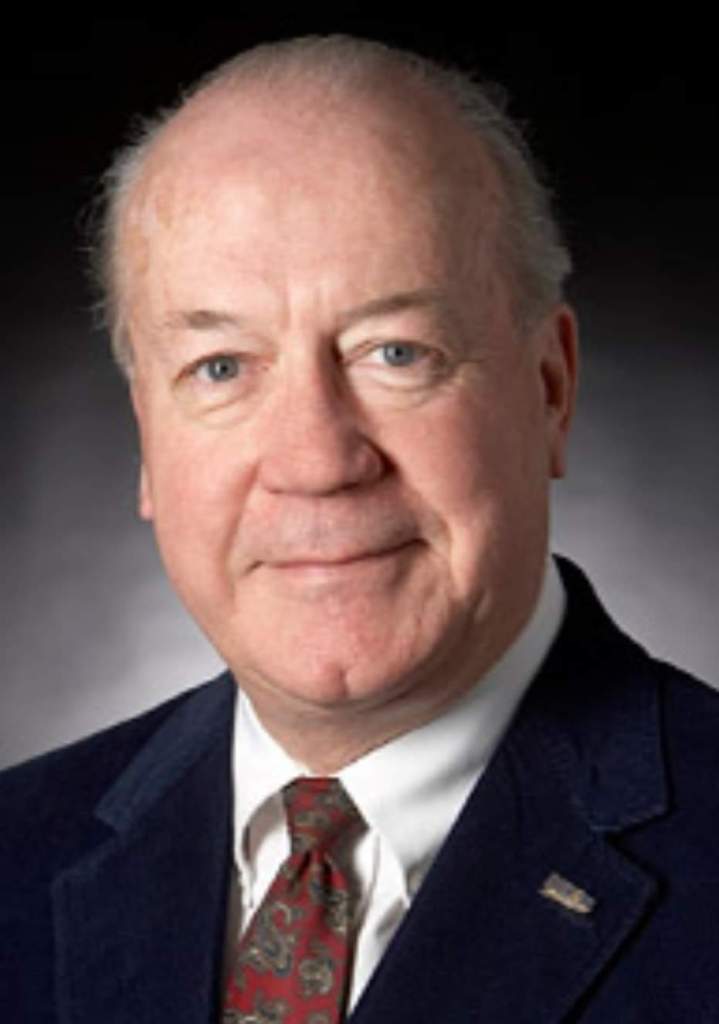
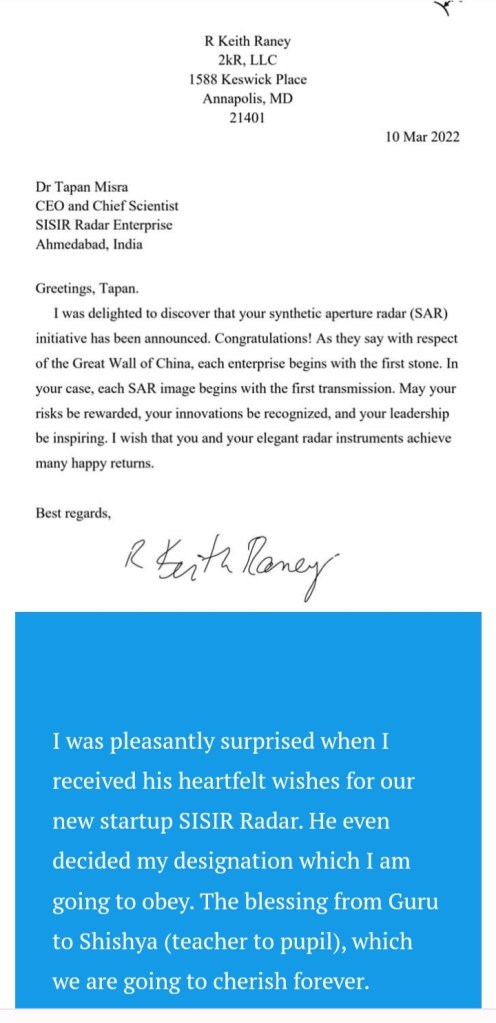
Russel Keith Raney and myself share an unequal friendship. He was in Master’s, when I was born, in another distant continent, in another country, trying to rise like Sphinx from the injuries inflicted for centuries of domination by invaders and colonial masters.
What draws us together is a common trait – being maverick. In 1978, NASA launched first SAR satellite in space, Seasat. NASA employed analogue data recording and optical processing, developed by JPL. NASA scientists believed that, SAR processing was so complex that no computer, at that timeframe, could process SAR data. Everybody in NASA gave a cold shoulder to this gentleman, who proposed that digital SAR processing is more elegant and doable by adding a few hardware tricks. He was disheartened and left for Canada, developed the first digital SAR processor and brought SAR processing to adolescence. Rest is history.
The celebrated Canadian SAR satellite Radarsat had imprints of his clever system design and leadership. He discovered the very elegant Chirp Scaling algorithm for SAR processing. Mini SAR from NASA on-board our own Chandrayan-1 was his brain child.
MiniSAR made history as it conclusively proved that water is present as dirty ice in the dark depths of polar craters, raising the hope of establishing the first human base, outside our blue planet.
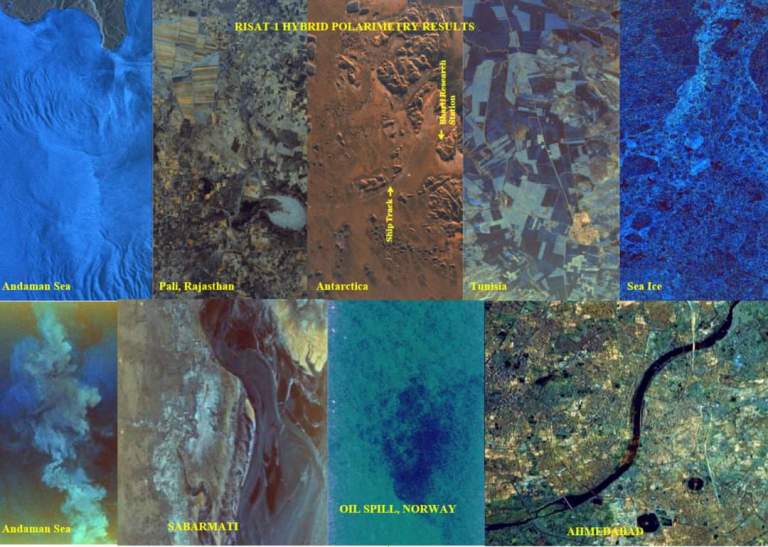
I was drawn to him in the EuSAR Dresden conference in 2006 where he proposed a maverick idea of Hybrid polarimetry. Everybody listened to him while yawning and with lack of interest. But I sensed a great idea and implemented hybrid polarimetry for the first time in RISAT-1. I was undaunted by severe opposition in ISRO trying to implement an idea which nobody had implemented! RISAT turned SAR polarimetry upside down and democratised the polarimetry science. Today it is the global standard for all spaceborne SAR satellites conceived after RISAT-1.

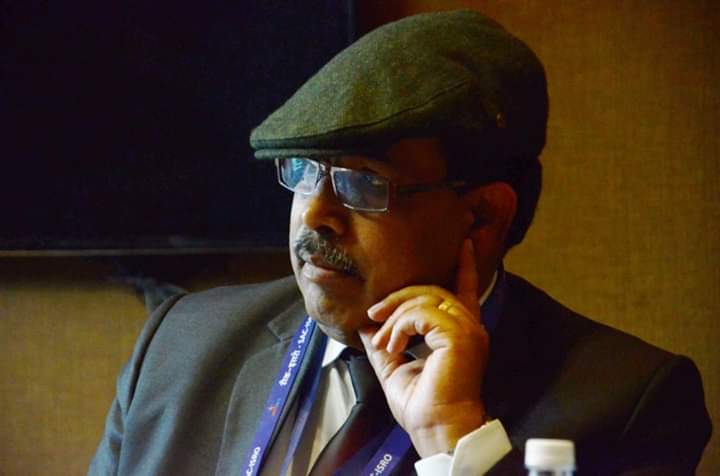
Tapan Misra is a distinguished scientist, who has earlier served as Director Space Applications Centre (SAC) and has contributed immensely to India’s Space Programme. He has founded the startup SISIR Radar to make synthetic aperture radars (SAR). These can be fitted on drones and SISIR Radar has already demonstrated the immense capability of drone borne radars to take clear pictures even at low altitude.
