
Newsroom24x7 Network
Article 30, added to the Constitution of India through the First Amendment in 1951, is a provision that guarantees the right of minority communities to establish and administer educational institutions of their choice. Article 30 ensures that minority communities have the freedom to preserve their culture and language through education. This is one right, that has been denied to the followers of Sanatan Dharma under the Constitution. Hence, educational institutions run by the minorities can impart religious teachings to their students, the other educational institutions are deprived of the right to teach the fundamental truths of Sanatan Dharma.

The Board of Trustees of the Central Hindu
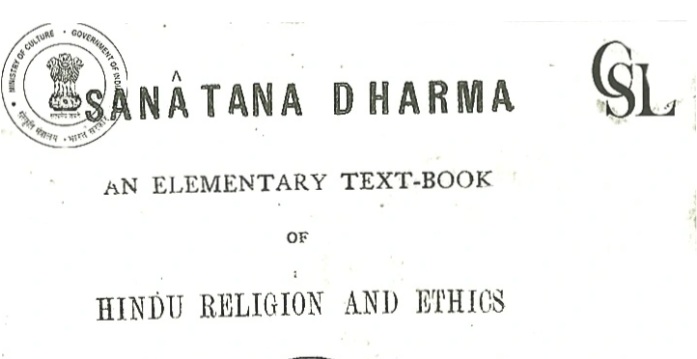
College, Benaras, through the book titled “SANATANA DHARMA – An elementary text-book of HINDU RELIGION AND ETHICS, published in 1916, had laid down the following principles on which religious and moral teaching was to be given in all institutions under its control.
The object of the Central Hindu College was
to combine Hindu religious and ethical training
with the western education suited to the needs of the time. Hence, it was decided that it was necessary that this religious and ethical training shall be of a wide, liberal and unsectarian character, while at the same time it should be definitely and distinctively Hindu. Also, it must be inclusive enough to unite the most divergent forms of Hindu thought, but exclusive enough to leave outside it, forms of thought that were non-Hindu.
The Board of Trustees of the Central Hindu
College took the decision that it must avoid all doctrines that were the subject of controversy between schools recognised as orthodox and that it must not enter into any of the social and political questions of the day; but it must lay a solid foundation of religion and ethics on which the students could build, later on in life, the more specialised principles suited to their intellectual and emotional temperament.
The considered decision was taken that the content of the book must be directed to the building up of a character – pious, dutiful, strong, self-reliant, upright, righteous, gentle and well-balanced – a character of a good man and a good citizen; since the fundamental principles of religion, governing the general view of life and of life’s obligations, were alone sufficient to form such a character. That which unites Hindus in a common faith must be clearly and simply taught; all that divides them must be ignored. Lastly, care must be taken to cultivate a wide spirit of tolerance that not only respects the differences of thought and practice among Hindus, but also respects the differences of religion among non-Hindus, regarding all faiths with reverence, as roads whereby men approach the Supreme.
Therefore the Board of Trustees of the Central Hindu College decided:
1. The religious and ethical instruction must be such that all Hindus would accept,
2. It must include the special teachings that mark out Hinduism from other religions.
3. It must not include the distinctive views of any special school or sect.
The elementary Text-Book, written in accordance with this scheme, was intended for the use of Hindu students in the middle and upper sections of the High Schools of India, and was designed to give them a general but correct idea of their national religion, such as may be filled in by fuller study in College and in later life, but without the need to be changed in any essential respect. …”
The book that can be downloaded by scrolling down this page contains the fundamental ideas, and doctrines which are generally received as orthodox, but does not enter into the details as a result of which sectarian divisions have arisen. While finalising the text for this book, it was believed that a sectarian parent or teacher will probably make additions to it, but they would not find in it anything which one would want to repudiate.
While the book was intended to be placed in the hands of the students for their own study, it was, at the same time, intended to be simplified by the oral explanations of the teacher, with each chapter serving as an outline on which one or more lessons could be based.
The shlokas given at the end of the chapters were intended to be committed to memory by the students. In this way, the young students were supposed to acquire a useful store of sacred knowledge of their religion.
The name of the series, Sanâțana Dharma was chosen after full discussion, as best representing the idea of the fundamental truths governing the way of life of the people, who share in common the legacy of the most ancient civilisation on Earth.
Download SANATANA DHARMA – AN elementary text-book of HINDU RELIGION AND ETHICS
 This is News