
Lalit Shastri
“Those who cannot remember the past are condemned to repeat it.” This is a famous, valid and much appreciated quote attributed to the Spanish American Philosopher and writer George Santayana. To remember, events, experiences, wide-ranging information about the present and the past, the human beings are blessed with memory, which is one of the important cognitive processes. But what one should not forget is that memory also involves forgetting.
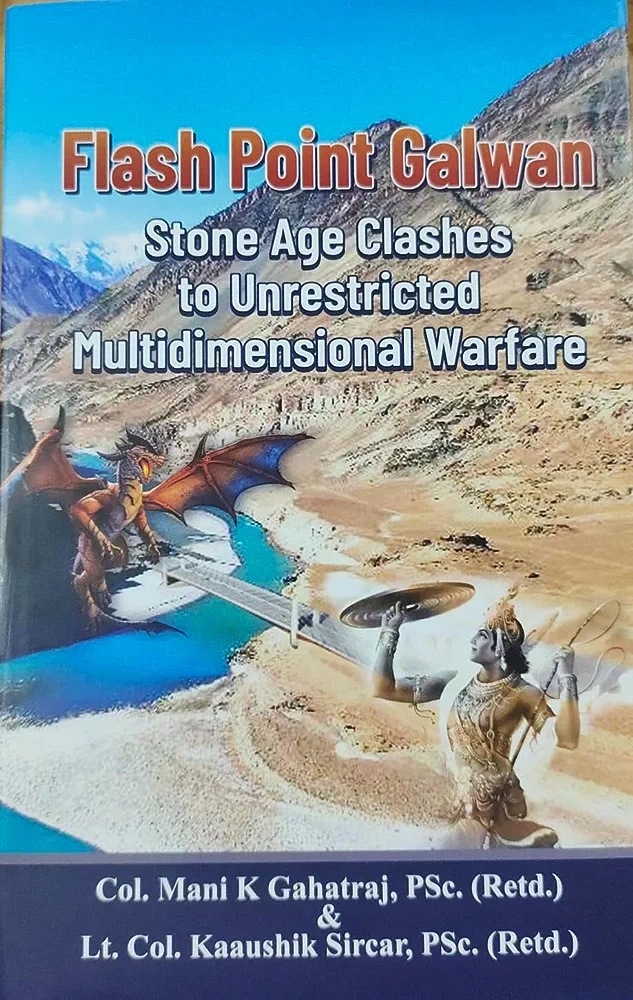
Through this pathbreaking book “Flash Point Galwan – Stone Age Clashes to Unrestricted Multidimensional Warfare“, the co-authors Col Mani K Gahatraj, PSc (Retd) and Lt Col Kaushik Sircar, PSc (Retd), both Indian Army veterans, have played a monumental role in bridging gaps and providing us with valuable and objective bits of information about China and how menacingly it has continued to pose a threat to India. The purpose is to ensure we know the facts and we do not forget them.
The ocean of information in this brilliantly written book is the result of not only deep and meticulous research by the authors but also inputs received by them directly as commissioned officers of the Indian Army and what they have witnessed and have been through while they have been ready for the supreme sacrifice as they have protected our borders. They have rolled out chronologically, most analytically and with a historical perspective- a document that will be worth reading over and over again. It is authentic work and should be an ideal reference volume across libraries. It will serve the important purpose of helping the coming generations, especially in India, towards gaining and retaining crucial and security-specific information vis-a-vis China for the purpose of influencing future action.
Ask Higher Secondary students, what do they know about the cowardly attack on the Indian Army soldiers by the PLA (the Chinese Army) at Galwan and most would take the cover of short memory and just repeat the query in the answer mode. If you give them the task of writing a piece on this subject, they would use the internet and the search engine and roll out plenty of information without bothering an iota about the source they would be relying upon to build their article. Similarly, we have successive generations who know very little of what happened during the 1962 War with China or the Wars forced upon India in 1965 and 1971 by Pakistan…..

The readers will find the book gripping indeed as they would read about the “The barbaric hand to hand clashes that erupted in the afternoon of 15 June 2020, on the barren icy wind-swept mountains in Galwan valley in Eastern Ladakh” and how it “snowballed into a multidimensional unrestricted but silent warfare”.
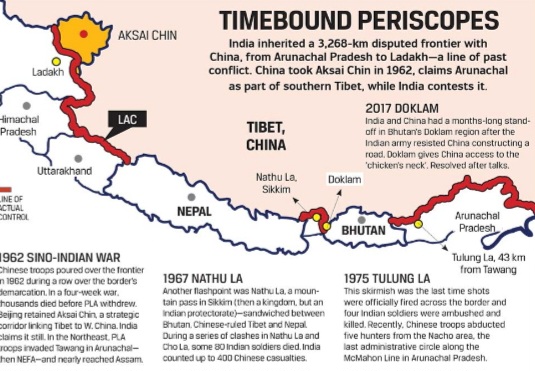
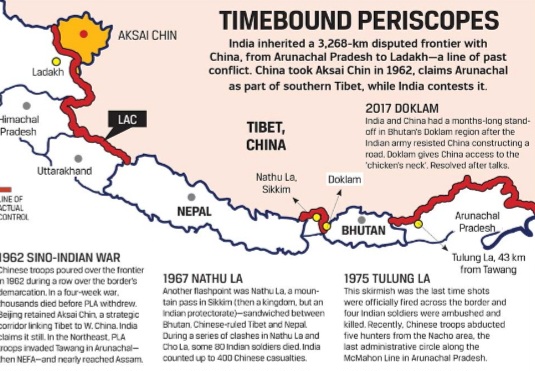
The Galwan analysis should shake awake the sensibilities of the nation (the Indian people), more specifically, those running the affairs of the country, the Parliamentarians and members of the bureaucracy. The authors, most succinctly and incisively, have pointed to the undisputable situation by underscoring the “Indian politicians and diplomats did not visualise that Chinese would find another vicious means to use force and kill Indian soldiers without using fire arms. Chinese were preparing for this kind of showdown that India did not see or refused to see. 1996 agreement shows that it was aimed at avoiding a full-scale war between India and China by reducing use of weaponry and aggression along the LAC. Indian Army, being one of the most professional armed forces in the world, they did not carry firearms to respect the Agreement signed by the government of India. On the other-hand PLA cunningly exhibited false respect for the Agreement by not carrying fire arms but had plans to attack and kill Indian troops by using iron rods, stones and clubs studded with nails and wrapped in barbed wire”.
Further, it has been pointed out that “the policy of no use of fire arms along LAC, initiated by China in 1993-96 and foolishly lapped up by the China trusting, China friendly Indian politico-bureaucrat mandarins of South Block, was a to be shattered on India’s face a-la ditto 1962 deceit. India’s willingness to appease China resulting in unnatural and artificial bonhomie between the two countries including the Armies deployed along the LAC was to be shattered like crystal jar falling on the hard icy surface of Galwan mountains”.
While throwing light on the martyrdom of Col Santosh Babu, Commanding Officer 16 Bihar Regiment, and 19 fellow soldiers by treachery, the book also gives a detailed account of the punitive strike, bravery and valour of the Indian soldiers, who killed about 46 PLA men during the Galwan clash.
After Galwan, the book takes you “fast-backward” to 1959-60, when the Galwan River Valley had become the “flash-point of Sino-Indian war of 1962. In 1959 China had claimed the entire valley up to Shyok River confluence of Galwan River. The valley became a flashpoint after China constructed a road between Xinjiang and Tibet, without India’s consent. After China’s occupation of Tibet in 1959 India, under the first Prime Minister Jawaharlal Nehru, did nothing hoping to deal with China diplomatically without understanding Chinese philosophy, aims and intentions. The Chinese Aggression was the automatic corollary that exposed Nehru’s Forward Policy, which lacked a strategic appreciation and matching military wherewithal, and was a knee jerk reaction to China’s expansionist stance.
The description of Nehru in this book will remain deeply etched in the readers’ mind. It goes as follows:
“Schooled in Harrow and Trinity College, Cambridge having studied law in City Law School in England, Nehru was an Englishman at heart, soul & taste. Selected & appointed by Gandhi to be the Prime Minister, not elected by the parliamentary election process, Nehru lorded over the impoverished Indian masses as an English emperor. In other words, his congress party had replaced the crown in a smooth transfer of power while opposition were silenced and sidelined. His idea as the PM of India was clear, “my way or the highway”.
One could go on endlessly citing from this book but with these words, I would like to urge the readers to go ahead, read it from cover to cover to satiate the hunger for knowledge and crucial bits of information concerning national security.
Click image to order your copy👇
 This is News