
Lalit Shastri
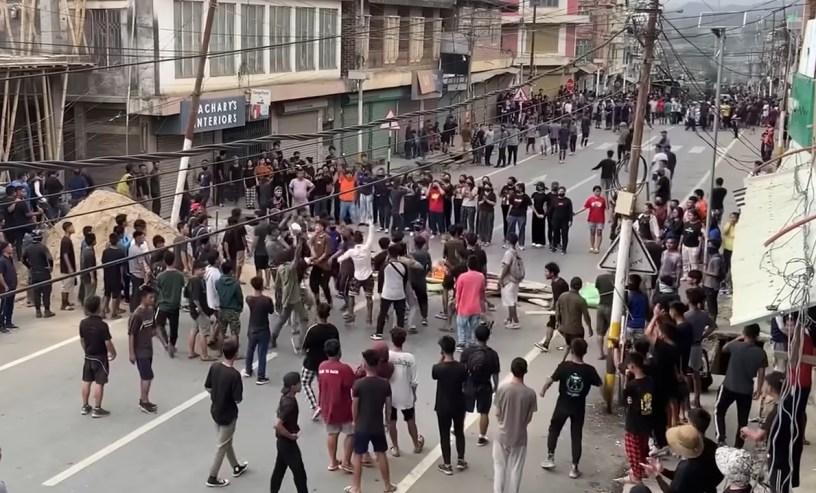
There is outrage in India after a video has surfaced more than 60-days after the incident showing two women being paraded naked on a road and sexually assaulted by a mob in the trouble-torn north-eastern state of Manipur. One of the women, stripped and raped by the mob, has gone on record stating that they were picked up by Police who then left them to the mob.
BBC, in an analytical piece last week, has zoomed on the ethnic violence that got sparked on May 3 on the issue of reservation following a Manipur High Court order asking the state government to send a recommendation to the Centre on the demand for ST status to the majority Meitei community.
The BBC report by Soutik Biswas underscores “tensions in Manipur stem from a complex interplay of various factors, one of which is a crackdown on drugs in recent years”. It is an entirely a different matter that the author of this report even has described the campaign targeting poppy farming launched by the Bharatiya Janata Party (BJP) led state government, under Chief Minister N Biren Singh, as a “controversial campaign”.
Since 2017, the Manipur government claims to have destroyed more than 18,600 acres of poppy farms, the majority of them in Kuki-inhabited areas, the BBC report points out adding Manipur has long battled a drug-addiction crisis and is among four north-eastern Indian states bordering Myanmar, the world’s second-largest opium producer.
While there is no end to violence in Manipur, Newsroom24x7 has information that many war veterans of Indian Army, who are from the Kuki tribe and were living in the hills of Manipur, have lost everything, including homes, in the ongoing orgy of violence and arson and have fled with meagre belongings to other north-eastern States. This information has been shared with one of our sources by a retired Subedar of Indian Army, a Kuki, who had settled near a Brigade Headquarter in Manipur. His House has been burnt down after violence erupted on 3 May and by the end of that month, his entire family had shifted to Shillong along with so many others. According to him, many commoners, who have lost their home and hearth, also have left Manipur. Some of them have gone to Assam and Meghalaya. While the ex-Armymen have their pension to rely upon and there is also help coming from their batallions, the others are finding it difficult to get shelter and meet both ends.
While the Opposition parties are playing politics on the issue of Manipur, the Centre has a lot to answer. Even from a common citizen’s point of view the situation has gone out of control and the Central Government led by Prime Minister Narendra Modi should have intervened and imposed President’s rule by invoking Article 356 of the Constitution which gives powers to the Union government to take direct control of the state machinery, if a state government is unable to function according to Constitutional provisions.
The same was expected of the Centre when West Bengal was rocked by violence during the recent round of elections.
Recently the Prime Minister marked the inauguration of the new building of India’s Parliament by placing a magnificent and historic Sengol near the Speakers chair. Union Home Minister Amit Shah had said in a tweet that the ‘Sengol’, represents the “values of fair and equitable governance”.
While in ancient times the rulers, who receieved their eduation from the “rishis” (sages) in their Ashrams and were tought to follow the path of dharma while performing their duties as a Raja (king), the modern day rulers in parliamentary democracy are supposed to follow the letter and spirit of the constitutiom when it comes to governance. Today, the Sengol or Dand is there to remind those at the helm of affairs to govern strictly under the Constitution. The messsage is straight, the Centre cannot blackout or turn a blind eye to Article 356 of the Constitution when a state government fails to protect the Constitution and guarantee “Protection of Life and Personal Liberty” to the citizens – a Fundamental Right under Article 21 that states “No person shall be deprived of his life or personal liberty except according to procedure established by law.”
There are apologists who hold a brief for the Centre whenever it fails to impose Article 356 by taking the plea that the Centre has to be circumspect in the matter due to the Supreme Court judgement in the Bommai Vs Union of India case. In this case, the Supreme Court held that the proclamation under Article 356(1) is not immune from judicial review. In this matter there is a srong view that’s of course debatable but it cannot be swept aside. The point to be asserted is that the People of India have constituted the nation and given us the Constitution. The Supreme Court has been established under the Constitution and it is the people who directly elect their Govenment to perform its constitutional role and responsibilities under the Parliamentary system.
Given the reality of a given situation, if the Centre is of the opinion that imposition of President’s Rule is imperative, it should tell the Supreme Court in categorical terms that the line between governance and judicial review should be clear and cannot be allowed to be fudged.
POSTSCRIPT: Israeli Parliament passes law to limit judicial power (updated: 24.07.23, 07:52 PM)
